

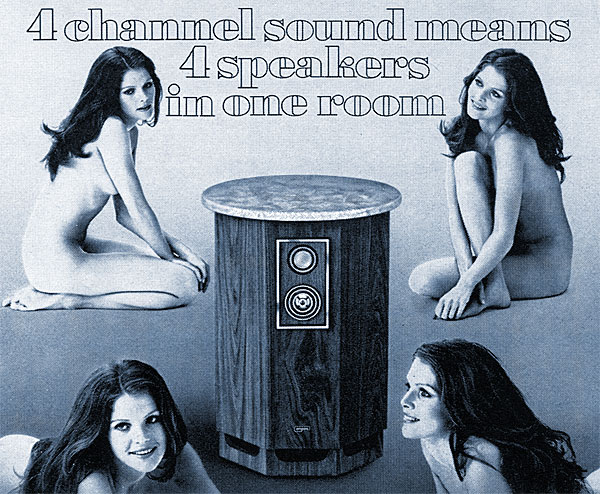
Four-channel stereo is here, but for how long? By the time this gets in print, it is extremely unlikely that any of our readers will have escaped being told that 4-channel stereo is here. "Two channels brought us direction," the announcements trumpet. "Now, four channels bring us dimension." Now, for the first time in the history of hi-fi (footnote 1), modern technology can bring us hall acoustics in stereo, to surround us with the sense of spaciousness that we hear in the concert hall.
On first hearing of this, our reaction was "Whoopee'A breakthrough in realism." The more we read about it, though, and the more we think about it, the less inclined we are to do cartwheels of joy over this latest incentive to increased component sales.
Don't misunderstand; we like the idea very much. It is sound in principle, and it works just the way it is claimed to. In fact, if you haven't heard it, it's hard to imagine how much two channels of nothing but reverberation can enhance concert-hall realism. On the other hand, it is hard to believe how unrealistic this can be when those benighted recording engineers start playing games with the new 4-channel medium.
Just in case you've been living in a cave somewhere for the past few months, we'll fill you in, briefly. In a concert hall, we hear not only the direct sounds from the instruments, but also a complex pattern of reflections from the sides and rear of the concert hall. Most of the time, we are not much aware of these reflections reaching us from all directions, because we tend to concentrate on the stereo-from-in-front that we pay our money to hear. But the subconscious mind does respond to the re™flections, and tells us on the basis of their direction that we are indeed in a large enclosed space.
At home, in front of the two-channel stereo system, we concentrate once again on the instruments and the few reflections that are coming from their general direction, and we think "How realistic it is." But the subconscious prods us in the ribs and whispers "But there's no concert hall around you. You're not in the hall; you're just peeking into it through a large doorway." And it keeps prodding, until we add another two stereo channels to reproduce the reflections from the right and the left behind us. Suddenly, the subconscious is placated, and the reproduction sounds more "realistic" to us, even though we may never before have been really aware that anything was missing.
In other words, 4-channel stereo is another giant step toward the you-are-there kind of realism that 2-channel stereo promised but never quite delivered. Of course, it costs another tape machine (or another playback head and two more preamps), another stereo amplifier, a completely new breed of stereo preamp with four channels, two balance controls and a 4-gang volume control, and two more speakers. But exhorbitant cost has never stood in the way of audio advancement before, so why should it now? Because 4-channel stereo may not necessarily pave the way to greater realism.
Those old fogies among us who can hark back to the first days of 2-channel stereo may recall that the added expense of the second channel was justified by the audio industry on the basis of enhanced realism. Learned treatises in the audio journals explained that, since stereo increased the detail of the sound, it was no longer necessary to spotlight soloists as in the old days, and microphones could be moved farther back to improve instrumental blending and to pick up more of the hall reverberation that contributed the sense of spaciousness in stereo sound.
Some early stereo discs were made in this way (notably by RCA Victor and London and, a bit later, by Deutsche Grammophon), and they were stunningly realistic. Because of the simple and rather distant miking of the orchestra, stereo separation wasn't very wide; the instruments occupied a relatively small segment of the stereo "stage" between the speakers, while the rest of the space to the left and right of this segment was hall reverberation or "spaciousness." This was actually pretty much as one would hear things at a concert, from any seat more than about 50 feet from the stage. At that distance, you can tell that an instrumental section is approximately in that direction, but pinpoint location of instruments by ear alone is almost impossible.
Dwindling Ambience
But it soon became apparent to the record makers that this sort of recording perspective would not do. Perhaps it was because most record buyers insisted on console "stereos" with closely-spaced speakers, or perhaps it was because most record buyers, who hadn't been in a concert hall for years, didn't react at all to the sensation of spaciousness, and demanded instrumental directionality as proof that a stereo recording was actually different from a mono one. But whatever the reason, stereo recordings started getting closer and closer more and more widely separated, and as the instruments spread out toward the loudspeakers, the space available for the ambient reverberation—for the hall acoustics—dwindled until it became nothing more than a shroud overlaying the whole panorama of direct sounds from the instruments.
Since the background reverberation no longer gave any information about the size of the performing hall, the recording industry decided What the hell, and took to adding the reverb via an echo chamber whose reflection characteristics bore no resemblance to those of any existing concert hall. The performing hall, as an aspect of recorded sound, was flushed down the drain along with most of the other niceties of sonic "realism" until, finally, we reached a point where recording engineers were admitting publicly (to the applause of some record critics who should know better) that recording was now an art form unto itself, divorced from the concert hall, in which the name of the game is "pleasant sounds."
If a recording director thought an oboe would sound "more effective" if it resembled nervous flatulence, or if the market researchers had found that the public expected violins to sound like musical saws, the means were on hand to accomplish these things. And they were accomplished on increasing numbers of recordings, not in the name of music, but in the name of sound. Now, they have four channels to play with!
Sound-in-the-Round
Already, some of the 4-channel promoters are demonstrating honest-to-goodness sound-in-the-round, with instruments spritzing the listener from all directions like the spray jets of a speedy auto wash. But some other demonstrations, using the rear channels for hall ambience, have shown that the 4-channel medium can indeed produce a markedly better simulation of the you-are-there illusion than we are accustomed to hearing. But we wonder—how much difference would there be between the 2- and the 4-channel media if the 2-channel variety hadn't ceased to carry ambience information?
New Dimensions
Okay, you say, but if 4-channel stereo provides any significant improvement in realism, it's worthwhile isn't it? We agree that it could be, but whether or not it actually is depends upon what the recording companies who use it decide to do with it. Certainly, it will be great fun to see how it can be used to add, literally, new dimensions to popular music, which is a field where sonic innovation is an essential part of its growth. But it took hundreds of years of such innovation to refine the sound of a symphony orchestra and its environment to its present point, and we do not feel that a recording director with one eye on the cash register and the other on his creative fulfilment has the right to decide for us what an orchestra would have sounded like if Beethoven had had access to modern technology. And we are afraid it is this, rather than enhanced realism, that the two new channels will be used for. Acoustic Research, Inc. (who led the development of the 4-channel medium) informed us that the first releases, from Vanguard, will be true ambient-stereo recordings, and will be issued only on 7½-ips open-reel format, to establish 4-channel at the outset as a quality medium. This is supposed to make it attractive to the hobbyists and serious listeners who form the stable base from which new developments gain public acceptance. But Vanguard is just one of hundreds of recording companies, and most of them have proven through their past actions that they have less concern for fidelity, and the people who appreciate it, than Van™ guard has demonstrated. In other words, we don't believe the rest of the industry is going to bother with the quality market. If Vanguard is not prepared to jump right in with 4-channel cassette and cartridge releases featuring instruments from four directions, we're willing to bet many of the other companies will.
Don't think for a moment that no "responsible" recording company would stoop to make the internationally renowned Luxitania Philharmonic Orchestra sound like a musical carousel. Who would have thought that London Records would start using their "strictly-for-fun" Phase-4 technique for classical works, but now they're doing just that. And after the first 4-channel recordings of the Verdi Requiem and "Wellington 's Victory" (with front and rear channels reversible, depending on whether we currently favor the English or the French) and some antiphonal religious works, what's a recording director to do? Keep his hands off the ambience channels? Not likely!
Sit Tight
On the other hand, what's an audiophile to do? Rush right out and buy all the new stuff necessary to play 4-channel tapes, in the hope that they will be more realistic and will be around for a while, or sit back and see which way the wind blows? Our inclination would be to sit tight, at least until the first spate of poorly designed 4-channel preamps have bitten the dust and been superseded by ones that are worth buying. We might even be inclined to wait a bit longer than that, because we are not at all convinced that 4-channel stereo is here to stay. Here's why.
We may have trouble proving this, but it is our belief that 2-channel stereo succeeded with the buying public for three main reasons. First, it did not take any judgement on anyone's part to perceive that it was basically different from monophonic sound. The press did a fine job of informing the public that stereo was new and better, but if they hadn't been able to hear the difference and to assume that directionality alone was what made it better, they would not have bought it.
Second, since the stereo disc was compatible with the established home-music medium, the LP disc, it did not require the learning of new patterns of handling, as did open-reel stereo tape (which had to be threaded, and did not go over the with the general public). And finally, the stereo disc appealed to all types of music buyers, from the audiophile to the tin ear that liked music but didn't give a damn about hifi. This allowed the whole recording industry to become geared to the stereo disc as the home-music medium, establishing it on its present rather firm base.
Now, how does the 4-channel-stereo medium shape up? Is it different from 2-channel stereo? Not really. Mono had no directionality, but 2-channel stereo has, and so has 4-channel stereo. More of the same, but not different. Is it compatible with the existing standard home-music medium? Not entirely. It is not practical at the present state of the art to put 4 channels in a single disc groove, so the person who wants four channels will have to get them on tapes. These, and their players, will probably be compatible with current 2-channel tapes and players, and since cassettes or cartridges look as if they may well become the "standard" mass-market medium for home music, we can grant that 4-channel tape will be compatible with a standard existing medium.
The hooker, though, is the matter of appeal. Who'll buy the 4-channel tapes?
Disc Holdouts
There should be no difficulty convincing serious-listener types—audiophiles and record collectors—that 4-channel stereo provides considerably greater realism. But both groups of buyers are likely to be strongly committed to the disc medium now, and while many of them—the hobbyists in particular—will probably get set up for 4-channel tapes, we doubt that they will be eager to switch allegiances. Prerecorded tapes have improved tremendously in recent years, but they still have a long way to go before they can equal the consistent quality of discs in terms of high-end response (tapes vary widely), hiss and overall transparency. Then there is the simple but important matter of commitment. People who collect recordings (as opposed to those who buy them, play them to death and then discard them) generally collect discs rather than tapes, because the tape medium is too subject to technological obsolescence, often at the expense of fidelity. So this "hard core" of potential 4-channel users may be less than wholehearted in their acceptance of 4-channel tape, if indeed they accept it at all. We may recall that there was no such dilemma facing the record collector when 2-channel stereo came out. He could still play his treasured old discs on the same phono unit that played stereo discs, so nothing was lost as a result of the switch. Of course, he can still keep his phono unit and supplement it with a 4-channel tape machine, but that means more money and more space, and it doesn't change the fact that the increased spatial realism of the new medium must be gained at the expense of higher hiss, reduced transparency, and variable high end. What about the rest of the buying public; the ones who determine in the long run whether something new can pay its own way? We may be proven wrong in this, but we do not think that J.Q. Public is going to pay for the two extra channels for the privilege of hearing reverberation in 3-D, because it won't mean anything to him. If you have never been in a concert hall often enough to develop even a subconscious affinity for aural spaciousness, you can't have learned to value it enough to pay money for it. They won't respond to it in four channels any more than they did in two channels, and will demand instrumental directionality from all four directions.
Plenty of record companies will be happy to give it to them, too, but the more the medium leans in this direction, the less it is going to interest the serious-music listeners. And although the record companies like to believe that it is the mass market that supports them (it is, economically), it is the hobbyists and the serious collectors who give a new technological advance the stability it needs to escape rapid obsolescence. They are often hard to convince, at the start, but when they accept something new, they do so out of appreciation for its intrinsic worth rather than for its fad value or snob appeal. It will not be hard to convince them that true ambient stereo is a legitimate technological advance, but it remains to be seen whether they will trade the other points of disc superiority for this one aspect of 4-channel tape's superiority.
As we see it, there is only one thing that might ensure the long-term success of the 4-channel medium: A serious effort on the part of the recording companies to produce tapes which are really sonically competitive with discs. At the present state of the art, this would mean using low-noise tape, end-to-end Dolbyization from master to final tape, automated quality control to reject tapes with dropouts, flutter, and deviate treble response, and one-to-one-speed duplication (as opposed to the current high-speed duplication) directly from the original master tape (or final reduction copy of a multitrack master). It might also be a help if the industry offered a public commitment to make all future releases for the next 10 years compatible with the present ones.
Considering the likelihood of all this, we expect the two-channel stereo disc to be the leading high-fidelity recording medium for a long time yet, even if the recording engineers don't elect to use the two new channels for fun and games with Mozart.—J. Gordon Holt
Fascinating footnote 1: The Japanese pronounce it "hee-fee."
But it soon became apparent to the record makers that this sort of recording perspective would not do. Perhaps it was because most record buyers insisted on console "stereos" with closely-spaced speakers, or perhaps it was because most record buyers, who hadn't been in a concert hall for years, didn't react at all to the sensation of spaciousness, and demanded instrumental directionality as proof that a stereo recording was actually different from a mono one. But whatever the reason, stereo recordings started getting closer and closer more and more widely separated, and as the instruments spread out toward the loudspeakers, the space available for the ambient reverberation—for the hall acoustics—dwindled until it became nothing more than a shroud overlaying the whole panorama of direct sounds from the instruments.
Already, some of the 4-channel promoters are demonstrating honest-to-goodness sound-in-the-round, with instruments spritzing the listener from all directions like the spray jets of a speedy auto wash. But some other demonstrations, using the rear channels for hall ambience, have shown that the 4-channel medium can indeed produce a markedly better simulation of the you-are-there illusion than we are accustomed to hearing. But we wonder—how much difference would there be between the 2- and the 4-channel media if the 2-channel variety hadn't ceased to carry ambience information?
Okay, you say, but if 4-channel stereo provides any significant improvement in realism, it's worthwhile isn't it? We agree that it could be, but whether or not it actually is depends upon what the recording companies who use it decide to do with it. Certainly, it will be great fun to see how it can be used to add, literally, new dimensions to popular music, which is a field where sonic innovation is an essential part of its growth. But it took hundreds of years of such innovation to refine the sound of a symphony orchestra and its environment to its present point, and we do not feel that a recording director with one eye on the cash register and the other on his creative fulfilment has the right to decide for us what an orchestra would have sounded like if Beethoven had had access to modern technology. And we are afraid it is this, rather than enhanced realism, that the two new channels will be used for. Acoustic Research, Inc. (who led the development of the 4-channel medium) informed us that the first releases, from Vanguard, will be true ambient-stereo recordings, and will be issued only on 7½-ips open-reel format, to establish 4-channel at the outset as a quality medium. This is supposed to make it attractive to the hobbyists and serious listeners who form the stable base from which new developments gain public acceptance. But Vanguard is just one of hundreds of recording companies, and most of them have proven through their past actions that they have less concern for fidelity, and the people who appreciate it, than Van™ guard has demonstrated. In other words, we don't believe the rest of the industry is going to bother with the quality market. If Vanguard is not prepared to jump right in with 4-channel cassette and cartridge releases featuring instruments from four directions, we're willing to bet many of the other companies will.
On the other hand, what's an audiophile to do? Rush right out and buy all the new stuff necessary to play 4-channel tapes, in the hope that they will be more realistic and will be around for a while, or sit back and see which way the wind blows? Our inclination would be to sit tight, at least until the first spate of poorly designed 4-channel preamps have bitten the dust and been superseded by ones that are worth buying. We might even be inclined to wait a bit longer than that, because we are not at all convinced that 4-channel stereo is here to stay. Here's why.
There should be no difficulty convincing serious-listener types—audiophiles and record collectors—that 4-channel stereo provides considerably greater realism. But both groups of buyers are likely to be strongly committed to the disc medium now, and while many of them—the hobbyists in particular—will probably get set up for 4-channel tapes, we doubt that they will be eager to switch allegiances. Prerecorded tapes have improved tremendously in recent years, but they still have a long way to go before they can equal the consistent quality of discs in terms of high-end response (tapes vary widely), hiss and overall transparency. Then there is the simple but important matter of commitment. People who collect recordings (as opposed to those who buy them, play them to death and then discard them) generally collect discs rather than tapes, because the tape medium is too subject to technological obsolescence, often at the expense of fidelity. So this "hard core" of potential 4-channel users may be less than wholehearted in their acceptance of 4-channel tape, if indeed they accept it at all. We may recall that there was no such dilemma facing the record collector when 2-channel stereo came out. He could still play his treasured old discs on the same phono unit that played stereo discs, so nothing was lost as a result of the switch. Of course, he can still keep his phono unit and supplement it with a 4-channel tape machine, but that means more money and more space, and it doesn't change the fact that the increased spatial realism of the new medium must be gained at the expense of higher hiss, reduced transparency, and variable high end. What about the rest of the buying public; the ones who determine in the long run whether something new can pay its own way? We may be proven wrong in this, but we do not think that J.Q. Public is going to pay for the two extra channels for the privilege of hearing reverberation in 3-D, because it won't mean anything to him. If you have never been in a concert hall often enough to develop even a subconscious affinity for aural spaciousness, you can't have learned to value it enough to pay money for it. They won't respond to it in four channels any more than they did in two channels, and will demand instrumental directionality from all four directions.
Fascinating footnote 1: The Japanese pronounce it "hee-fee."















