
The Very Well Balanced Noontec Zoro II HD Measurements

Click on graphs image to download .pdf for closer inspection.
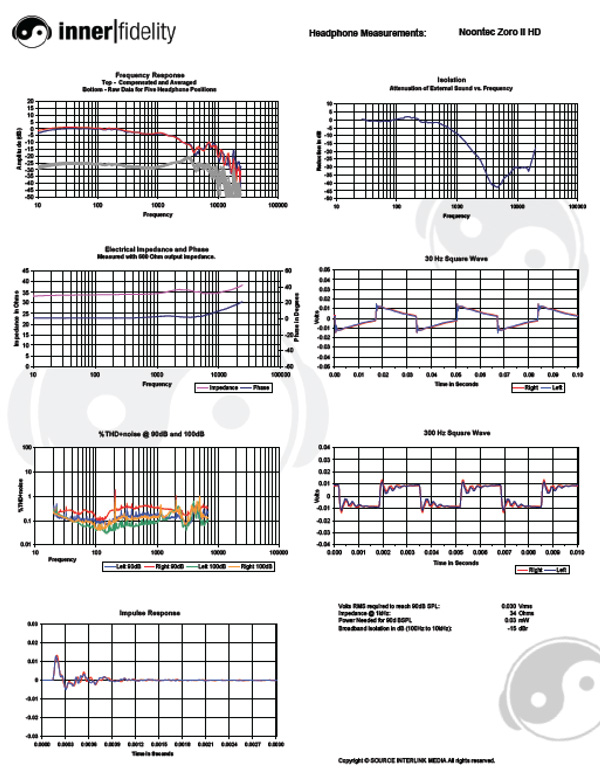
Raw frequency response plots show an on-ear headphone that manages to successfully seal with the ear as position changes on the ear.

Raw frequency response is very close to the Harman target response. Problem areas are in the bass boost going up to about 400Hz, when it should stop at about 150-200Hz. Fortunately, the boost is modest and just a very slight thickness in the upper-bass/low-mids is apparent. The rise to 3.5kHz is fairly long and desirable with a peak about 10dB above baseline—this delivers a good sense of presence in the sound. The subsequent fall off after 3.5kHz may be a bit too steep, but some headphone designers feel this is a dangerous area as it can get very strident and annoying, and should be withdrawn a little. The level does come back by 10kHz however giving these cans a pretty well tonally balanced sound in the treble.

Compensated frequency response plot shows an overall slightly warm and gently ever increasing tilt (desirable), with the small notch at 4kHz as the only potentially erroneous feature. These are very good frequency response plots.

30Hz square wave has stunningly good shape, combined with low THD+noise in the lower registers lead me to believe these cans would be very tight and well extended in the lows. In listening, though, it didn't seem to perform as well as it measured. Somehow the mild bass bump intruding on the mid-range seems to alter the balance enough to take the listening experience of the bass down a notch.


300Hz square wave is fairly good. The first overshoot should be a tad larger perhaps, and the subsequent ringing and noise is slightly excessive, but this is still a very good result relative to the other headphones in this category.

I was looking for something to indicate the lack of finesse in these cans and was hoping to see more noise trailing the initial spike of the impulse response relative to the other headphones in the category. It appears there might be a little more fine grain noise here than the Beats Solo2 and Urbanite, but not so the Momentum On-Ear that has similar amounts of noise, but sounded cleaner to my ears.

THD+noise has no remarkable features. One channel is slightly higher than the other, but this could easily be a noise artifact. THD+noise is definitely a measurement that needs to be taken with a big grain of salt. Unless there's an obvious artifact, probably exceeding 1% or strongly related to artifacts in the impedance plot, it's my opinion that this plot can safely be ignored.

Impedance and phase plots indicate a nicely designed headphone without any strong resonances or modal breakup occurring. This is a nomially 35 Ohm headphone.

Isolation is modest; these cans will not isolate you well in very loud environments. The good news is that they will allow you to keep your situational awareness as you walk around, and their 30mVrms needed to achieve 90dBspl at the ear will ensure solid volume levels with portable devices.

This is an excellent set of measurements.
Noontec
Building C,Zhangkeng Industial Park, Minzhi,Longhua
Shenzhen 518031 China
sales@noontec.com
+86 755 8179 8305
http://en.noontec.com/
Advertisement
Advertisement
Advertisement













