

Most of my listening was to CDs, but I also used the Marantz for SACDs (two-channel DSD tracks only), which were played only through the Consummate preamp and its two-channel analog link to the player.
Some manufacturers recommend breaking in their speakers for ungodly amounts of time. Others disdain the break-in concept, apart perhaps for a few minutes to allow the drivers' suspensions to loosen up. In my opinion, listening to music while speakers settle in is a questionable practice; it's just as likely that your ears are breaking in to the sound of the speakers than anything dramatic happening to the speakers themselves. Nevertheless, I followed my usual practice of playing pink noise at moderate levels through the Viennas for about 100 hours before doing any serious listening. (The speakers faced each other and were wired out-of-phase, to minimize the noise.) After that, it was time for music.
Listening
Though a precise comparison of the sounds of the Symphony Edition of the Beethoven Baby Grands and that Vienna Acoustics demo of a decade ago is of course impossible, my general reactions to both were very similar. "Wow, do these speakers do detail," reads p.1 of my listening notes. I heard subtleties I'd missed before. But while it would be appropriate to call these speakers a bit bright—"open and airy" might be more accurate—in no way did they sound hard. In fact, if anything, they sounded slightly forgiving in the mid-treble or "brightness" region.
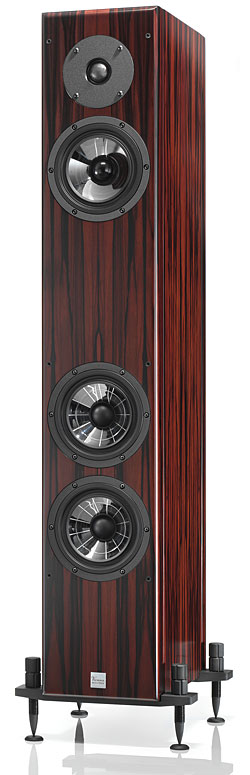 Male voices—such as Aaron Neville's on his Warm Your Heart (CD, A&M 397 148-2) and Michael Jonasz's on his La Fabuleuse Histoire de Mister Swing (CD, WEA 22924)—sounded clean and neutral, with no clearly recognizable coloration. The unique textures of these singers' voices were clearly reproduced. Sibilants were audible, but in a way that close miking might have produced, and were neither unnaturally sibilant nor sizzly. The soundstage was also impressive, with the singers tightly locked in to the center. The latter, however, was no surprise; it's more common than not in my room, likely the result of speaker placement well clear of adjoining walls, particularly the wall behind the speakers. The downside of such positioning is that the bass was a bit subdued, as was evident with the usually bass-heavy Jonasz album. But it wasn't lean, and listeners unfamiliar with this recording might not be aware that anything was missing.
Overall, the bass seemed more subdued than smash-mouthed, but I never found it lacking. Some basic measurements showed it to be reasonably strong down to 40Hz, but largely gasping for air at 30Hz—not surprising from a relatively small floorstander. For bass testing I often pull out a compilation CD-R given me some years ago by a manufacturer at a CES. The sources of the tracks aren't well specified, so I can't give you precise references, but they run the gamut from pipe organ to synth to bass drum. Yes, I've heard far more room-shaking bass in my relatively large listening room than the Viennas offered, though usually from either a much larger speaker or a subwoofer. But even with the bass-heavy selections on this and other discs, I rarely missed that bottom octave. The Baby Grands responded rapidly to leading-edge transients, and since the "quickness" of a drumstroke is defined primarily by its higher overtones, drum recordings of all types, from timpani to Kodo drums, often made me sit up and take notice. While the very bottom end lacked the range to get that deep-down, low-frequency, reverberant hall sound, with less transient-loaded bass information it was nevertheless very satisfying, and never thin or anemic.
Even with pipe organ, the Viennas had enough bass power to provide a realistic feel, though organ fans may want to look further to get that count-the-cycles feeling that only much larger speakers can provide. I've only once experienced the deepest bass in John Rutter's Requiem, as performed by Timothy Seelig and the Turtle Creek Chorale (CD, Reference RR-57CD): in a show demo that included an 18" Revel Ultima subwoofer. The Viennas couldn't do that, but, again, most listeners won't think anything is missing. The VAs' bass provided a generous, warm undertone for the singers, which the speakers also reproduced with excellent depth and dimensionality.
I did find the Vienna's bass to be a little soft and furry with some recordings, and more so with such transient-limited material as pipe organ or bass synth than more percussive bass instruments—but that's been true of most speakers in my room. I've said it before, and it's worth repeating: A reviewer can tell you only how a speaker will perform in the bass in his or her room—never in your room.
Other recordings continued to impress me. Solo-piano recordings, such as Minoru Nojima's Nojima Plays Liszt (CD, Reference RR-25CD), sounded well balanced on the bottom end and clean and clear through the middle. My only reservation was that some of the very highest keys sounded too prominent. Percussion recordings were exceptionally, often shockingly well defined. Yes, cymbals could sound hard and metallic through the Beethovens, but if you've never sat within 20' of an orchestra's percussion section, as I once did, don't tell me that orchestral cymbals should sound sweet. If they're close-miked, they certainly don't.
Female and male voices and solo instruments, in addition to being uncolored, often sounded surprisingly immediate, but without turning edgy or in my face. The Viennas seemed to love this sort of music most of all; many of the more memorable moments I had with them were with just such recordings.
To check how the speakers responded with a different front end, I later replaced the Integra pre-pro with my classic but still pristine Jeff Rowland Consummate preamp, connecting the latter to the two-channel analog outputs of the Marantz player. The amp was still the Parasound Halo A 51, and this time the sources were both CDs and SACDs.
The top end of the system was now sweeter—not surprising, as that's part of the Rowland's signature sound. So while there was a little less air and sparkle than before, with leading transient edges slightly softened, all of my other observations remained the same. Imaging was precise, bass clean and perhaps a bit warmer than with the Integra, and voices and instruments just a bit forward (though a little less than before). The SACDs I played also sounded impressive—none more so than Opus 3's Showcase sampler (SACD/CD, Opus 3 SACD 21000), one of the best-sounding SACDs I've heard. I'm still wrapping my head around high-resolution recordings—in my opinion, they matter only if the original recording is pristine, and this one certainly is. The Viennas handled all of it beautifully.
Conclusion
Male voices—such as Aaron Neville's on his Warm Your Heart (CD, A&M 397 148-2) and Michael Jonasz's on his La Fabuleuse Histoire de Mister Swing (CD, WEA 22924)—sounded clean and neutral, with no clearly recognizable coloration. The unique textures of these singers' voices were clearly reproduced. Sibilants were audible, but in a way that close miking might have produced, and were neither unnaturally sibilant nor sizzly. The soundstage was also impressive, with the singers tightly locked in to the center. The latter, however, was no surprise; it's more common than not in my room, likely the result of speaker placement well clear of adjoining walls, particularly the wall behind the speakers. The downside of such positioning is that the bass was a bit subdued, as was evident with the usually bass-heavy Jonasz album. But it wasn't lean, and listeners unfamiliar with this recording might not be aware that anything was missing.
Overall, the bass seemed more subdued than smash-mouthed, but I never found it lacking. Some basic measurements showed it to be reasonably strong down to 40Hz, but largely gasping for air at 30Hz—not surprising from a relatively small floorstander. For bass testing I often pull out a compilation CD-R given me some years ago by a manufacturer at a CES. The sources of the tracks aren't well specified, so I can't give you precise references, but they run the gamut from pipe organ to synth to bass drum. Yes, I've heard far more room-shaking bass in my relatively large listening room than the Viennas offered, though usually from either a much larger speaker or a subwoofer. But even with the bass-heavy selections on this and other discs, I rarely missed that bottom octave. The Baby Grands responded rapidly to leading-edge transients, and since the "quickness" of a drumstroke is defined primarily by its higher overtones, drum recordings of all types, from timpani to Kodo drums, often made me sit up and take notice. While the very bottom end lacked the range to get that deep-down, low-frequency, reverberant hall sound, with less transient-loaded bass information it was nevertheless very satisfying, and never thin or anemic.
Even with pipe organ, the Viennas had enough bass power to provide a realistic feel, though organ fans may want to look further to get that count-the-cycles feeling that only much larger speakers can provide. I've only once experienced the deepest bass in John Rutter's Requiem, as performed by Timothy Seelig and the Turtle Creek Chorale (CD, Reference RR-57CD): in a show demo that included an 18" Revel Ultima subwoofer. The Viennas couldn't do that, but, again, most listeners won't think anything is missing. The VAs' bass provided a generous, warm undertone for the singers, which the speakers also reproduced with excellent depth and dimensionality.
I did find the Vienna's bass to be a little soft and furry with some recordings, and more so with such transient-limited material as pipe organ or bass synth than more percussive bass instruments—but that's been true of most speakers in my room. I've said it before, and it's worth repeating: A reviewer can tell you only how a speaker will perform in the bass in his or her room—never in your room.
Other recordings continued to impress me. Solo-piano recordings, such as Minoru Nojima's Nojima Plays Liszt (CD, Reference RR-25CD), sounded well balanced on the bottom end and clean and clear through the middle. My only reservation was that some of the very highest keys sounded too prominent. Percussion recordings were exceptionally, often shockingly well defined. Yes, cymbals could sound hard and metallic through the Beethovens, but if you've never sat within 20' of an orchestra's percussion section, as I once did, don't tell me that orchestral cymbals should sound sweet. If they're close-miked, they certainly don't.
Female and male voices and solo instruments, in addition to being uncolored, often sounded surprisingly immediate, but without turning edgy or in my face. The Viennas seemed to love this sort of music most of all; many of the more memorable moments I had with them were with just such recordings.
To check how the speakers responded with a different front end, I later replaced the Integra pre-pro with my classic but still pristine Jeff Rowland Consummate preamp, connecting the latter to the two-channel analog outputs of the Marantz player. The amp was still the Parasound Halo A 51, and this time the sources were both CDs and SACDs.
The top end of the system was now sweeter—not surprising, as that's part of the Rowland's signature sound. So while there was a little less air and sparkle than before, with leading transient edges slightly softened, all of my other observations remained the same. Imaging was precise, bass clean and perhaps a bit warmer than with the Integra, and voices and instruments just a bit forward (though a little less than before). The SACDs I played also sounded impressive—none more so than Opus 3's Showcase sampler (SACD/CD, Opus 3 SACD 21000), one of the best-sounding SACDs I've heard. I'm still wrapping my head around high-resolution recordings—in my opinion, they matter only if the original recording is pristine, and this one certainly is. The Viennas handled all of it beautifully.
Conclusion
Despite its tongue twister of a name, I thoroughly enjoyed my time with the Vienna Acoustics Beethoven Baby Grand Symphony Edition. Yes, $6000/pair is a little pricey for its size in today's market, but not outrageously so, given the speaker's first-class European labor and workmanship. That aside, its lively but always natural-sounding balance kept me listening to recordings long after I'd planned to move on to others. The Beethoven Baby Grand's up-front but not overripe nature may not suit everyone, but for some, it will certainly be love at first listen.
Though a precise comparison of the sounds of the Symphony Edition of the Beethoven Baby Grands and that Vienna Acoustics demo of a decade ago is of course impossible, my general reactions to both were very similar. "Wow, do these speakers do detail," reads p.1 of my listening notes. I heard subtleties I'd missed before. But while it would be appropriate to call these speakers a bit bright—"open and airy" might be more accurate—in no way did they sound hard. In fact, if anything, they sounded slightly forgiving in the mid-treble or "brightness" region.
Male voices—such as Aaron Neville's on his Warm Your Heart (CD, A&M 397 148-2) and Michael Jonasz's on his La Fabuleuse Histoire de Mister Swing (CD, WEA 22924)—sounded clean and neutral, with no clearly recognizable coloration. The unique textures of these singers' voices were clearly reproduced. Sibilants were audible, but in a way that close miking might have produced, and were neither unnaturally sibilant nor sizzly. The soundstage was also impressive, with the singers tightly locked in to the center. The latter, however, was no surprise; it's more common than not in my room, likely the result of speaker placement well clear of adjoining walls, particularly the wall behind the speakers. The downside of such positioning is that the bass was a bit subdued, as was evident with the usually bass-heavy Jonasz album. But it wasn't lean, and listeners unfamiliar with this recording might not be aware that anything was missing.
Overall, the bass seemed more subdued than smash-mouthed, but I never found it lacking. Some basic measurements showed it to be reasonably strong down to 40Hz, but largely gasping for air at 30Hz—not surprising from a relatively small floorstander. For bass testing I often pull out a compilation CD-R given me some years ago by a manufacturer at a CES. The sources of the tracks aren't well specified, so I can't give you precise references, but they run the gamut from pipe organ to synth to bass drum. Yes, I've heard far more room-shaking bass in my relatively large listening room than the Viennas offered, though usually from either a much larger speaker or a subwoofer. But even with the bass-heavy selections on this and other discs, I rarely missed that bottom octave. The Baby Grands responded rapidly to leading-edge transients, and since the "quickness" of a drumstroke is defined primarily by its higher overtones, drum recordings of all types, from timpani to Kodo drums, often made me sit up and take notice. While the very bottom end lacked the range to get that deep-down, low-frequency, reverberant hall sound, with less transient-loaded bass information it was nevertheless very satisfying, and never thin or anemic.
Even with pipe organ, the Viennas had enough bass power to provide a realistic feel, though organ fans may want to look further to get that count-the-cycles feeling that only much larger speakers can provide. I've only once experienced the deepest bass in John Rutter's Requiem, as performed by Timothy Seelig and the Turtle Creek Chorale (CD, Reference RR-57CD): in a show demo that included an 18" Revel Ultima subwoofer. The Viennas couldn't do that, but, again, most listeners won't think anything is missing. The VAs' bass provided a generous, warm undertone for the singers, which the speakers also reproduced with excellent depth and dimensionality.
I did find the Vienna's bass to be a little soft and furry with some recordings, and more so with such transient-limited material as pipe organ or bass synth than more percussive bass instruments—but that's been true of most speakers in my room. I've said it before, and it's worth repeating: A reviewer can tell you only how a speaker will perform in the bass in his or her room—never in your room.
Despite its tongue twister of a name, I thoroughly enjoyed my time with the Vienna Acoustics Beethoven Baby Grand Symphony Edition. Yes, $6000/pair is a little pricey for its size in today's market, but not outrageously so, given the speaker's first-class European labor and workmanship. That aside, its lively but always natural-sounding balance kept me listening to recordings long after I'd planned to move on to others. The Beethoven Baby Grand's up-front but not overripe nature may not suit everyone, but for some, it will certainly be love at first listen.















