

Sidebar 3: Measurements
I used DRA Labs' MLSSA system and a calibrated DPA 4006 microphone to measure the right-hand sample of the Wharfedale Diamond 11.2's frequency response in the farfield, and an Earthworks QTC-40 for the nearfield and spatially averaged room responses.
My estimate of the Diamond 11.2's voltage sensitivity was 89dB(B)/2.83V/m, or 1dB higher than the specified 88dB. The Diamond 11.2's impedance is specified as "8 ohms compatible." However, the magnitude drops below 6 ohms in the midrange and the high treble. The minimum magnitude is 3.7 ohms at 215Hz (fig.1, solid trace), and there is a current-hungry combination of 5 ohms and –43° electrical phase angle at 129Hz. The Diamond 11.2 will work best with amplifiers that are comfortable with 4 ohm loads. There is a small discontinuity in the impedance traces at 230Hz, and an accelerometer-derived, cumulative spectral-decay plot reveals a very strong resonant mode at that frequency on the sidewalls (fig.2) as well as on the top panel.

 The saddle centered at 41Hz in fig.1 suggests that the reflex-loading slot is tuned to this frequency. The woofer, measured in the nearfield, had its minimum-motion notch, where the back pressure from the port resonance holds the cone stationary, at the same frequency (fig.3, blue trace). The slot's output (red trace) peaks between 25 and 80Hz, but its upper-frequency rolloff is marred by a strong peak at 750Hz and a discontinuity at 160Hz. The latter gives rise to a slight notch in the complex sum of the nearfield woofer and slot outputs (black trace below 300Hz). While there is the usual response peak in the upper bass, due to the nearfield measurement technique, this isn't quite as large as usual.


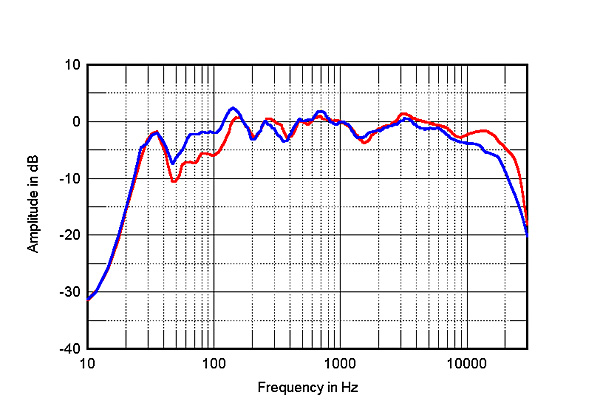


Fig.1 Wharfedale Diamond 11.2, electrical impedance (solid) and phase (dashed) (2 ohms/vertical div.).
Fig.2 Wharfedale Diamond 11.2, cumulative spectral-decay plot calculated from output of accelerometer fastened to center of sidewall (MLS driving voltage to speaker, 7.55V; measurement bandwidth, 2kHz).
Fig.3 Wharfedale Diamond 11.2, anechoic response on tweeter axis at 50", averaged across 30° horizontal window and corrected for microphone response, with nearfield woofer (blue) and port (red) responses and their complex sum (black), respectively plotted below 300Hz, 750Hz, and 300Hz.
Higher in frequency in fig.3, the black trace shows the Diamond 11.2's farfield response, averaged across a 30° horizontal window centered on the tweeter axis. It is respectably flat overall, though with a small notch in the upper midrange and an octave-wide, 4dB-high shelf in the top octave. This measurement was taken without the grille, which is how I preferred listening to the Wharfedales. With the grille, the height of the top-octave peak wasn't affected but the presence region was slightly attenuated. The plot of the Diamond 11.2's lateral dispersion, normalized to the tweeter-axis response (fig.4), reveals that the tweeter starts to become directional above 9kHz. In a normal-size room the on-axis peak will tend to compensate for this lack of off-axis energy, meaning that the Diamond 11.2's treble balance will sound neutral. The dispersion below the top octave is well controlled and the contour lines are relatively even. In the vertical plane (fig.5, again normalized to the tweeter-axis response), a suckout develops in the crossover region more than 5° above the tweeter axis. Make sure the stands you use with this Wharfedale are tall enough to place the tweeter axis on or just above the level of your ears.
Fig.4 Wharfedale Diamond 11.2, lateral response family at 50", normalized to response on tweeter axis, from back to front: differences in response 90–5° off axis, reference response, differences in response 5–90° off axis.
Fig.5 Wharfedale Diamond 11.2, vertical response family at 50", normalized to response on tweeter axis, from back to front: differences in response 45–5° above axis, reference response, differences in response 5–45° below axis.
The red trace in fig.6 shows the Diamond 11.2s' spatially averaged response in my room, generated by averaging 20 1/6-octave–smoothed spectra, taken for the left and right speakers individually using a 96kHz sample rate, in a vertical rectangular grid 36" wide by 18" high and centered on the positions of my ears. This was with the speakers as first set up in my room, in the same positions occupied by the similar-size Dynaudio Special 40s (blue trace) when I reviewed the latter for the September 2018 issue. The two models appear to have very similar responses throughout the midrange and low treble, but the Wharfedales have a touch more energy between 3 and 9kHz, and 3dB more in the top octave. The Dynaudios' in-room response is closer to what I've come to hear as being the correct amount of high treble, due to the increasing absorption by the room's furnishings as the frequency rises. More significant is that while the two pairs of speakers excite the lowest-frequency mode in my room to a similar degree, the Diamond 11.2s have less upper- and midbass energy than the Dynaudios. This is why I moved the Wharfedales closer to the room boundaries for the bulk of my auditioning.
Fig.6 Wharfedale Diamond 11.2, spatially averaged, 1/6-octave response in JA's listening room (red); and of Dynaudio Special Forty (blue).
In the time domain, the Diamond 11.2's step response on the tweeter axis (fig.7) reveals that its tweeter and woofer are both connected in positive acoustic polarity. The tweeter's output arrives at the microphone before that of the woofer, but the decay of the tweeter's step doesn't blend smoothly with the start of the woofer's step. I wonder if this correlates with a small resonant ridge in the crossover region in the Wharfedale's cumulative spectral-decay plot (fig.8). Other than that, and some delayed energy associated with the on-axis suckout between 1 and 2kHz, this waterfall plot is very clean.
Fig.7 Wharfedale Diamond 11.2, step response on tweeter axis at 50" (5ms time window, 30kHz bandwidth).
Fig.8 Wharfedale Diamond 11.2, cumulative spectral-decay plot on tweeter axis at 50" (0.15ms risetime).
Other than its rather lively cabinet, the Wharfedale Diamond 11.2's measured performance is generally excellent, especially considering its affordable price.—John Atkinson















