Sidebar 3: Measurements
I used DRA Labs' MLSSA system and a calibrated DPA 4006 microphone to measure the Wilson Sophia Series 3's frequency response in the farfield, and an Earthworks QTC-40 for the nearfield and in-room responses. My estimate of the Sophia's sensitivity was 88.3dB(B)/2.83V/m—the same as the original Sophia, which I reviewed in July 2002. (See that speaker's measurements.) Though a little higher than the specified 87dB/W/m, this can be explained by the fact that the Sophia 3's impedance (fig.1) remains below 7 ohms for the entire midrange and much of the bass. It therefore draws more than 1W from the amplifier at a voltage level of 2.83V, which is equivalent to a power of 1W only into 8 ohms. I commend Wilson Audio Specialties for their honesty in specifying the Sophia 3's sensitivity. Though the impedance drops to 3.15 ohms in the upper bass and there is a combination of 5 ohms and –44° electrical phase angle at 57Hz, overall the Sophia 3 will not be hard to drive. The shape of its impedance curve will tilt the high frequencies up a little with tubed amplifiers, however.
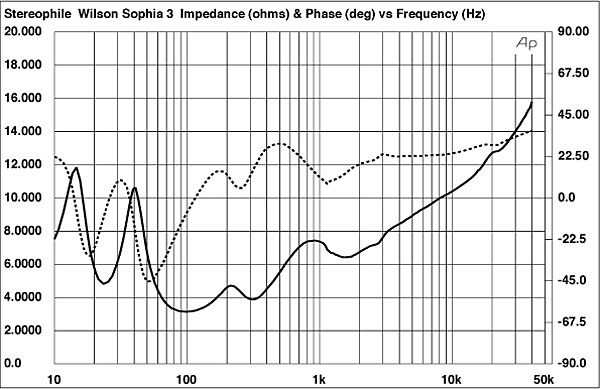 Fig.1 Wilson Sophia Series 3, electrical impedance (solid) and phase (dashed). (2 ohms/vertical div.)
The traces in fig.1 are free from the small wrinkles that would imply the existence of cabinet vibrational resonances, but I did find some modes when I investigated the enclosure panels' behavior with a plastic-tape accelerometer. Fig.2, for example, is a cumulative spectral-decay plot calculated from the output of the accelerometer while it was fastened to the center of a sidewall level with the woofer dustcap. While two resonant modes can be seen, at 313 and 598Hz, both are so low in level and of sufficiently high Quality Factor (Q) that they will not lead to any coloration. The higher-frequency mode could also be found on the sidewalls and rear panel level with the midrange unit, but remained at a low level. The Sophia's heroic construction—oh, my aching back—renders the cabinet effectively acoustically inert.
Fig.1 Wilson Sophia Series 3, electrical impedance (solid) and phase (dashed). (2 ohms/vertical div.)
The traces in fig.1 are free from the small wrinkles that would imply the existence of cabinet vibrational resonances, but I did find some modes when I investigated the enclosure panels' behavior with a plastic-tape accelerometer. Fig.2, for example, is a cumulative spectral-decay plot calculated from the output of the accelerometer while it was fastened to the center of a sidewall level with the woofer dustcap. While two resonant modes can be seen, at 313 and 598Hz, both are so low in level and of sufficiently high Quality Factor (Q) that they will not lead to any coloration. The higher-frequency mode could also be found on the sidewalls and rear panel level with the midrange unit, but remained at a low level. The Sophia's heroic construction—oh, my aching back—renders the cabinet effectively acoustically inert.
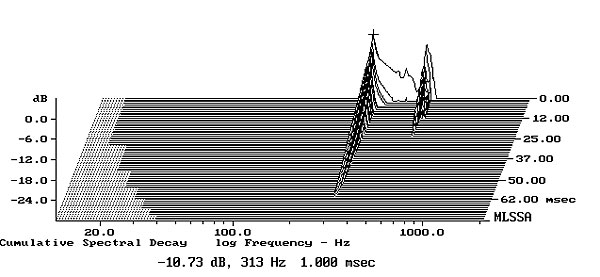 Fig.2 Wilson Sophia Series 3, cumulative spectral-decay plot calculated from output of accelerometer fastened to center of side panel adjacent to woofer (MLS driving voltage to speaker, 7.55V; measurement bandwidth, 2kHz).
With the Sophia 3's sloped-back front baffle and adjustable spiked feet, deciding on what, exactly, is the best axis to measure the speaker was not immediately obvious. As set up by Peter McGrath in Art Dudley's listening room, the speakers' tweeters were just below the level of Art's ears. Fig.3 shows the Sophia's step response on its tweeter axis. The initial up/down spike is the tweeter output; the negative-going decay of the tweeter's step blends smoothly into the midrange unit's step response, the positive-going decay of which blends smoothly into the start of the woofer's step response. (The tweeter and woofer are connected in positive acoustic polarity, the midrange unit in inverted polarity.) But if you look very closely at this graph, there is a slight depression just before the tweeter's step. This is the start of the midrange unit's negative-going step, which suggests that the Sophia's optimal axis—ie, where the outputs of the three drive-units optimally sum in the frequency domain—is actually just above the tweeter axis. However, the plot of the Sophia's vertical dispersion normalized to the tweeter axis (fig.4) indicates that the response doesn't change by much over a ±3° vertical window.
Fig.2 Wilson Sophia Series 3, cumulative spectral-decay plot calculated from output of accelerometer fastened to center of side panel adjacent to woofer (MLS driving voltage to speaker, 7.55V; measurement bandwidth, 2kHz).
With the Sophia 3's sloped-back front baffle and adjustable spiked feet, deciding on what, exactly, is the best axis to measure the speaker was not immediately obvious. As set up by Peter McGrath in Art Dudley's listening room, the speakers' tweeters were just below the level of Art's ears. Fig.3 shows the Sophia's step response on its tweeter axis. The initial up/down spike is the tweeter output; the negative-going decay of the tweeter's step blends smoothly into the midrange unit's step response, the positive-going decay of which blends smoothly into the start of the woofer's step response. (The tweeter and woofer are connected in positive acoustic polarity, the midrange unit in inverted polarity.) But if you look very closely at this graph, there is a slight depression just before the tweeter's step. This is the start of the midrange unit's negative-going step, which suggests that the Sophia's optimal axis—ie, where the outputs of the three drive-units optimally sum in the frequency domain—is actually just above the tweeter axis. However, the plot of the Sophia's vertical dispersion normalized to the tweeter axis (fig.4) indicates that the response doesn't change by much over a ±3° vertical window.
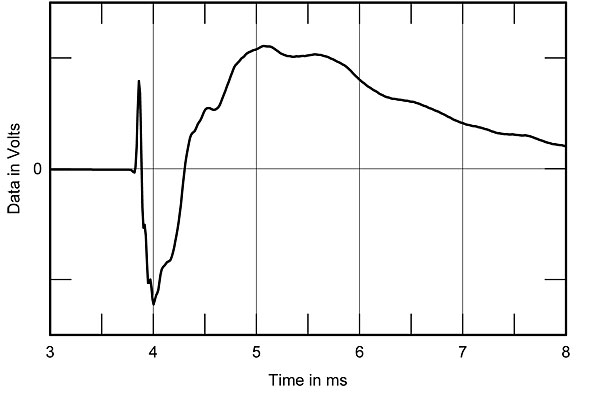 Fig.3 Wilson Sophia Series 3, step response on tweeter axis at 50" (5ms time window, 30kHz bandwidth).
 Fig.4 Wilson Sophia Series 3, vertical response family at 50", normalized to response on tweeter axis, from back to front: differences in response 15–3° above axis, reference response, differences in response 3–12° below axis.
For convenience, therefore, in that the tweeter axis accurately defines a place to put the microphone in three-dimensional space, I continued with the measurements of the Sophia 3 on that axis. Above 300Hz, the black trace in fig.5 shows the response of the Wilson averaged across a 30° horizontal window on its tweeter axis, with the grille removed. It looks very similar to the response of the original Sophia: very flat in the midrange, with small peaks in the treble balanced by small dips. Adding the grille, which is how AD reviewed the speaker, deepened the depression between 2 and 3kHz by a couple of dB, and reduced the mid- and high-treble regions by about 1dB (fig.6). Pair matching was excellent, the responses of the speakers generally matching within 0.5dB, but serial no. 3414 was about 1dB hotter above 5Hz than no. 3413 when driven by AD's Shindo monoblocks.
Fig.4 Wilson Sophia Series 3, vertical response family at 50", normalized to response on tweeter axis, from back to front: differences in response 15–3° above axis, reference response, differences in response 3–12° below axis.
For convenience, therefore, in that the tweeter axis accurately defines a place to put the microphone in three-dimensional space, I continued with the measurements of the Sophia 3 on that axis. Above 300Hz, the black trace in fig.5 shows the response of the Wilson averaged across a 30° horizontal window on its tweeter axis, with the grille removed. It looks very similar to the response of the original Sophia: very flat in the midrange, with small peaks in the treble balanced by small dips. Adding the grille, which is how AD reviewed the speaker, deepened the depression between 2 and 3kHz by a couple of dB, and reduced the mid- and high-treble regions by about 1dB (fig.6). Pair matching was excellent, the responses of the speakers generally matching within 0.5dB, but serial no. 3414 was about 1dB hotter above 5Hz than no. 3413 when driven by AD's Shindo monoblocks.
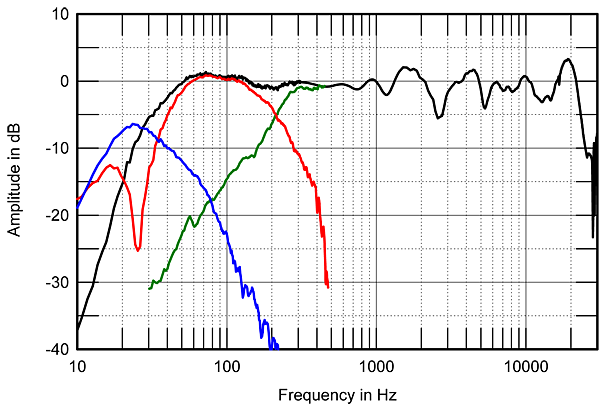 Fig.5 Wilson Sophia Series 3, anechoic response on tweeter axis at 50", averaged across 30° horizontal window and corrected for microphone response, with complex sum of nearfield midrange, woofer, and port responses plotted below 300Hz (black), and nearfield responses of midrange unit (green), woofer (red), and lower port (blue).
 Fig.6 Wilson Sophia Series 3, anechoic response on tweeter axis with grille (red) and without (blue) (4dB/vertical div.).
Lower in frequency in fig.5, the black trace below 300Hz shows the complex sum of the nearfield responses of the midrange unit (green trace), woofer (red), and the two ports. The upper port, which loads the midrange unit, doesn't contribute much at all to the speaker's output; the lower port (blue) is tuned to a low 25Hz, as revealed by both the impedance plot and the fact that this is the frequency of the minimum-motion notch in the woofer's output. The original Sophia's rather exaggerated woofer alignment led to bass problems in some rooms (though not mine). That the Series 3 has a tighter, lower-Q tuning is evidenced in the lower-frequency traces in fig.5, which have very little of the boost that is inevitable with the nearfield measurement technique. The crossover between the midrange unit and woofer appears to be set just above 200Hz, and both drive-units offer well-behaved rolloffs outside their passbands.
The Sophia's lateral dispersion (figs.7 & 8) indicates that the dip between 2 and 3kHz does tend to fill in to the speaker's sides, and that the speaker offers relatively wide dispersion, at least below 10kHz. As a result, its spatially averaged response in Art's room (fig.9, red trace) is very even in the upper midrange and above, other than a slight excess of energy at the bottom of the tweeter's passband. In fact, in this region, the Sophia 3's in-room response appears smoother than that of Wilson's Sasha W/P. The relative lack of energy between 100 and 400Hz appears to be characteristic of AD's room, as it is a consistent feature when this kind of measurement is made there; I suspect that it is due to the cancellation between the direct sound from the woofer and the reflections of that sound from the floor and nearest sidewall. The former reflection does not appear to have as much effect on a speaker's perceived balance as might be expected, presumably because there is always a floor present when we listen and our brains can tune out its effect to some extent.
Fig.6 Wilson Sophia Series 3, anechoic response on tweeter axis with grille (red) and without (blue) (4dB/vertical div.).
Lower in frequency in fig.5, the black trace below 300Hz shows the complex sum of the nearfield responses of the midrange unit (green trace), woofer (red), and the two ports. The upper port, which loads the midrange unit, doesn't contribute much at all to the speaker's output; the lower port (blue) is tuned to a low 25Hz, as revealed by both the impedance plot and the fact that this is the frequency of the minimum-motion notch in the woofer's output. The original Sophia's rather exaggerated woofer alignment led to bass problems in some rooms (though not mine). That the Series 3 has a tighter, lower-Q tuning is evidenced in the lower-frequency traces in fig.5, which have very little of the boost that is inevitable with the nearfield measurement technique. The crossover between the midrange unit and woofer appears to be set just above 200Hz, and both drive-units offer well-behaved rolloffs outside their passbands.
The Sophia's lateral dispersion (figs.7 & 8) indicates that the dip between 2 and 3kHz does tend to fill in to the speaker's sides, and that the speaker offers relatively wide dispersion, at least below 10kHz. As a result, its spatially averaged response in Art's room (fig.9, red trace) is very even in the upper midrange and above, other than a slight excess of energy at the bottom of the tweeter's passband. In fact, in this region, the Sophia 3's in-room response appears smoother than that of Wilson's Sasha W/P. The relative lack of energy between 100 and 400Hz appears to be characteristic of AD's room, as it is a consistent feature when this kind of measurement is made there; I suspect that it is due to the cancellation between the direct sound from the woofer and the reflections of that sound from the floor and nearest sidewall. The former reflection does not appear to have as much effect on a speaker's perceived balance as might be expected, presumably because there is always a floor present when we listen and our brains can tune out its effect to some extent.
 Fig.7 Wilson Sophia Series 3, lateral response family at 50", normalized to response on tweeter axis, from back to front: differences in response 90–5° off axis, reference response, differences in response 5–90° off axis.
 Fig.8 Wilson Sophia Series 3, lateral response family at 50", from back to front: response 90–5° off axis, reference response on tweeter axis, response 5–90° off axis.
 Fig.9 Wilson Sophia Series 3, spatially averaged, 1/3-octave response in AD's listening room (red); spatially averaged response of AudioNote AN-E/SPe HE in AD's room (blue).
Lower in frequency, despite its overdamped woofer alignment, the Sophia offers in-room extension at full level almost down to 20Hz, though it is aided in this by the lowest-frequency mode in AD's room coinciding with the port's tuning frequency. For reference, the blue trace in fig.9 shows the spatially averaged response of Art's long-term reference speakers, the AudioNote AN-E/SPe HEs. The lumpier low frequencies, the excess of midrange energy, and the prematurely rolled-off top octaves are all what I would have expected from my own auditioning of the two pairs of speakers in this room.
Finally, fig.10 shows the Sophia 3's cumulative spectral-decay plot on the tweeter axis with the grille removed. It is very clean in the tweeter's region, but the on-axis notch at 1kHz is shown to be associated with some delayed energy. This could well result from a problem with the midrange unit's cone-surround termination, but I note that Art didn't comment on any coloration in this region.
Fig.9 Wilson Sophia Series 3, spatially averaged, 1/3-octave response in AD's listening room (red); spatially averaged response of AudioNote AN-E/SPe HE in AD's room (blue).
Lower in frequency, despite its overdamped woofer alignment, the Sophia offers in-room extension at full level almost down to 20Hz, though it is aided in this by the lowest-frequency mode in AD's room coinciding with the port's tuning frequency. For reference, the blue trace in fig.9 shows the spatially averaged response of Art's long-term reference speakers, the AudioNote AN-E/SPe HEs. The lumpier low frequencies, the excess of midrange energy, and the prematurely rolled-off top octaves are all what I would have expected from my own auditioning of the two pairs of speakers in this room.
Finally, fig.10 shows the Sophia 3's cumulative spectral-decay plot on the tweeter axis with the grille removed. It is very clean in the tweeter's region, but the on-axis notch at 1kHz is shown to be associated with some delayed energy. This could well result from a problem with the midrange unit's cone-surround termination, but I note that Art didn't comment on any coloration in this region.
 Fig.10 Wilson Sophia Series 3, cumulative spectral-decay plot on tweeter axis at 50" (0.15ms risetime).
Overall, I found no surprises in the Sophia Series 3's measured performance. The main change over the original version was its more room-friendly woofer tuning.—John Atkinson
Fig.10 Wilson Sophia Series 3, cumulative spectral-decay plot on tweeter axis at 50" (0.15ms risetime).
Overall, I found no surprises in the Sophia Series 3's measured performance. The main change over the original version was its more room-friendly woofer tuning.—John Atkinson
Fig.1 Wilson Sophia Series 3, electrical impedance (solid) and phase (dashed). (2 ohms/vertical div.)
The traces in fig.1 are free from the small wrinkles that would imply the existence of cabinet vibrational resonances, but I did find some modes when I investigated the enclosure panels' behavior with a plastic-tape accelerometer. Fig.2, for example, is a cumulative spectral-decay plot calculated from the output of the accelerometer while it was fastened to the center of a sidewall level with the woofer dustcap. While two resonant modes can be seen, at 313 and 598Hz, both are so low in level and of sufficiently high Quality Factor (Q) that they will not lead to any coloration. The higher-frequency mode could also be found on the sidewalls and rear panel level with the midrange unit, but remained at a low level. The Sophia's heroic construction—oh, my aching back—renders the cabinet effectively acoustically inert.
Fig.2 Wilson Sophia Series 3, cumulative spectral-decay plot calculated from output of accelerometer fastened to center of side panel adjacent to woofer (MLS driving voltage to speaker, 7.55V; measurement bandwidth, 2kHz).
Fig.3 Wilson Sophia Series 3, step response on tweeter axis at 50" (5ms time window, 30kHz bandwidth).
Fig.4 Wilson Sophia Series 3, vertical response family at 50", normalized to response on tweeter axis, from back to front: differences in response 15–3° above axis, reference response, differences in response 3–12° below axis.
For convenience, therefore, in that the tweeter axis accurately defines a place to put the microphone in three-dimensional space, I continued with the measurements of the Sophia 3 on that axis. Above 300Hz, the black trace in fig.5 shows the response of the Wilson averaged across a 30° horizontal window on its tweeter axis, with the grille removed. It looks very similar to the response of the original Sophia: very flat in the midrange, with small peaks in the treble balanced by small dips. Adding the grille, which is how AD reviewed the speaker, deepened the depression between 2 and 3kHz by a couple of dB, and reduced the mid- and high-treble regions by about 1dB (fig.6). Pair matching was excellent, the responses of the speakers generally matching within 0.5dB, but serial no. 3414 was about 1dB hotter above 5Hz than no. 3413 when driven by AD's Shindo monoblocks.
Fig.5 Wilson Sophia Series 3, anechoic response on tweeter axis at 50", averaged across 30° horizontal window and corrected for microphone response, with complex sum of nearfield midrange, woofer, and port responses plotted below 300Hz (black), and nearfield responses of midrange unit (green), woofer (red), and lower port (blue).
Fig.6 Wilson Sophia Series 3, anechoic response on tweeter axis with grille (red) and without (blue) (4dB/vertical div.).
Lower in frequency in fig.5, the black trace below 300Hz shows the complex sum of the nearfield responses of the midrange unit (green trace), woofer (red), and the two ports. The upper port, which loads the midrange unit, doesn't contribute much at all to the speaker's output; the lower port (blue) is tuned to a low 25Hz, as revealed by both the impedance plot and the fact that this is the frequency of the minimum-motion notch in the woofer's output. The original Sophia's rather exaggerated woofer alignment led to bass problems in some rooms (though not mine). That the Series 3 has a tighter, lower-Q tuning is evidenced in the lower-frequency traces in fig.5, which have very little of the boost that is inevitable with the nearfield measurement technique. The crossover between the midrange unit and woofer appears to be set just above 200Hz, and both drive-units offer well-behaved rolloffs outside their passbands.
Fig.7 Wilson Sophia Series 3, lateral response family at 50", normalized to response on tweeter axis, from back to front: differences in response 90–5° off axis, reference response, differences in response 5–90° off axis.
Fig.8 Wilson Sophia Series 3, lateral response family at 50", from back to front: response 90–5° off axis, reference response on tweeter axis, response 5–90° off axis.
Fig.9 Wilson Sophia Series 3, spatially averaged, 1/3-octave response in AD's listening room (red); spatially averaged response of AudioNote AN-E/SPe HE in AD's room (blue).
Lower in frequency, despite its overdamped woofer alignment, the Sophia offers in-room extension at full level almost down to 20Hz, though it is aided in this by the lowest-frequency mode in AD's room coinciding with the port's tuning frequency. For reference, the blue trace in fig.9 shows the spatially averaged response of Art's long-term reference speakers, the AudioNote AN-E/SPe HEs. The lumpier low frequencies, the excess of midrange energy, and the prematurely rolled-off top octaves are all what I would have expected from my own auditioning of the two pairs of speakers in this room.
Finally, fig.10 shows the Sophia 3's cumulative spectral-decay plot on the tweeter axis with the grille removed. It is very clean in the tweeter's region, but the on-axis notch at 1kHz is shown to be associated with some delayed energy. This could well result from a problem with the midrange unit's cone-surround termination, but I note that Art didn't comment on any coloration in this region.
Fig.10 Wilson Sophia Series 3, cumulative spectral-decay plot on tweeter axis at 50" (0.15ms risetime).
Overall, I found no surprises in the Sophia Series 3's measured performance. The main change over the original version was its more room-friendly woofer tuning.—John Atkinson