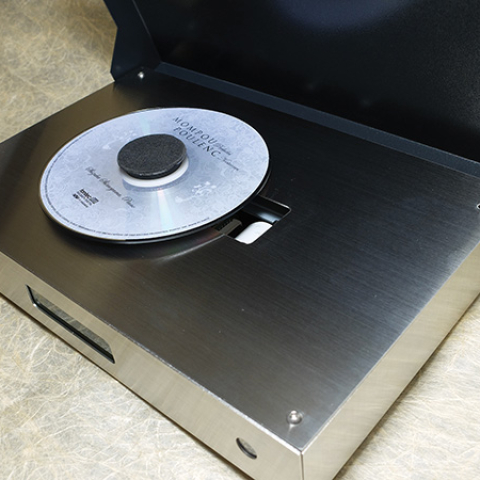
I turned quickly to another disc simply entitled Francis Poulenc (Adda 590042), an all-digital French production. Track 7, Trio for Oboe, Bassoon, and Piano, was a wonder and a joy to hear. First impressions were of a special kind of palpability that seemed to originate in the sense of fullness of harmonic information rather than in sharp focus. This proved a hallmark of the Blue Laser's sound.
In spite of what I might begin to characterize as a slightly cerebral sound, you still might find yourself, as I was, lifted practically out of your seat with the loveliness and refinement of the oboe. The fade at the end of the movement revealed the system's fine transparency and resolution.
Listening to this CD and many others highlighted the particularly clean window on sound the 6 Chassis offered. This was manifested in its ability to render acoustic decay as it flowed out into the recording venue, perhaps lightly slapping the walls as it faded away into the noise floor. The remarkably pristine, large, and layered soundstage always revealed nuances of decay and reverberation that enhanced the musical experience.
I'm talking about the 6 Chassis, but also, by extension, the CD 1 Blue Laser. As they say, garbage in... If you don't retrieve the information to begin with, you can never re-create it later. And it's clear to me that the information the Blue Laser retrieves, dithered as it appears to be by the blue diode's optical noise, is in some profound way changed in the process. Stochastic resonance does indeed seem to be responsible for a more analoglike sound. A perfect way to examine its influence in detail would be with...
Female Vocals, or Take Me, I'm yours...
I found myself captivated by the charm, beauty, and illumination of female singers. This was the strongest suit of the CD 1 Blue Laser's presentation. Over time I've come to see that a component's ability to present female vocals reveals much about the openness and linearity of the midrange, upper-midrange, and above. Get the ladies right, it seems, and, most often, everything else follows naturally. The notion of stochastic resonance and its ability to amplify low-level signals up and out of the noise floor may explain why vocals were so well rendered. Gorging myself on the beauty of it all, I listened one memorable late Friday night to selections from Patricia Barber's Café Blue (Premonition PREM 737-2), Marianne Faithfull's A Secret Life (Island 314-524 096-2), Patti Smith's Gone Again (Arista 18747-2), and finished off with Cassandra Wilson's New Moon Daughter (Blue Note CDP 8 32861 2).
All during the listening session, I grooved on the velvety midrange textures on tap. It was positively sexy. Marianne Faithfull just put me away on "Losing"; what a babe. The midrange textures on this pop release were as well-developed by the CD 1 as any I've ever heard. I was floored by the expressiveness and clarity of her voice.
Turning to something a little more audiophile, I played Patricia Barber's Café Blue, cut by Jim Davis at Music Direct ((312) 433-0200). Another babe—how this recording escaped my attention I'll never know. If I were going to listen to this CD for the first time, I'd start with track 3, "The Thrill is Gone" (it's not), then play track 8, "Ode to Billy Joe," for something familiar yet seductive, before blasting off on track 9 with my new theme song: "Too Rich for My Blood."
"Too Rich" knocked me out every time. What Barber does with her voice in the latter half of this lovely sonic onslaught ought to be illegal. "You like that recording? What about the reverb?" asked an audio acquaintance. Never mind the reverb—it's great music, beautifully recorded, and her voice is a wonder. Very complete in the midrange and above, the enhanced detail adding significantly to the realism of the event. She sounded so present it was frightening.
At one point in a surprising turn, Barber takes off and, paced by a driving drumbeat, climbs her vocal range in a simply astounding manner. As she traverses the upper echelons (and as I tried to keep the goosebump factor in check) there occurs another surprising turn, as the drums take on an even greater drive and end the song with a powerful, elemental, rhythmic tidal wave of energy and sound. It's sure to leave you tuckered out. (Was it good for you too?)
Man, that was a listening session!
Café Blue—available on LP as well—is a wonderful recording with which to track an audio system. The music is fantastic, first and foremost, and even the reverb as it decays into the noise floor can be telling. The quality of the superbly recorded acoustic bass and piano never ceases to amaze, and...just buy the bloody thing. You'll love it.
While there's plenty of resolution of fine detail, there is, in fact, less than with the admittedly much more expensive Ensemble Dichrono front-end or the Forsell air-bearing digital rig. The question is, for $6000, can YBA's blue-laser technology bring you—as importer Jacques claims it does—into the same frame as units costing two and three times as much? Interesting to ponder...
Listening notes: "Its a player of subtlety and nuance, not a sledgehammer. Could a tubed preamp possibly get the bassoon any more beautifully on the Francis Poulenc disc?" (I didn't think so until I hooked up the Graaf 13.5B.) My notes speak of a wide, transparent soundstage, each player occupying its own space, with a fine sense that the acoustic was shared with the other instruments. Though slightly cool and removed, there was a balanced wholeness to the presentation that nevertheless relaxed me into the music.
But the CD 1 Blue can boogie, make no mistake. Take the recent HDCD release of the Lynne Arriale Trio's With Words Unspoken (DMP CD-518), especially her take on that old Monk classic, "Think of One." It's a high-energy kick to hear the driving force with which Arriale leads her trio in this dynamic stunner. And they absolutely nail it. Anytime I was thinking the Blue Laser sounded a bit too soft or enigmatic, I just had to play this track to remind me how good it could be.
Track 2, Dizzy Gillespie's "Woody'n'You," also drives the listener right along with an undeniable energy and musical insistence, coupled with a speed that showed, in its own low-key way, that the CD 1 was fast enough to pull it off. Notes: "Niiiice highs, very PopeMusic-like in the clarity, shimmer, and burnish of the cymbals. The piano sounds fulsome and colorful, the acoustic bass strong, if somewhat lighter in overall impact and solidity than with the Statement amp. Huge soundstage, very ambient, and I note...yet another babe!"
Going for maximum impact, I spun the Yellowjackets' Live Wires (GRP GRD-9667). I noted the slightly digital nature of the master tape and nodded in approval. I cranked the volume, advanced to track 9, "Wildlife," and listened carefully. While it's true that this astoundingly dynamic and airy drum-set piece was less startling than I've heard it, I noted once again that there was enough of the visceral stuff on tap to grab my attention and keep it.
"Do you love it, J-10?..."
...asked JA when I told him the CD 1 Blue Laser would shortly be on its way to Santa Fe for measurement. "Uhhhh..." was my eloquent reply. The CD 1 is an altogether satisfying and musical piece of equipment. It's very French: discreet but not impotent. Considering this, I put the Signature monoblocks back in at the end of the review period and popped the clutch on the Patricia Barber CD. All-YBA sounded very balanced, it's true, but also wonderfully vivid. I felt the CD 1 Blue Laser to be truly communicative, if on its own terms. The music on this disc is powerful, emotive stuff.
The YBA may shake you up. But I found it entered into my musical conscience in an essentially different way than some other components manage; in a more cerebral manner, if you will. I found myself startled less, but nonetheless drawn into the music. Focus was not quite an issue, but, in a macro, single-ended sort of way, the initial wave-launch into the nearfield was more defined with the CD 1 than with other digital front-ends I've heard, some of which exhibit more razor-sharp image outlines. But that's the overall balance YBA has chosen.
Tonal color, harmonics, and a natural, musically balanced frequency response are the priorities here. It's a hard thing for an old hippy like me to comprehend, but you just can't have it all. In the end, the CD 1 Blue Laser was a little more easy to live with than I might ultimately prefer, but I respected its ability to make music. And yes, for your hard-won 6 kay, you do indeed get a digital solution that comes pretty close in sound quality to front-ends costing two to three times as much. Highly recommended for music lovers everywhere.
Footnote 1: $60 plus shipping for a set of three from Larry Kass Wood & Music. Tel: (415) 897-0982. Fax: (415) 892-3220.
I found myself captivated by the charm, beauty, and illumination of female singers. This was the strongest suit of the CD 1 Blue Laser's presentation. Over time I've come to see that a component's ability to present female vocals reveals much about the openness and linearity of the midrange, upper-midrange, and above. Get the ladies right, it seems, and, most often, everything else follows naturally. The notion of stochastic resonance and its ability to amplify low-level signals up and out of the noise floor may explain why vocals were so well rendered. Gorging myself on the beauty of it all, I listened one memorable late Friday night to selections from Patricia Barber's Café Blue (Premonition PREM 737-2), Marianne Faithfull's A Secret Life (Island 314-524 096-2), Patti Smith's Gone Again (Arista 18747-2), and finished off with Cassandra Wilson's New Moon Daughter (Blue Note CDP 8 32861 2).
...asked JA when I told him the CD 1 Blue Laser would shortly be on its way to Santa Fe for measurement. "Uhhhh..." was my eloquent reply. The CD 1 is an altogether satisfying and musical piece of equipment. It's very French: discreet but not impotent. Considering this, I put the Signature monoblocks back in at the end of the review period and popped the clutch on the Patricia Barber CD. All-YBA sounded very balanced, it's true, but also wonderfully vivid. I felt the CD 1 Blue Laser to be truly communicative, if on its own terms. The music on this disc is powerful, emotive stuff.
Footnote 1: $60 plus shipping for a set of three from Larry Kass Wood & Music. Tel: (415) 897-0982. Fax: (415) 892-3220.