

Sidebar 3: Measurements
I used DRA Labs' MLSSA system and a calibrated DPA 4006 microphone to measure the YG Acoustics Carmel 2's frequency response in the farfield, and an Earthworks QTC-40 for the nearfield and spatially averaged room responses.
The Carmel 2's voltage sensitivity is specified as 87dB/2.83V/m; my estimate was less than that, at 84dB(B)/2.83V/m. The impedance is specified as 4 ohms, with a minimum magnitude of 3.5 ohms. Fig.1 shows my measurement of the YGA's impedance magnitude (solid trace) and electrical phase angle (dotted). The impedance drops below 4 ohms only between 150 and 400Hz, and the minimum value is 3.68 ohms at 220Hz. While the phase angle is occasionally high, the amplitude is also high at those frequencies, ameliorating any problems. Note the increasingly capacitive phase angle below the sealed-box woofer-tuning frequency of 60Hz, which suggests there is a high-value series capacitor in the woofer feed.
 Turning to the acoustic measurements, the traces above 300Hz in fig.2 show the individual responses of the Carmel 2's drive-units on the tweeter axis at 50". The blue trace below 350Hz is the woofer's output measured in the nearfield. You can see that the woofer's response is extraordinarily flat over its entire passband, meeting ±1dB limits between 50Hz and 1kHz, and rolling off at 18dB/octave below that range. So why, then, did I feel that the Carmel 2 sounded a bit lean? A nearfield measurement assumes what is called a "2pi" acoustic environment—ie, one in which the drive-unit is mounted in a baffle that extends to infinity in all directions. A speaker that has a truly flat response in the usual "4pi" space will therefore appear to have a boosted upper-bass output with a nearfield measurement, the center frequency of that boost depending on the physical dimensions of the speaker and the woofer tuning. As the Carmel's nearfield response in fig.2 appears to be maximally flat, its woofer alignment must therefore be overdamped.

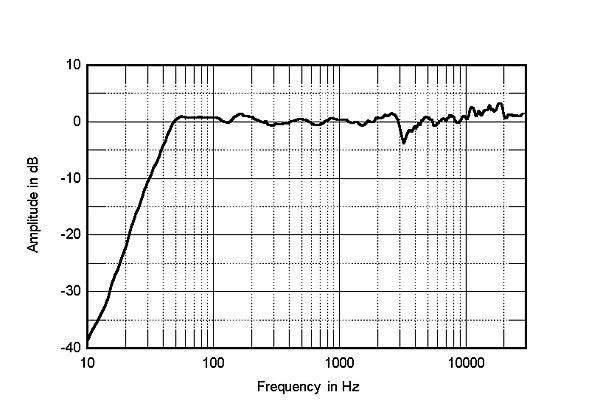

 Fig.6 shows the Carmel 2's spatially averaged response (red trace) in my room with, for reference, the response of the KEF Blade Two in the same room (blue). Both traces were generated by averaging 20 1/6-octave–smoothed spectra, taken for the left and right speakers individually using SMUGSoftware's FuzzMeasure 3.0 program and a 96kHz sample rate, in a vertical rectangular grid 36" wide by 18" high and centered on the positions of my ears. This mostly eliminates the room acoustic's effects, and integrates the direct sound of the speakers with the in-room energy to give a curve that I have found correlates reasonably well with a speaker's perceived tonal balance.
 In the time domain, the Carmel 2's step response on the tweeter axis (fig.7) indicates that both drive-units are connected in the same, positive acoustic polarity, and that the decay of the tweeter's step blends relatively smoothly with the start of the woofer's step. This suggests both an optimal crossover topology and that the setback of the tweeter has been well managed. However, there is the hint of a reflection of the tweeter's output around 100µs later, which might possibly be from the circular edge of the waveguide. Even so, other than a slight degree of delayed energy at the frequency of the on-axis suckout at the bottom of the tweeter's passband, the YGA's cumulative spectral-decay plot (fig.8) is impressively clean.


Fig.1 YG Acoustics Carmel 2, electrical impedance (solid) and phase (dashed) (2 ohms/vertical div.).
There is a suspicious-looking bump in the impedance traces around 150Hz. However, when I tried to examine the Carmel 2's enclosure for the presence of vibrational modes, I wasn't able to get my plastic-tape accelerometer to adhere sufficiently well to the aluminum panels to get a consistent reading. But sweeping a sinewave tone up and down as I listened through a stethoscope revealed the presence on the sidewalls of some high-Q, high-amplitude resonances between 600 and 800Hz. These modes were also present at a lower level on the front baffle. The affected areas seemed small, and the frequency and Q of these resonances will work against their having any effect on sound quality. But I was surprised to find them at all, given the sophisticated design of the Carmel 2's aluminum enclosure. I suspect these might be the reason for the slight degree of coloration I heard in speaking voices and solo piano.
Fig.2 YG Acoustics Carmel 2, acoustic crossover on tweeter axis at 50", corrected for microphone response with nearfield response of woofer plotted below 350Hz.
Higher in frequency in fig.2, the crossover is set to the specified 1.75kHz and the acoustic slopes are asymmetrical, the woofer (blue trace) rolling off at 24dB/octave but the tweeter (red) at 18dB/octave. The tweeter's output is also flat, though a slight discontinuity can be seen between 2.8 and 4.5kHz. This discontinuity is also evident in fig.3, which shows the Carmel 2's farfield response averaged across a 30° horizontal window centered on the tweeter axis. The Carmel 2's plot of lateral dispersion (fig.4) suggests that the discontinuity continues off axis, and that the slight peak between 2 and 3kHz is exacerbated by a slight lack of energy to the speaker's sides in the same region. The YGA's output becomes quite directional above 15kHz or so. However, its vertical-dispersion plot (fig.5) reveals that the Carmel 2's balance hardly changes over a wide (±10°) window centered on the tweeter axis, and that a suckout at the crossover frequency begins to appear only 15° above that axis.
Fig.3 YG Acoustics Carmel 2, anechoic response on tweeter axis at 50", averaged across 30° horizontal window and corrected for microphone response, with nearfield response of woofer plotted below 300Hz.
Fig.4 YG Acoustics Carmel 2, lateral response family at 50", normalized to response on tweeter axis, from back to front: differences in response 90–5° off axis, reference response, differences in response 5–90° off axis.
Fig.5 YG Acoustics Carmel 2, vertical response family at 50", normalized to response on tweeter axis, from back to front: differences in response 15–5° above axis, reference response, differences in response 5–10° below axis.
Fig.6 YG Acoustics Carmel 2, spatially averaged, 1/6-octave response in JA's listening room (red); and of KEF Blade Two (blue).
Both speakers offer very even in-room responses. However, the YGA has a slight excess of energy evident in the mid-treble compared with the KEF, and while the Blade Two's extended response significantly excites the lowest-frequency resonant mode in my room (ca 32Hz), the Carmel 2's low-frequency output is both shelved down and less even. (The bump at 150Hz and the slight trough centered on 200Hz present in both traces are most likely room effects that have not been ameliorated by the spatial averaging.) This graph does correlate with what I heard from the YGA. Interestingly, given the improvement that I found in the Carmel 2's low-frequency balance when I replaced the solid-state amplifiers with the tubed PrimaLuna, the change in the in-room response below 150Hz was less than 1dB.
Fig.7 YG Acoustics Carmel 2, step response on tweeter axis at 50" (5ms time window, 30kHz bandwidth).
Fig.8 YG Acoustics Carmel 2, cumulative spectral-decay plot on tweeter axis at 50" (0.15ms risetime).
Overall, the YGA Carmel 2's measured performance indicates impressive engineering, both in the overall system design and in the proprietary drive-units. That quasi-anechoic response is one of the flattest I have ever measured, rivaled only by YGA's Sonja 1.3 and KEF's Blade Two. But choosing the optimal low-frequency alignment for a relatively small two-way design is always tricky. The Carmel 2 maximizes low-frequency transparency and articulation at the expense of body to its sound.—John Atkinson















