

MartinLogan CLS loudspeaker

The quest for a full-range electrostatic loudspeaker has occupied many engineers' minds for many years. The problems are manifold: large physical size (which can lead to room placement problems and poor dispersion), the difficulty of achieving high sound pressure levels, the need for a potentially sound-degrading step-up transformer, and the unsuitability for production-line manufacture. Even so, the potential rewards are so great that one can understand why loudspeaker designers keep on attempting the apparently impossible. Epoch-making models do appear at infrequent intervals, keeping the flame burning since the appearance of the original Quad in 1955: Acoustat, Sound Lab, and Beveridge in the US, Stax in Japan, Audiostatic in Holland, Quad, of course, in England, and now MartinLogan.
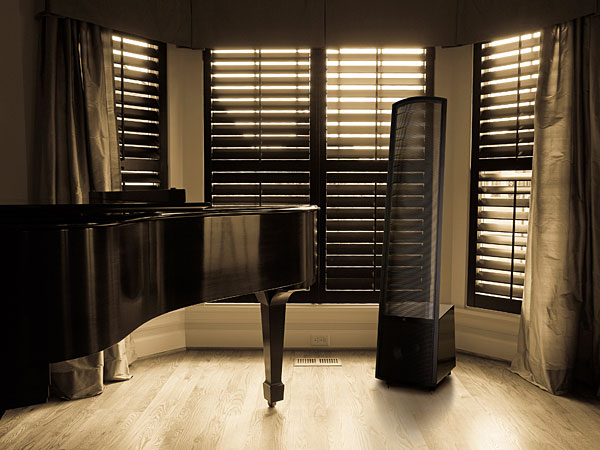
MartinLogan Masterpiece Renaissance ESL 15A loudspeaker

I prefer and have owned electrostatic speakers for most of my audiophile life. Depending on your point of view, this makes me either the most qualified or the least appropriate writer to review MartinLogan's new electrostatic loudspeaker, the Masterpiece Renaissance ESL 15A.
Oh, I've flirted with dynamic speakers. I've owned and lovedand ultimately, when I was an audio retailer, soldmodels from Revel, Thiel, Vandersteen, and many others, while my long-term choice has been electrostats. And while I've spent plenty of time with electrostatic speakers from Acoustat and Quad, I've ended up owning MartinLogans: Sequels, Quests, ReQuests, and, currently, Prodigys.
MartinLogan Monolith loudspeaker
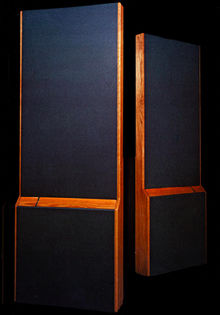
Most Stereophile readers are aware by now of why the full-range electrostatic should, in theory, be the ideal transducer. (If you aren't aware, see the accompanying sidebar.) Acoustat was the first manufacturer to design a full-range electrostatic that was so indestructible it came with a lifetime warranty. (MartinLogan is now offering a three-year warranty on their speakers, and is considering going to a lifetime warranty). But Acoustat was never able to solve another problem that has plagued all flat-panel speakers: treble beaming.
MartinLogan Montage loudspeaker
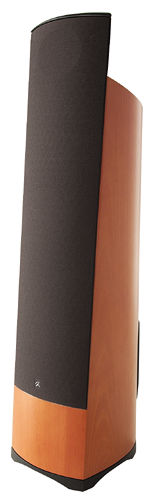
This lapsed fan of electrostatic speakers finds it curious that, while MartinLogan is the predominant representative of this technology in the US, I had never auditioned an ML design in my home. I've enjoyed many Janszen tweeters, a KLH 9, an AcousTech X, Stax ELS-F81s, and I've dallied with Quad">http://www.stereophile.com/loudspeakerreviews/416">Quad ESL-63s. But as dumb luck would have it, the first MartinLogan speaker to reach me, the new Montage, is a hybrid model.
MartinLogan Montis loudspeaker
One of my formative audiophile experiences was the first time I heard electrostatic speakers. I walked into an audio store and heard music played by a live jazz combo. But where were the musicians? I saw none, though I did notice a couple of room-divider panels in the part of the store where the music seemed to be coming from. Eventually, it dawned on me that these must be loudspeakersbut they sounded like no other speakers I'd ever heard, and nothing like the Advents I had at home.
MartinLogan Prodigy loudspeaker
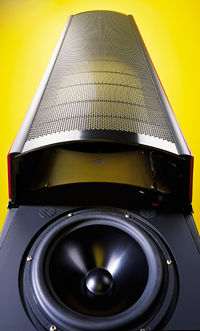
Electrostatic speakers are my passion. Why else have I put up with their high prices, unreliability, low power handling, tendency to arc, high-frequency beaming, limited bass response, and widely fluctuating impedances?
MartinLogan Quest Z loudspeaker

MartinLogan's Gayle">http://stereophile.com/loudspeakerreviews/145/index7.html">Gayle Sanders has almost single-handedly raised the electrostatic/dynamic hybrid loudspeaker to a position of prominence in the High End. First, there was the MartinLogan Monolith (reviewed in Vol.8 No.3 and Vol.9 No.3), followed by the much more affordable Sequel (reviewed in Vol.11 No.12, Vol.12 Nos.8, 9, and 12, and Vol.14 No.2). Then came the subject of this review, the Quest, and most recently the diminutive Aerius, reviewed">http://www.stereophile.com/loudspeakerreviews/312">reviewed by JA elsewhere in this issue.
MartinLogan Sequel II loudspeaker

Loudspeaker designers are dreamers. Something takes hold of a man—the fact that loudspeaker designers are all men must be significant—and he wrestles with recalcitrant wood, arcane drive-units, and sundry coils, capacitors, and cables, to produce something which will be individual in its sound quality yet inherently more true to the original sound. An impossible task. Yet if there were to be an aristocratic subset of those dreamers, it would be those who have taken upon themselves the burden of producing electrostatic loudspeakers. For these farsighted engineers, there is no standing on the shoulders of others, there is no recourse to tried and tested combinations of other manufacturers' drive-units. Every aspect of the design, no matter how apparently insignificant, has to be created afresh from first principles. For a new electrostatic design to produce a sound at all represents a great triumph for its progenitor, let alone having it sound musical. And to produce an electrostatic loudspeaker that is also possessed of great visual beauty is indeed a bonus.
MartinLogan SL3 loudspeaker

"Wow! What's that?" asked the pizza delivery boy, peering over my shoulder at the slender, 5'-tall Martin-Logan SL3 visible behind me.
mbl 101E Radialstrahler loudspeaker

Back in the late 1980s, when I was writing for The Abso!ute Sound and couldn't afford any of the audio gear I was reviewing, my system consisted of an Oracle turntable with Magnepan unipivot arm, a pair of Spica TC-50 loudspeakers, and a heavily modified Hafler DH-200 power amp and DH-101 preamp. It was a fun system that imaged like hell, but my fondest audio memories of that time were of visiting fellow TAS reviewer Dr. Michael Gindi, who lived on Manhattan's West End Avenue, and listening to his mbl speakers. (With his shrink's paycheck, he could afford them.)