

Tidal Audio Akira loudspeaker
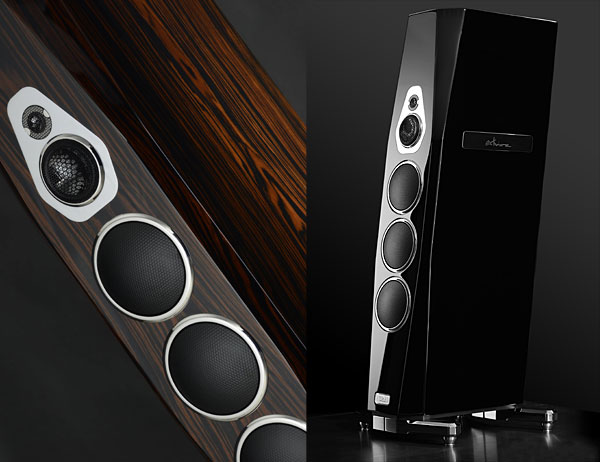
Doug White, of Philadelphia-area retailer The Voice That Is, has been a fixture at US audio shows the past few years, where he always gets great sound using loudspeakers from Tidal Audio. (There is no connection between the German audio manufacturer and the music-streaming service owned by Jay Z and Sprint.) In early 2017, Herb Reichert, Jana Dagdagan, and I visited White and spent a delightful afternoon listening to Tidal's then-new Akira loudspeakers. I promised myself to review the Akira, which costs a wallet-straining $215,000/pair, when my schedule opened up. As things turned out, it was more than a year before that opportunity presented itself.
Totem Acoustic Forest loudspeaker

Those who have read this magazine regularly over the past five years know that Canadian designer Vince Bruzzese has been marketing his small, two-way loudspeakers under the Totem Acoustic brand name. Every review of one of these designs has raved about their strong bass response and three-dimensional imaging, but ends with a "but": "the sound is totally awesome, the imaging is holographic, and my wife thinks it looks terrific in the living room, but..."
Trenner & Friedl Osiris loudspeaker
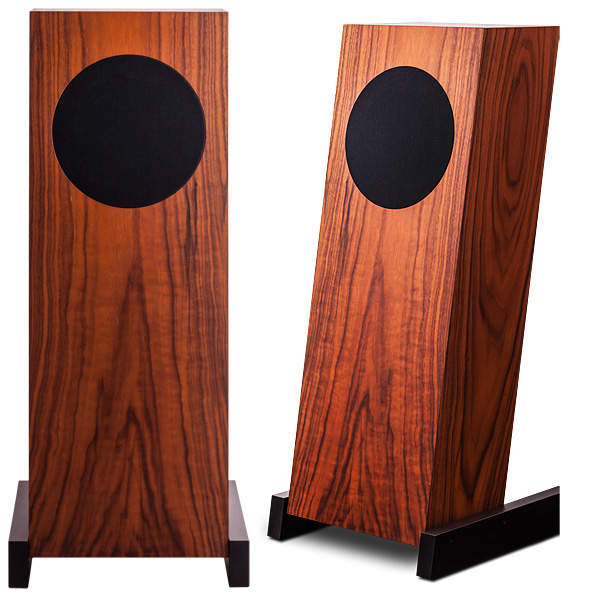
Austrian loudspeaker manufacturer Trenner & Friedl has a thing for coaxial drivers. They're used in at least three of the company's eight loudspeaker models, including the diminutive Sun bookshelf speaker and the large floorstanding Taliesin. In these models, T&F eschew more conventional stacked drivers for a putatively time-aligned, wide-frequency range coaxial design.
Triangle Antal 40th Anniversary Edition loudspeaker

Has it ever crossed your mind that the reason you like your system more than your friend's or the store's is not because yours is better, even if you think it is, but because you're used to the sound of yours and not of theirs? Welcome to product habituation.
Some people, including some audiophiles, believe that product habituation is what's really behind what some people refer to as product break-in. It's not a mechanical or electronic phenomenon, they contend, but a mental one. Assuming the sound of the new gear is of adequate quality, it's the listener that breaks in to the product, as the product's sound, which was initially strange, grows more familiar and, so, right.
Triangle Magellan Concerto loudspeaker

I don't know whether Sam Tellig or I first discovered the delights of some slightly idiosyncratic loudspeakers made by Triangle—Tree-ON-gle, if you add the relevant accent—in the northeastern corner of France. I do recall feeling quite relieved to find that I wasn't the only hi-fi writer who liked and wrote about them.
Triangle Signature Delta loudspeaker
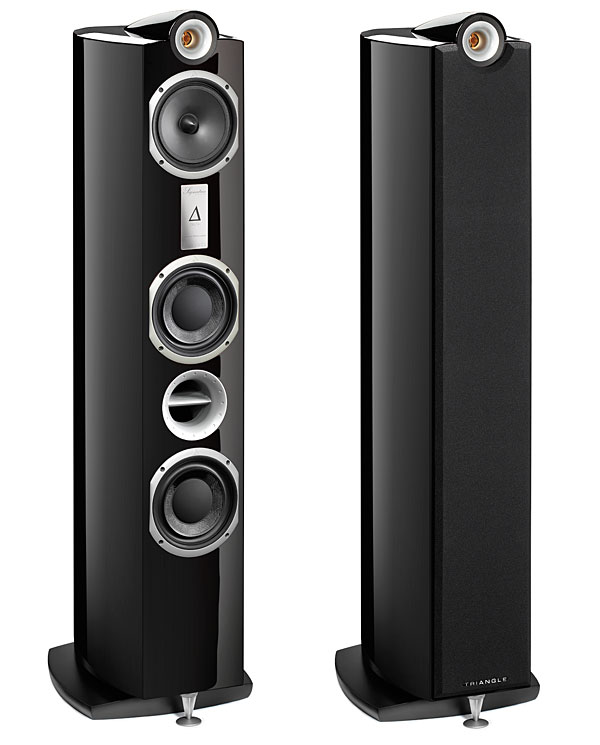
The French do things differently. I first heard Triangle loudspeakers at the 1981 Festival du Son, in Paris. That was, of course, after I had obtained admission to the show, in a nonintuitive process in which members of the press obtained their credentials at a booth inside the show. But my experience of the Triangle speaker, a small, three-way floorstander, was positive: It sounded clean and uncolored, and nothing like the BBC-inspired speakers I preferred at that time. The Triangle wasn't as neutral as the English norm, but there was something appealing about its soundsomething that, I later learned, Stereophile's founder, J. Gordon Holt, referred to as jump factor.
Unity Audio Signature 1 loudspeaker
 For anyone who wants to be up to date on all the audio products available in North America, Audio's Annual Equipment Directory is an indispensable source of information. (So is the publication you're reading now, of course.) The 1992 Directory (aka Audio's October issue) arrived when I was finishing up the review of the Acarian Alón IV (see February 1993, Vol.16 No.2) and about to start seriously listening to the Unity Audio Signature 1s. As I leafed through the issue, I wondered how fledgling loudspeaker manufacturers feel reading the section on loudspeakers. According to the Directory, there are 329 makers of speakers (17 more than in 1991) producing no fewer than 2286 different models. How can a new loudspeaker manufacturer compete with the established makes and their marketing clout, brandname recognition, and economics of scale? You'd better have a really good productor be a genius at promotion.
Unity Audio Signature 3
 When I saw the Unity Audio Signature 3 speakers ($1895/pair) arrive in one box, I was happy. Not just because it meant there would be that much more space left in my basement. No, because it means that Unity is saving money on packaging costs. That means they can spend more money on things like super-nice crossover components. That means...well, I think you know what that means. After all, any piece of audio gear is only as good as the parts it's made from.
To get these overgrown bookends to stand up, you slide little black boards into the slots in their bottoms. Each board is held in place by two set screws, and sticks out to support the speaker with two of the four spikes. The board also tilts the speaker back a little. How do they get sufficient bass out of such slim cabinets?
When I saw the Unity Audio Signature 3 speakers ($1895/pair) arrive in one box, I was happy. Not just because it meant there would be that much more space left in my basement. No, because it means that Unity is saving money on packaging costs. That means they can spend more money on things like super-nice crossover components. That means...well, I think you know what that means. After all, any piece of audio gear is only as good as the parts it's made from.
To get these overgrown bookends to stand up, you slide little black boards into the slots in their bottoms. Each board is held in place by two set screws, and sticks out to support the speaker with two of the four spikes. The board also tilts the speaker back a little. How do they get sufficient bass out of such slim cabinets? Vandersteen 2C loudspeaker

Whenever I think of cone speaker systems, I think of three brand names: Snell, Thiel, and Vandersteen. There are many good loudspeakers and many good designers and manufacturers, but it is these three who, in my opinion, consistently produce the best cone loudspeaker systems. All three companies produce full-range systems, transparent systems, and systems which mate well with a wide range of equipment. Their systems can be owned and enjoyed for years. Long after some fad or special feature has given a competing designer brief notoriety, these are the products you turn back to for music.
Vandersteen 2Ce Signature II loudspeaker

There are three requirements: You must invent a very good loudspeaker that sells for between $1000 and $2000/pair. You have to make enough of them, over a long enough time, to achieve a certain level of brand recognition and market penetration. And you must create a dealer network of reasonable size, with an emphasis on well-promoted specialty shops.