

Luxman B-1000F monoblock power amplifier

When Philip O'Hanlon of On a Higher Note, Luxman's US distributor, delivered the B-1000F monoblocks, it took three of us to wrestle their shipping crates into my house and then into the listening room. Once they were unpacked, it still took two of us to maneuver each of them into positionat 141 lbs and 16.9" wide by 11.6" high by 23.3" deep, the B-1000F is far from easy to shift. Fortunately, O'Hanlon had also brought along a pair of Stillpoint stands specifically made for the Luxmans; the B-1000Fs certainly wouldn't have fit into my equipment racks. (The Stillpoints are lovely things. I recommend 'em if you go for the B-1000Fs.)
When O'Hanlon told me the price of the stands$2500/pairI asked what the amps cost.
"Fifty-five," he said.
"You mean the stands are 45% of the price of the amps?"
Luxman M-05 power amplifier
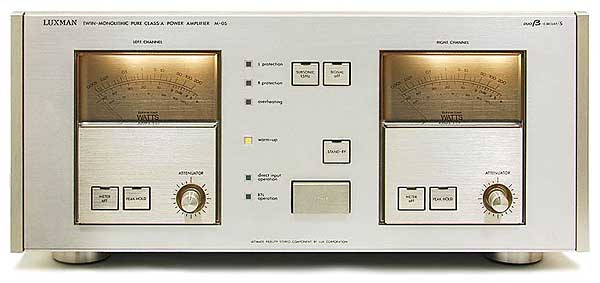
Japanese audiophiles venerate American high-end audio components, paying huge sums for vintage Marantz tube amplifiers, racks of Levinson ML-2s, and early Audio Research tube preamplifiers. The balance of trade, at the high end anyway, hasn't been reciprocated: Japanese high-end amplifiers and preamplifiers have not received as positive a reception in the US. Perhaps it was a matter of styling, but the sonics of the Sony Esprit line and the class-A Stax amplifiers did not receive the following they might have, had the products been American.
Luxman M-10X power amplifier
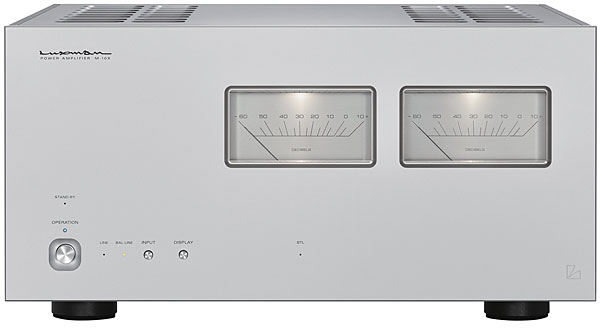
As I started to write this review, the news broke that Sound United, the owner of Boston Acoustics, Bowers & Wilkins, Classé, Definitive Technology, Denon, Marantz, and Polk, was going to be purchased by a corporation that makes medical instruments. Such consolidation is not new. China- and UK-based International Audio Group (IAG) was one of the first organizations to acquire iconic audio brands. IAG owns Audiolab, Castle, Quad, Leak, Mission, and Wharfedale. In 2009, they purchased Luxman.
Luxman M-800A power amplifier

Founded in 1925, Luxman has long been one of Japan's most highly regarded audio manufacturers. Throughout the 1970s and into the 1980s, Luxman's tube preamplifiers and power amplifiers occupied the top shelves of high-performance audio retailers, and to many older American audiophiles, the Luxman name is as familiar and esteemed as those of such storied American brands as McIntosh and Marantz. Luxman's combination of rich, warm sound, superb build quality, and indelible industrial design made its products fully competitive with other brands then considered among the world's best.
Lyngdorf Audio MXA-8400 8-channel power amplifier
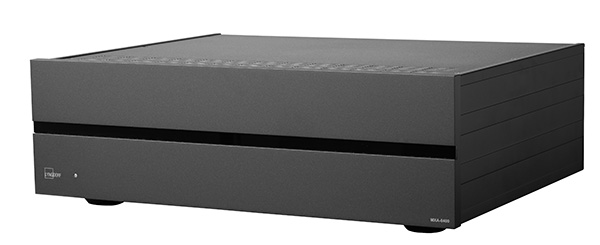
Woot, woot! I was thrilled when I saw the announcement for this amplifier. I was tempted to order one sight unseen and sound unheard. Why? First off, it employs the newest (as of March 2025) class-D amplification technology. Second, it can accommodate all sorts of audio systems, from an eight-channel surround setup to a megalomaniacal two-channel stereo system. Third, the specs, even in the context of its technology, are impressive. And fourth, I can lift it by myselfeasily! How can I pass this amplifier up?
Marantz SM-11S1 Reference power amplifier

Some of the old audio names, such as Eico and Pilot, are gone. Others—Fisher, AR, KLH, H.H. Scott, etc.—have been rendered meaningless by corporate mergers and acquisitions. Yet more than 50 years after their founding, McIntosh and Marantz, arguably the two most prestigious names in American high-quality audio electronics, survive. The products they make today are probably closer in spirit to their original classics of half a century ago than at any time since the early 1970s.
Mark Levinson No.23.5 power amplifier

"A high-quality amplifier must be capable of passing rigid laboratory measurements, meet all listening requirements, and be simple and straightforward in design in the interest of minimizing performance degradation..."—Cdr. Charles W. Harrison Jr., Audio, January 1956 (footnote 1)
Mark Levinson No.29 power amplifier
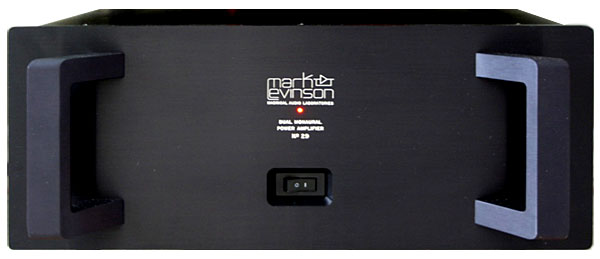
I still remember reading about my first Mark Levinson product 14 or 15 years ago. It was a preamp. The model number escapes me, but it sold for over $2000. It was soon followed by the JC-2, designed by John Curl, which was a bit less pricey but still astonishingly expensive for a mid-'70s preamp. We've come a long way since then. The man, Mark Levinson, left the company that bore his name in the early 1980s and founded a new company, Cello. The company Mark Levinson became the core of Madrigal. It is a mark of their continued dedication to uncompromising high-end products that their bread-and-butter line remains the high-priced Mark Levinsons. They no longer have the Rolls-Royce of the audio market to themselves (in their early years, they made the never exactly inexpensive Audio Research productsARC was certainly a contender for the same titlelook like bargains), but they are certainly a leading player.
Mark Levinson No.331 power amplifier

The No.331 is the latest iteration in a series of Mark Levinson 100Wpc, solid-state, stereo power amplifiers. Extensive cosmetic alterations, internal structural changes, and new circuit designs make it quite different from the No.27 and No.27.5 models that preceded it. These design refinements emanate from Madrigal Audio Laboratories' latest flagship amplifier, the $32,000/pair, 300W RMS Mark Levinson No.33 Reference.
Mark Levinson No.333 power amplifier

If I've read it once in mainstream audio magazines, I've read it a hundred times: "The most important component in a system is the loudspeaker, because it is the loudspeaker that makes the sound." Putting aside the obvious illogic of this statementthat without other components in the playback chain, even the perfect loudspeaker can't make a soundmy experience is that it just is not so. Yes, it is true that changing from one loudspeaker to another makes the greatest overt changes in a system's sound.