

Electrocompaniet Nemo monoblock power amplifier
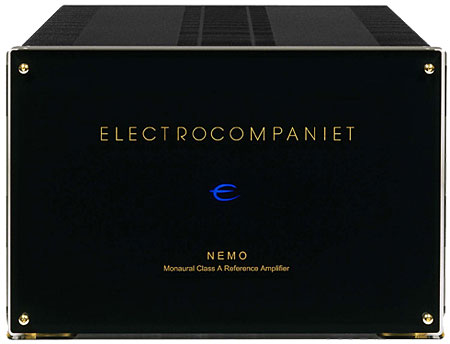
In his 20,000 Leagues Under the Sea, Jules Verne presents the enigmatic Captain Nemo, commander of the great submarine Nautilus, as powerful, charismatic, and mysterious. On first meeting Nemo, the narrator, M. Aronnax, notes, "I made out his prevailing qualities directly: self-confidence—because his head was well set on his shoulders, and his black eyes looked around with cold assurance; calmness—for his skin, rather pale, showed his coolness of blood; energy—evinced by the rapid contraction of his lofty brows; and courage—because his deep breathing denoted great power of lungs." All in all, "this man was certainly the most admirable specimen I had ever met."
Electron Kinetics Eagle 2 power amplifier
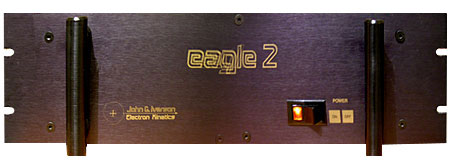
When I first heard the Eagle 2 at the 1985 Winter CES I knew this amplifier was a winner. I was eager for a chance to get my hands on it, but I also knew that J. Gordon Holt was champing at the bit to do the same. So it came as both a surprise and a delight when ye Gracious Editor gave me first crack at the Eagle 2. I wasn't disappointed; the little Eagle more than lived up to expectations. It's not the best power amplifier I've ever heard, but it's damn good. It is, in fact, better than its big brother, the Eagle 7A, in significant ways; in view of the 2's reasonable price, that's saying a lot.
EMM Labs MTRS power amplifier

Edmund (Ed) Manfred Meitner's name and reputation have long been synonymous with pioneering achievements in the fields of digital audio, especially DSD. In 1971, after designing the first fully automated studio console, Ed identified what he calls "the jitter problem." He worked with Sony and Philips to help create and refine SACD and subsequently designed the first complete six-channel DSD playback system for home use.
In 1998, while developing the eight-channel A/D and D/A DSD converters still used to create most SACDs, Ed founded EMM Labs and became head of design, with the goal of bringing DSD to the consumer realm...
Less widely discussed are Ed's amplifier circuit designs, which are the heart of the EMM Labs MTRX and MTRS amplifiers he designed collaboratively with Mariusz Pawlicki, EMM manager of R&D, and the late Zenon "Zanny" Muzyka.
Emotiva XPA Gen3 two-channel power amplifier
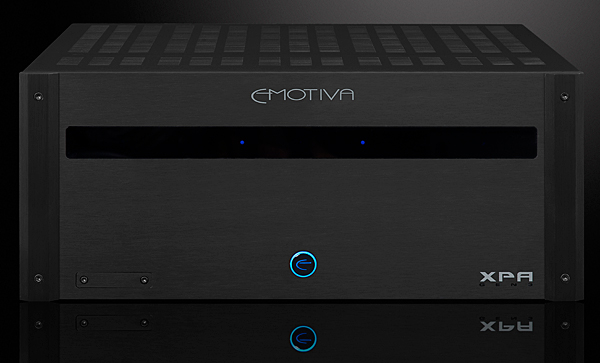
Have I told you about my objectivist friendthe left-brain audiophile who puts a lot of trust in measurements? He has a high natural intelligence and is an extremely experienced listener, but once he knows a component doesn't measure well, he can never again experience it impartially.
I don't want to embarrass my friend, so in this story I will call him O., for Mr. Objectivity.
Esoteric Grandioso M1X monoblock power amplifier
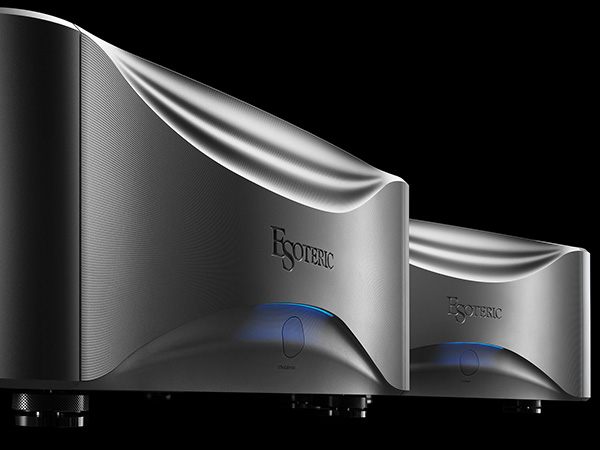
At AXPONA 2022, I eagerly headed to the Esoteric exhibit, where I spoke with Keith Haas, national sales manager of 11 Trading Company, Esoteric's US distributor. When I learned of the forthcoming Grandioso M1X monoblock ($35,500 each), the culmination of a complete revision of the company's top-selling M1 monoblock (now discontinued), I worked with Haas and Editor Jim Austin and set up a review.
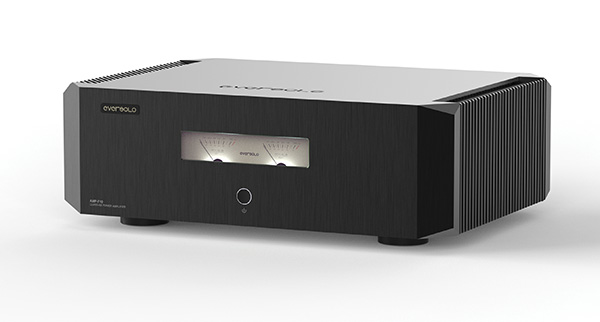
Eversolo AMP-F10 power amplifier
A century ago, pioneering psychiatrist Carl Jung had a wild encounter with the power of sound. "In a village on the way from Lake Albert to Rejaf in the Sudan we had a very exciting experience," Jung wrote in his book Memories, Dreams, Reflections. He goes on to describe his participation in a tribal drum and dance ritual. "Night had fallen ... when we heard drums and horn blasts. Soon some sixty men appeared, martially equipped with flashing lances, clubs, and swords."
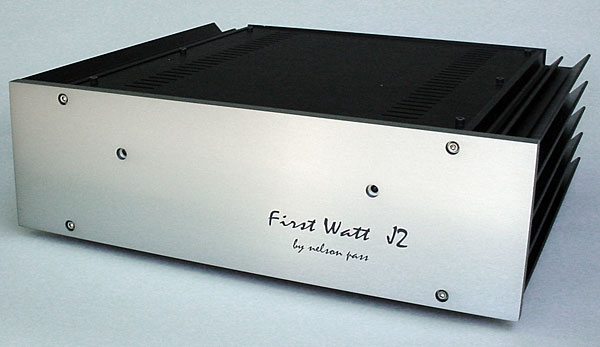
First Watt J2 power amplifier
Every time a new audio technology enters the marketplace, a debate begins about its relative merit. That debate never ceases, even decades after the technology first came (and sometimes went). Turntable platters driven by belts vs rims vs idlers vs directly by their motors. Analog vs digital. Tubes vs solid-state. Triodes vs pentodes, Single-ended vs push-pull. Objectivism vs subjectivism. The power and seriousness of each of these debates has splintered our global hobby into diverse tribes, cults, and subcultsand therein lies one of the chief joys of being an audiophile: participating in cult rivalries.
First Watt SIT-3 power amplifier

I am obliged to begin this review of First Watt's new stereo power amplifier, the SIT-3, with an explanation of how I believe a power amplifier should be reviewed. Why? Because the 18Wpc SIT-3 is a unique and historically important design that can't be wired up to just any loudspeaker and then critiqued on the basis of its bass power, treble brightness, or midrange acuity.
Goldmund Mimesis 8 power amplifier
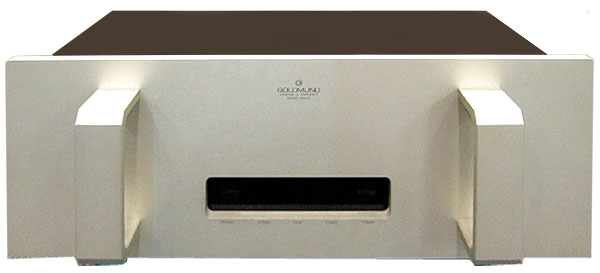
To judge from the $6400 Mimesis 8, Goldmund walks its own way when it comes to power amplifier design. High-end solid-state amplifiers from US companies like Krell, Mark Levinson, Threshold, and the Jeff Rowland Design Group marry massive power supplies to large numbers of output devices (these often heavily biased to run in class-A), built on chassis of such nonmagnetic materials as aluminum. By contrast, the Mimesis 8 has a magnetic (steel) chassis, and uses a relatively modest power supply, that for each channel based on two main 4700µF reservoir capacitors. The 8 offers just two pairs per channel of complementary output MOSFETs (Hitachi K134/J49). These carry a modest bias current of around 80mA total.
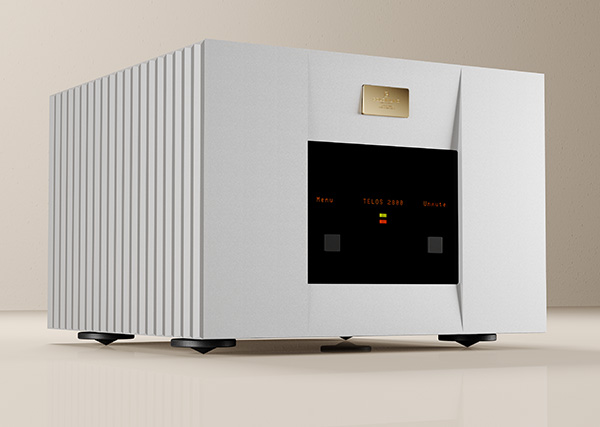
Goldmund Telos 2800 monoblock power amplifier
Frederich Nietzsche distinguished between two approaches to culture: The Apollonian, which is characterized by order and rationality, and Dionysian, which is about chaos, intoxication, and vitality. Apollo was the god of Music, Art, Light, and Knowledge, and to Nietzsche, the Apollonian impulse was the main source of beauty.