

Recording of February 2023: The Wheel

Caroline Shaw: The Wheel
I Giardini: Shuichi Okada, violin; Léa Hennino, viola; Pauline Buet, cello; Eriko Minami, percussion; David Violi, piano
Alpha 881 (24/192 WAV download). 2022. Olivier Rosset, prod., edit., mastering.
Performance *****
Sonics ***** Prolific composer, vocalist, and violinist Caroline Shaw, who turned 40 just last year, possesses a unique giftone that earned her the 2013 Pulitzer Prize in Music. Shaw has translated the old performer edict "Don't let them see you sweat" into her compositional craft and mastered the art of expressing complex thoughts economically through the simplest of means. Using minimal gestures, spare instrumentation, and unpredictable shifts in rhythm, pitch, and texture, she manages to create one masterful, all-engrossing composition after the other.
I Giardini: Shuichi Okada, violin; Léa Hennino, viola; Pauline Buet, cello; Eriko Minami, percussion; David Violi, piano
Alpha 881 (24/192 WAV download). 2022. Olivier Rosset, prod., edit., mastering.
Performance *****
Sonics ***** Prolific composer, vocalist, and violinist Caroline Shaw, who turned 40 just last year, possesses a unique giftone that earned her the 2013 Pulitzer Prize in Music. Shaw has translated the old performer edict "Don't let them see you sweat" into her compositional craft and mastered the art of expressing complex thoughts economically through the simplest of means. Using minimal gestures, spare instrumentation, and unpredictable shifts in rhythm, pitch, and texture, she manages to create one masterful, all-engrossing composition after the other.
Recording of February 2024: Jerome Sabbagh: Vintage

Jerome Sabbagh: Vintage
Sabbagh, saxophone; Kenny Barron, piano; Joe Martin, bass; Johnathan Blake, drums
Sunnyside SSC 1698 (LP). 2023. Jerome Sabbagh, prod.; Ryan Streber, Pete Rende, Bernie Grundman, engs.
Performance ****
Sonics ****½ This is an album with serious audiophile cred. It was recorded to analog tape on a Studer A800 MKIII at 30ips, by Ryan Streber at Oktaven Audio in Mount Vernon, New York. It was mixed, also at 30ips, on a custom, tubed Ampex 351, by Pete Rende. Bernie Grundman mastered it for vinyl and cut the lacquer, direct from the analog tape, on an all-tube system. The executive producer for the vinyl version is Hervé Delétraz of darTZeel, who, Sabbagh told me, helped finance the mastering and pressing. Sabbagh listened to the acetates and test pressings at Ana Might Sound in Paris.
Sabbagh, saxophone; Kenny Barron, piano; Joe Martin, bass; Johnathan Blake, drums
Sunnyside SSC 1698 (LP). 2023. Jerome Sabbagh, prod.; Ryan Streber, Pete Rende, Bernie Grundman, engs.
Performance ****
Sonics ****½ This is an album with serious audiophile cred. It was recorded to analog tape on a Studer A800 MKIII at 30ips, by Ryan Streber at Oktaven Audio in Mount Vernon, New York. It was mixed, also at 30ips, on a custom, tubed Ampex 351, by Pete Rende. Bernie Grundman mastered it for vinyl and cut the lacquer, direct from the analog tape, on an all-tube system. The executive producer for the vinyl version is Hervé Delétraz of darTZeel, who, Sabbagh told me, helped finance the mastering and pressing. Sabbagh listened to the acetates and test pressings at Ana Might Sound in Paris.
Recording of February 2025: Elvis Costello: King of America & Other Realms
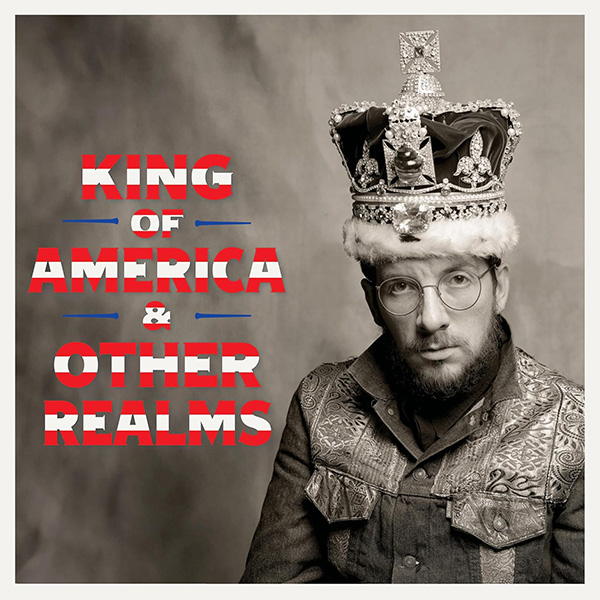
Elvis Costello: King of America & Other Realms
UMG 602488514378 (6 CDs). 2024. Costello and Henry "T Bone" Burnett, original album prod., Costello, Steve Berkowitz, reissue prods.; William Berry Jackson, David Dominguez, Larry Hirsch, Mark Linett, others, engs.
Performance ****½
Sonics **** By the mid-1980s, Elvis Costello was in dire need of a change in musical direction. As he recounts in the extensive new liner notes, he was "playing in a band that suddenly sounded like four strangers." Seeking inspiration, he decided the path forward was to use his own name, Declan MacManus, in the credits and to indulge his love and respect for American music.
UMG 602488514378 (6 CDs). 2024. Costello and Henry "T Bone" Burnett, original album prod., Costello, Steve Berkowitz, reissue prods.; William Berry Jackson, David Dominguez, Larry Hirsch, Mark Linett, others, engs.
Performance ****½
Sonics **** By the mid-1980s, Elvis Costello was in dire need of a change in musical direction. As he recounts in the extensive new liner notes, he was "playing in a band that suddenly sounded like four strangers." Seeking inspiration, he decided the path forward was to use his own name, Declan MacManus, in the credits and to indulge his love and respect for American music.
Recording of February 2026: Mahler: Das Lied von der Erde
Mahler: Das Lied von der Erde
Marie-Nicole Lemieux, contralto; Andrew Staples, tenor. Les Siècles, François-Xavier Roth, cond.
Harmonia Mundi HMM 902740 (CD; reviewed as 24/96). 2026. Jiri Heger, prod., eng.
Performance *****
Marie-Nicole Lemieux, contralto; Andrew Staples, tenor. Les Siècles, François-Xavier Roth, cond.
Harmonia Mundi HMM 902740 (CD; reviewed as 24/96). 2026. Jiri Heger, prod., eng.
Performance *****
Recording of January 1979: The Art of Fuguing
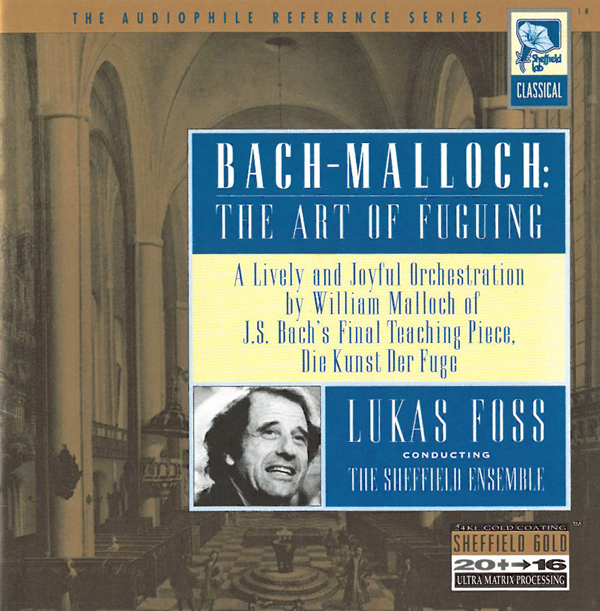
Bach-Malloch: The Art of Fuguing
The Sheffield Ensemble and California Boy's Choir, Lukas Foss, cond., recorded live at First Presbyterian Church, Hollywood.
Town Hall Records S-20 & S-21 (each 2 LPs, 1979), Sheffield Lab 10047-2-G (CD, 1995). Lincoln Mayorga, prod., Ron Hitchcock, eng., Lincoln Mayorga Doug Sax, CD mastering eng. AAA (LP), AAD (CD). These 2-disc albums are of unusual interest for several reasons. First, although both are of exactly the same program material, there were recorded with completely different microphone techniques. One was done with the usual (for commercial recordings) multi-microphone set-up and mixdown (S-20). The other (S-21) was done with a single stereo mikethe technique preferred by most audio perfectionists. [This is the version on the 1995 CD reissueEd.]
The Sheffield Ensemble and California Boy's Choir, Lukas Foss, cond., recorded live at First Presbyterian Church, Hollywood.
Town Hall Records S-20 & S-21 (each 2 LPs, 1979), Sheffield Lab 10047-2-G (CD, 1995). Lincoln Mayorga, prod., Ron Hitchcock, eng., Lincoln Mayorga Doug Sax, CD mastering eng. AAA (LP), AAD (CD). These 2-disc albums are of unusual interest for several reasons. First, although both are of exactly the same program material, there were recorded with completely different microphone techniques. One was done with the usual (for commercial recordings) multi-microphone set-up and mixdown (S-20). The other (S-21) was done with a single stereo mikethe technique preferred by most audio perfectionists. [This is the version on the 1995 CD reissueEd.]
Recording of January 1983: The Art of the Transcription
 EARL WILD: The Art of the Transcription
Earl Wild, piano, recorded live at Carnegie Hall on November 1, 1981
Audiofon 2008-2 (2 LPs). Julian Kreeger, prod., Peter McGrath, eng. AAA It takes nerve for a performer to allow an entire concert to be recorded for release on disc. It also takes extraordinary confidence in one's technique. Mistakes that are overlooked in the live experience become snags for the ear in the recorded version. One starts to listen for them and loses the musical experience in its totality.
Recording of January 1984: Debussy: Three Nocturnes; Jeux
 Debussy: Three Nocturnes; Jeux
Concertgebouw Orchestra of Amsterdam, Bernard Haitink conducting.
Philips ACD 400-023-2 (CD). This is the first classical CD I have heard that was originally mastered on analog tape, and the sound is quite different from what I'm accustomed to hearing from the silver discs. I had read so many critics' complaints about excessive background (tape) hiss from analog-mastered CDs that I was fully prepared to be appalled. I wasn't. Perhaps my speakers (Watkins WE-1s as of now) are smoother than what some other critics listen to, perhaps I prefer a more subdued high end than some, but I did not find hiss to be a problem with this Philips disc. Yes, it is audible at high listening levels, but it is not a ssss, it is a hhhh, like the sound of a very gentle rain far off in the background. I have heard worse hiss from microphone preamps.
Recording of January 1985: Works for Piano
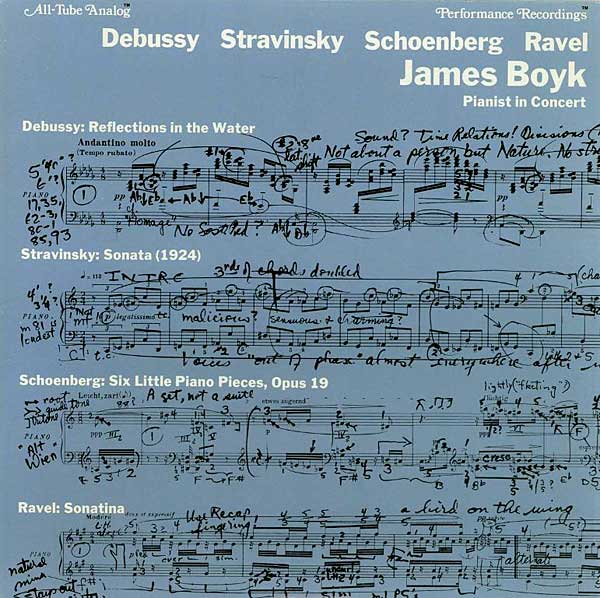
Performance Recordings is the closest thing to a one-man label. James Boyk is president, A&R director, musical director, recording engineer, production manager, jacket notes author, and the star performer. He is also Artist in Residence and lecturer in music and engineering (specifically sound recording and reproduction) at Cal Tech. And he happens to be one of digital's most ardent detractors, having conducted, and widely publicized, several controlled listening tests that proved to his satisfaction that digital recordings are destructive to musical sound. (I will not question his methodology or conclusions here; suffice it to say that James is as stalwartly pro-analog and anti-digital as it is possible to be.)
Recording of January 1988: Renaissance
 Branford Marsalis: Renaissance
Branford Marsalis, tenor & soprano sax; Kenny Kirkland & Herbie Hancock, piano; Bob Hurst & Buster Williams, bass; Tony Williams, drums
CBS FC 40711 (LP). Dennis Ferrante, Bob Margoleff, Howard Siegel, engs.; Delfeayo Marsalis, prod. DDA. TT: 57:09 These are heady days for those who believe that jazz may have reached its height in the mid- to late '60s, before its disastrous 15-year romance with fusion. With such strong new talents as the Marsalis and Brecker brothers and Chico Freeman embracing the spirit of that time, and fusion-scarred veterans like Freddie Hubbard and Joe Henderson returning to the basics of acoustic trios, quartets, and quintets in recent recordings and concerts, jazz has attained a new and cherished seriousness valued all the more for its unexpectedness.
Recording of January 1989: Live and Let Live!
 BOBBY KING & TERRY EVANS: Live and Let Live!
Rounder 2089 (LP), CD 2089 (CD). Larry Hirsch, eng.; Ry Cooder, prod. AAA/AAD. TT: 44:42 If you've heard a Ry Cooder album in the last 12 years, you've heard Bobby King and Terry Evansthey're the gorgeously voiced gospel/R&B singers who've backed up Ry while he's learned to sing in publicand from whom he can't help but have learned a lot. To crib from the liner notes, King is from a Louisiana gospel background, while Evans sang R&B in Mississippi. Their music together is a seamless blend of the best of both sides of the churchyard gate, smack dab in the middle of the strongest undercurrents of American music. Virtually every tune is a gem, but "Let Love Begin," so warm and lovingly sensual it'll melt your speakers, and the best version I've ever heard of "Dark End of the Street," are instant classics. "Saturday Night" has a hint of sprung Cajun rhythm, and "Let Me Go Back to the Country" has that vital feel of a pick-up band one by one sitting down to sit in, music made for the sheer joy of singing and playing. Only "Bald Head," another misogynistic Cooder tune, falls flat, though not for lack of trying by King & Evans.