

Recording of October 1974: Bax Symphony No.5
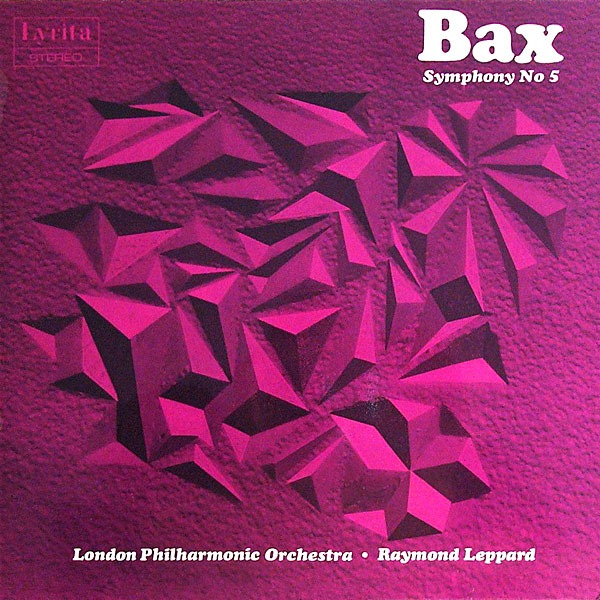
Bax: Symphony No.5 in c sharp
London Philharmonic Orchestra; Raymond Leppard, conductor.
Musical Heritage Society MHS-1652 (LP, From Lyrita SRCS-58). Sir Arnold Bax (18831953) completed his fifth symphony in 1932 and dedicated it to Sibelius. Its first performance was conducted by Sir Thomas Beecham in 1934. Have any of our major orchestras ever played it? Not to my knowledge, and after over 40 years, it's about time. At least we have it on disc now, in addition to The Garden of Fand and Tintagel. Lyrita has even more Bax in their catalog.
London Philharmonic Orchestra; Raymond Leppard, conductor.
Musical Heritage Society MHS-1652 (LP, From Lyrita SRCS-58). Sir Arnold Bax (18831953) completed his fifth symphony in 1932 and dedicated it to Sibelius. Its first performance was conducted by Sir Thomas Beecham in 1934. Have any of our major orchestras ever played it? Not to my knowledge, and after over 40 years, it's about time. At least we have it on disc now, in addition to The Garden of Fand and Tintagel. Lyrita has even more Bax in their catalog.
Recording of October 1978: For Duke
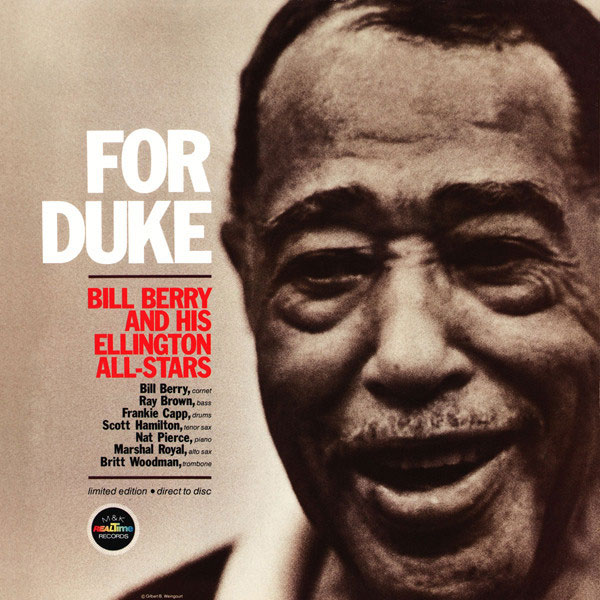
Bill Berry and His Ellington All-Stars: For Duke
Works by Duke Ellington
Bill Berry, cornet; Ray Brown, bass; Frankie Capp, drums; Scott Hamilton, tenor sax; Nat Pierce, piano; Marshal Royal, alto sax; Britt Woodman, trombone.
M&K Real-Time RT-101 (direct-to-disc LP). This is to-date the best direct-to-disc recording I have heard. For once I can't complain about the high end being shrill or hard. The balances are excellent and the performances superior, with each member of the group getting his chance to show off. Marshal Royal's saxophone solos must be heard to be believed, Everyone present is obviously having a good time making music, which is the way it always ought to be but often isn't.
Works by Duke Ellington
Bill Berry, cornet; Ray Brown, bass; Frankie Capp, drums; Scott Hamilton, tenor sax; Nat Pierce, piano; Marshal Royal, alto sax; Britt Woodman, trombone.
M&K Real-Time RT-101 (direct-to-disc LP). This is to-date the best direct-to-disc recording I have heard. For once I can't complain about the high end being shrill or hard. The balances are excellent and the performances superior, with each member of the group getting his chance to show off. Marshal Royal's saxophone solos must be heard to be believed, Everyone present is obviously having a good time making music, which is the way it always ought to be but often isn't.
Recording of October 1979: The Telarc 1812 Overture

Tchaikovsky: 1812 Overture (Op.49), Capriccio Italien (Op.45
), "Cossack Dance" from Mazeppa (LP), plus Marche slav, Op.31, Polonaise and Waltz from
Eugene Onegin
, Op.24, Festival Coronation March
(CD).
Cincinnati Pops Orchestra, Kiev Symphony Chorus; Children's Choir of Greater Cincinnati, Erich Kunzel cond.
Telarc Digital DG-10041 (LP, CD-80041 (CD). 1979 (LP), 1984 (CD). Edited at Soundstream, Inc. Robert Woods, prod.; Jack Renner, eng. DAA (LP), DDD (CD). TT: 35:19 (LP), 60:23 (CD). I must say I'm getting a bit bored with the 1812 Overture, but as long as there are audiophiles, it will be recorded due to the stringent demands it can make upon one's playback system. This version produced by Telarc is going to be hard to beat. The cannon fire is unbelievable.
Cincinnati Pops Orchestra, Kiev Symphony Chorus; Children's Choir of Greater Cincinnati, Erich Kunzel cond.
Telarc Digital DG-10041 (LP, CD-80041 (CD). 1979 (LP), 1984 (CD). Edited at Soundstream, Inc. Robert Woods, prod.; Jack Renner, eng. DAA (LP), DDD (CD). TT: 35:19 (LP), 60:23 (CD). I must say I'm getting a bit bored with the 1812 Overture, but as long as there are audiophiles, it will be recorded due to the stringent demands it can make upon one's playback system. This version produced by Telarc is going to be hard to beat. The cannon fire is unbelievable.
Recording of October 1980: Growing Up In Hollywood Town
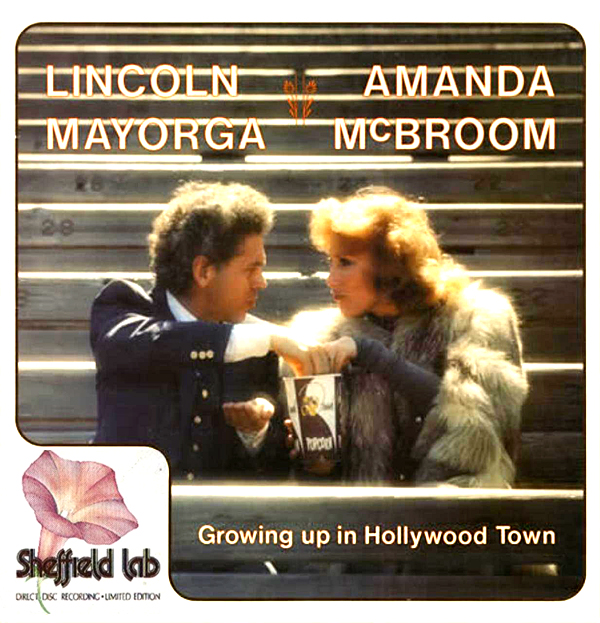
Lincoln Hayorga and Amanda McBroom: Growing Up In Hollywood Town
Lincoln Hayorga and Amanda McBroom
Sheffield LAB-13 (LP). This is a gorgeous recording. And would you believe, it's multi-miked? Sheffield's first since 1975, according to the notes. Ms. McBroom has that purity of intonation that once distinguished Julie Andrews' voice. This, plus a predominantly-string backup orchestra delivers a rich, warm sound. Each of the songs here is a gem in its own right, and the collaboration of McBroom and Mayorga creates moments here that are magical. My favorite is the song entitled "Amanda," with its frontier flavor and unadorned lyrics, followed by Mayorga's'waltz, "Wistful Lady."
Lincoln Hayorga and Amanda McBroom
Sheffield LAB-13 (LP). This is a gorgeous recording. And would you believe, it's multi-miked? Sheffield's first since 1975, according to the notes. Ms. McBroom has that purity of intonation that once distinguished Julie Andrews' voice. This, plus a predominantly-string backup orchestra delivers a rich, warm sound. Each of the songs here is a gem in its own right, and the collaboration of McBroom and Mayorga creates moments here that are magical. My favorite is the song entitled "Amanda," with its frontier flavor and unadorned lyrics, followed by Mayorga's'waltz, "Wistful Lady."
Recording of October 1982: The Sheffield Track Record
 The Sheffield Track Record
Robbie Buchanan and James Newton Howard, keyboards; Lennie Castro, percussion; Nathan East, bass guitar; Mike Landau, guitar; Carlos Vega, drums. Ron Tutt, and Jim Keltner, drum solos. TT: 22:13.
Sheffield LAB-20. What, a recording of rock backup tracks? Who could care less? Me, is who. Quibble over the program if you will (actually, it isn't all that dull, and two of the numbers are fun to listen to), but this wasn't released for the program material. You might call it a tantalizing sample of where a lot of rock sound begins, before it is fuzzed, reverbed, and cross-dubbed God knows how many times before the final mess is released for the edification of the peons. This has to be one of the most astonishing rock recordings ever issued! The Absolute Sound's Harry Pearson (who obviously got his before we got ours, as you are reading this 9 weeks after our copy arrived) is quoted on the jacket as declaring this to be "Absolutely the best-sounding rock record ever made." He's right.
Recording of October 1983: The Stranger
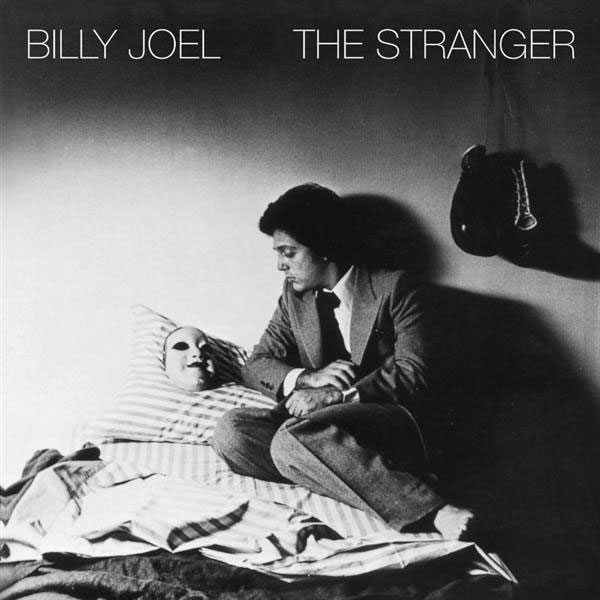
Billy Joel: The Stranger
CBS CD 35DP2 (CD) and JC34987 (digitally mastered, CX-encoded LP). This is one of four recordings we now have on hand in both the CD and digital-mastered LP formats, and all reviews of these will be parallel reviews. In the case of the CBS discs, there is no "conventional" version, as all of their recent LP releases are CX-encoded. Thus, I will be comparing decoded CXed CBS LPs (footnote 1) with their CD equivalents.
CBS CD 35DP2 (CD) and JC34987 (digitally mastered, CX-encoded LP). This is one of four recordings we now have on hand in both the CD and digital-mastered LP formats, and all reviews of these will be parallel reviews. In the case of the CBS discs, there is no "conventional" version, as all of their recent LP releases are CX-encoded. Thus, I will be comparing decoded CXed CBS LPs (footnote 1) with their CD equivalents.
Recording of October 1984: Saint-Saëns & Rachmaninoff Piano Works
 Saint-Saëns: Piano Concerto No.2
Rachmaninoff: Rhapsody on a Theme of Paganini
Bella Davidovich (pno), Concertgebouw Orchestra, Neeme Jarvi, cond.
Philips CD 410-052 2 (CD), 6514-164 (LP). At last we're starting to realize some of the promise of CD from a major record company. This is the best CD recording I've heard yet from Philips. Both of these are virtuoso romantic works requiring a big piano sound and the stamina to produce it for 610 minutes at a stretch, which is probably why few lady pianists will tackle them. Bella Davidovich pulls these off with great aplomb. To me, the Saint-Saëns is the better of the two, and is one of the truly great performances of this work. I grudgingly rate it as equal to my long-time favorite, the Rubinstein/Reiner performance on a 1958 RCA LP (LSC-2234), although I would have liked a little more TLC from Ms. Davidovich in the first movement. She seems a little rushed where an occasional lingering caress is indicated, but that is quibbling with what is a really rousing performance.
Recording of October 1987: Duruflé & Fauré Requiems

Duruflé: Requiem; Fauré: Requiem
Blegen, Morris, Shaw, Atlanta SO and Chorus.
Telarc 80135 (CD). Robert Woods, prod.; Jack Renner, eng. DDD. TT: 74:23 To have two Requiems by French composers on the same disc certainly invites comparisons. Superficially similar, the works are actually quite different: both are conceived for small-scale performance, both rely on the organ, and neither places any great demands on chorus or orchestra. The differences concern mood and even intent. Fauré's Requiem, composed between 1887 and 1890, has survived all kinds of performances, both amateur and professional, without losing its ability to move hearers with its gentle hymn for the dead. The Duruflé, composed in 1947, has not achieved this kind of public appeal. A commissioned work, and not unified in style, this requiem is enjoyed by those who sing it; audiences tend to find it bland.
Blegen, Morris, Shaw, Atlanta SO and Chorus.
Telarc 80135 (CD). Robert Woods, prod.; Jack Renner, eng. DDD. TT: 74:23 To have two Requiems by French composers on the same disc certainly invites comparisons. Superficially similar, the works are actually quite different: both are conceived for small-scale performance, both rely on the organ, and neither places any great demands on chorus or orchestra. The differences concern mood and even intent. Fauré's Requiem, composed between 1887 and 1890, has survived all kinds of performances, both amateur and professional, without losing its ability to move hearers with its gentle hymn for the dead. The Duruflé, composed in 1947, has not achieved this kind of public appeal. A commissioned work, and not unified in style, this requiem is enjoyed by those who sing it; audiences tend to find it bland.
Recording of October 1988: Pontiac
 Lyle Lovett: Pontiac
MCA/Curb MCA-42028 (LP), MCAD-42028 (CD). Willie Pevear, eng.; Tony Brown, Lyle Lovett, prods. DDA/ DDD. TT: 35:41 Jesse Winchester has been silent for seven years now, and we needed some mint-julepvoiced cowboy to write and croon such smooth, fluid, irresistible songs, no sharp edges and none needed, thanks. Thank God Lyle Lovett stepped in; we could have done much, much worse.
Recording of October 1989: Ysaÿe Kreisler Bach
YSAŸE KREISLER BACH
J.S. Bach: Partita No.2, BWV 1004, Kreisler: Recitativo & Scherzo, Op.6, Ysaÿe: Sonata, Op.27 No.2
Arturo Delmoni, violin
Water Lily Acoustics WLA-WS-07 (LP), WLA-WS-07-CD (CD). Kavichandran Alexander, eng., prod. AAA/AAD. Subsequently released on CD as John Marks Records CD JMR 14G (footnote 1). TT: 48:03
J.S. Bach: Partita No.2, BWV 1004, Kreisler: Recitativo & Scherzo, Op.6, Ysaÿe: Sonata, Op.27 No.2
Arturo Delmoni, violin
Water Lily Acoustics WLA-WS-07 (LP), WLA-WS-07-CD (CD). Kavichandran Alexander, eng., prod. AAA/AAD. Subsequently released on CD as John Marks Records CD JMR 14G (footnote 1). TT: 48:03