

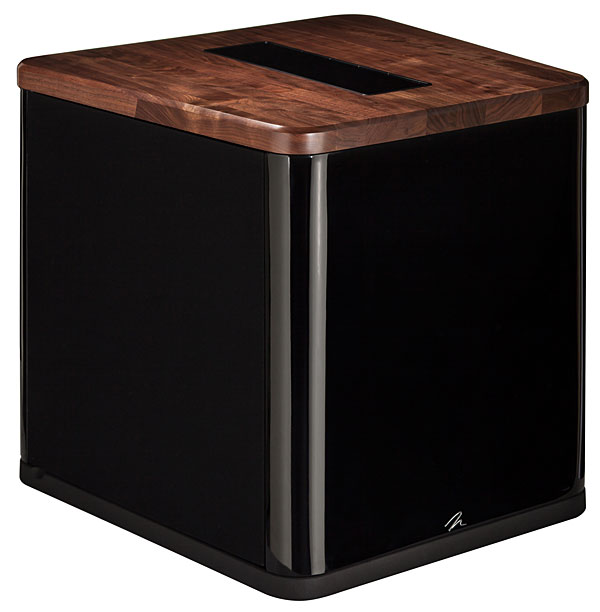
MartinLogan BalancedForce 212 subwoofer
I like big bass, but I cannot lie
Tubby thumpers need not apply
And when a speaker drops in with itty-bitty bass
It puts a frown upon my face
I get bummed . . .
Sir BassaLot, first audiophile rapper, 1992 Some folks put a pair of bookshelf speakers on stands in their room and are happy as clams. I imagine that they imagine the missing bass and never give it another thought. Not me, and perhaps not you. Some of us want to hear it and feel it, just as we would real instruments. We want sex in the room.
Tubby thumpers need not apply
And when a speaker drops in with itty-bitty bass
It puts a frown upon my face
I get bummed . . .
Sir BassaLot, first audiophile rapper, 1992 Some folks put a pair of bookshelf speakers on stands in their room and are happy as clams. I imagine that they imagine the missing bass and never give it another thought. Not me, and perhaps not you. Some of us want to hear it and feel it, just as we would real instruments. We want sex in the room.
MartinLogan Depth powered subwoofer

"You certainly love weird music!" my wife yelled from the kitchen. This just reconfirmed my suspicion that reviewing subwoofers is a lonely job that brings no respect. What's so weird about the droning of Tibetan temple horns accompanied by the chants of Tibetan Gyuto monks, all framed by a powerful synthesizer in Philip Glass's soundtrack to Kundun (CD, Nonesuch 79460-2)? What's so strange about the karate-like cries of the drummers in the Kromata Percussion ensemble as they smash away at their timpani and gongs in Yoshihisa Taira's Hierophonie V (CD, BIS CD-232)? What's so odd about the shuddering majesty of 25Hz notes played by Harry Partch's one-of-a-kind Eroica Marimba, heard on his Delusion of the Fury (LP, Columbia M2 30576)? Why would any spouse object to the primitive, driving synthesizer growls and screams from Morton Subotnick's The Wild Bull (LP, Nonesuch H-71208)?
MartinLogan Dynamo 800X powered subwoofer

In the late 1980s, when I began reviewing high-end subwoofers, they were big and heavy, difficult to move or find space for in a room. Their controls were always on an inconveniently positioned rear panel, and there were no built-in automatic room-optimization options or parametric equalizers. Velodyne's 105-lb, downfiring ULD-18 ($2570), ca 1989, was typical: Two people were needed to unpack and move it; it was powered by an outboard 400W amplifier, connected inconveniently with a speaker cable and an RCA-terminated interconnect for its servo control; and its controls were on the bottom of the cabinet. Changing its crossover frequency involved soldering new resistors onto a printed circuit board inside the amp.
Muse Model 18 subwoofer
 I should begin this review by confessing that I've never been a fan of subwoofers. Most subwoofer systems I've heard have been plagued by a familiar litany of sonic horrors: poor integration between subwoofer and main speakers, boom, bloat, tubbiness, slowness, excessive LF output, and an overall presentation that constantly reminds the listener he is hearing a big cone moving. To me, subwoofers often sound detached from the music, providing an accompanying thump that bears little relationship to the sound from the main speakers. Rather than revealing the music's harmonic underpinnings, subwoofers often obscure them in a thick morass of featureless boom. In addition, adding a subwoofer often destroys the qualities of the main speakers that made you buy them in the first placejust to name a few of my observations (footnote 1).
Other than that, I like subwoofers.
I should begin this review by confessing that I've never been a fan of subwoofers. Most subwoofer systems I've heard have been plagued by a familiar litany of sonic horrors: poor integration between subwoofer and main speakers, boom, bloat, tubbiness, slowness, excessive LF output, and an overall presentation that constantly reminds the listener he is hearing a big cone moving. To me, subwoofers often sound detached from the music, providing an accompanying thump that bears little relationship to the sound from the main speakers. Rather than revealing the music's harmonic underpinnings, subwoofers often obscure them in a thick morass of featureless boom. In addition, adding a subwoofer often destroys the qualities of the main speakers that made you buy them in the first placejust to name a few of my observations (footnote 1).
Other than that, I like subwoofers.
Nelson-Reed 1204 subwoofer
 I was so impressed by the Nelson-Reed 8-04/B loudspeaker's low-end range that I seriously doubted the add-on subwoofers could add enough of significance to be cost-effective.
I was wrong.
Two of the subwoofers were provided, along with the necessary electronic crossover unit. Each 1204 unit contains four 12" woofers in a very solid sealed enclosure, with two facing to the front and two facing the rear. The electronic crossover has three controls, besides the AC power switch: a hardwire (footnote 1) bypass switch, a stereo/mono switch, and a subwoofer level control. In the stereo mode, the low frequencies are kept separate, left from right; in mono mode, they are blended together for feeding to a single subwoofer. I will not resurrect the question of whether or not it is important to maintain stereo separation into the LF range, except to echo N-R's observation that there is no LF separation on analog discs to begin with; the lows are mixed together, to limit vertical excursions of the cutting stylus that could cause it to rise above the disc surface or, worse, dig into the aluminum base of the master disc.
I was so impressed by the Nelson-Reed 8-04/B loudspeaker's low-end range that I seriously doubted the add-on subwoofers could add enough of significance to be cost-effective.
I was wrong.
Two of the subwoofers were provided, along with the necessary electronic crossover unit. Each 1204 unit contains four 12" woofers in a very solid sealed enclosure, with two facing to the front and two facing the rear. The electronic crossover has three controls, besides the AC power switch: a hardwire (footnote 1) bypass switch, a stereo/mono switch, and a subwoofer level control. In the stereo mode, the low frequencies are kept separate, left from right; in mono mode, they are blended together for feeding to a single subwoofer. I will not resurrect the question of whether or not it is important to maintain stereo separation into the LF range, except to echo N-R's observation that there is no LF separation on analog discs to begin with; the lows are mixed together, to limit vertical excursions of the cutting stylus that could cause it to rise above the disc surface or, worse, dig into the aluminum base of the master disc.
Paradigm Reference Servo-15 powered subwoofer

Émile Durkheim (1858-1917) once wrote, "The less limited one feels, the more intolerable all limitation appears" (footnote 1). Although directed at the paradoxical observation that suicide rates are higher in newly prosperous countries than in those mired in poverty, his comment applies equally well to subwoofers.
REL Acoustics Studio II powered subwoofer
From The Audio Catechism:
Q: What is a subwoofer?
A: A large, ugly device that must be placed in the most inconvenient location in the listening room—for instance, in front of the only door.
Q: What is the purpose of the subwoofer?
A: To produce prodigious amounts of low-frequency sound and to glorify its owner, who can rest safe in the knowledge that his is the biggest.
Q: What is a subwoofer?
A: A large, ugly device that must be placed in the most inconvenient location in the listening room—for instance, in front of the only door.
Q: What is the purpose of the subwoofer?
A: To produce prodigious amounts of low-frequency sound and to glorify its owner, who can rest safe in the knowledge that his is the biggest.
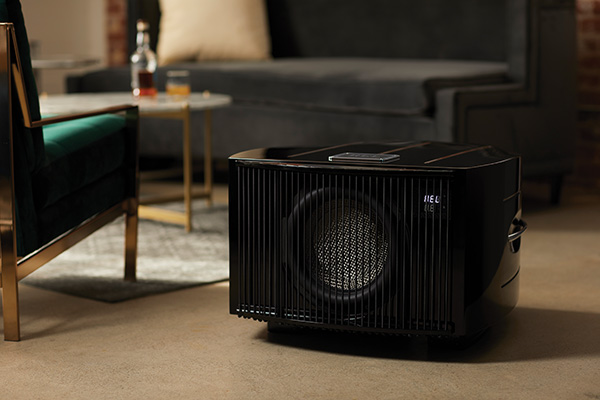
REL No.31 powered subwoofer
I have a love-hate relationship with subwoofers. They tend to bring out my tweaky alter ego. Perhaps one of these sorry personae lives within you too: the perennially neurotic Mr. Hyde to your more obliging Dr. Jekyll. Hyde is the tense, never-satisfied fault-sniffer who zeroes in on sonic details that are perhaps slightly off, even when other people in the room are enjoying themselves.
With subwoofers, he's at his worst. Did you hear that?, he'll exclaim when he worries that a low bass note received too much emphasis. He nags and niggles that perhaps the integration between the main speakers and the subwoofer leaves a crater somewhere in the low-frequency band. He harps, not always believably, that he can hear where the subwoofer is, even though deep bass is supposed to be impossible to localize. Most of all, he barely lasts a song without getting twitchy about the sub's gain setting, imagining that he has to dial in exactly the right amount of deep-bass presence with each track.
REL Studio III subwoofer
Makers of powered subwoofers fall into two camps: those that fit a high-powered amplifier and a single, large woofer into a relatively small, unobtrusive enclosure; and those that build two or more 10" woofers and an amp of moderate power into a larger, heavier enclosure.
Revel Ultima Rhythm2 powered subwoofer

Powerful, massive, and expensive, Revel's Ultima Rhythm2 subwoofer ($10,000) swept me off my feet when I first saw it in Harman International's suite at the 2013 Consumer Electronics Show. It outsizes, by 49 lbs and 2.6 cubic feet, Revel's previous flagship model, the Ultima Sub30, which I reviewed in the November 2004 issue. Its specs read like no other sub's: 196 lbs; 18" cast-frame woofer; dual 4" voice-coils; 4kW peak power from twin internal amplifiers that generate 1kW RMS; 115dB peak acoustic output; a fully configurable, high-resolution, 10-band parametric equalizer (PEQ); an internal crossover with high- and low-pass outputs; and PC-based setup via USB. The Rhythm2's patent-pending design is said to let just enough air move in and out of the cabinet to prevent any distortion-inducing pressure due to heating of the voice-coils. And its veneer, shape, beveled top edges, and bottom plinth exude the quality found in Revel's top-of-the-line floorstanding speaker, the Ultima Salon2, with which I was familiar.