

dCS P8i SACD player

There are components that stick in a reviewer's memory long after they have been crated up and entrusted to the tender mercies of UPS. When I reviewed the Verona">http://www.stereophile.com/digitalprocessors/305dcs">Verona Master Clock from English company dCS in March 2005, the sound it allowed the combination of a dCS">http://www.stereophile.com/hirezplayers/814">dCS Verdi transport, Purcellhttp://www.stereophile.com/digitalprocessors/454">Purcell; upsampler, and Elgar">http://www.stereophile.com/digitalprocessors/259">Elgar Plus D/A processor to achieve from SACD was the best I had heard from my system—better, even, than I remember getting from the EMM Labs SACD transport and processor I had borrowed for a weekend a few months earlier. But at what price? The stack of four dCS components adds up to a cool $45k—"Yes, the complete dCS system is hip," I wrote in the conclusion to my review. "But $45k's worth of hip? That's a question I can't answer, I'm afraid, what with school fees and mortgages and taxes." The megabux dCS stack thus had to go back to the distributor at the end of the review period.
dCS Puccini SACD playback system
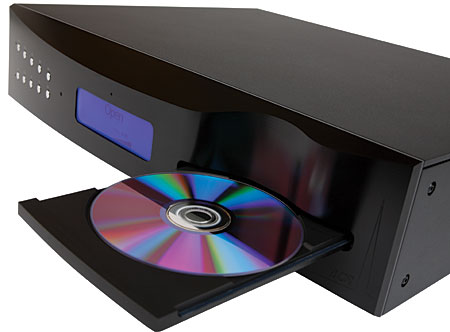
It's now 10 years since the launch of the two high-resolution audio disc formats, SACDhttp://www.stereophile.com/asweseeit/164">SACD; and DVD-Audiohttp://www.stereophile.com/asweseeit/1099awsi">DVD-Audio;. Yet, perhaps partly because both were hobbled">http://www.stereophile.com/asweseeit/257">hobbled in various ways to please the record industry, perhaps partly because too many supposed hi-rez releases sounded no better than CD, and perhaps partly because record retailers weren't sure how to display the formats to their best advantage, neither took off in any substantive way. DVD-A disappeared, and SACD survived only as a niche format for high-quality classical releases in both two- and multichannel forms. As we got deeper into the same decade, digital technology, despite various sparks and flashes, went into the doldrums. Mainstream digital technology was increasingly concerned with squashing the music into fewer and more portable bits, not with increased sound quality. Even the concept of "CD sound quality" began to seem an unattainable goal, as MP3">http://www.stereophile.com/features/308mp3cd">MP3 files became the dominant music carrier.
dCS Rossini Transport SACD/CD transport
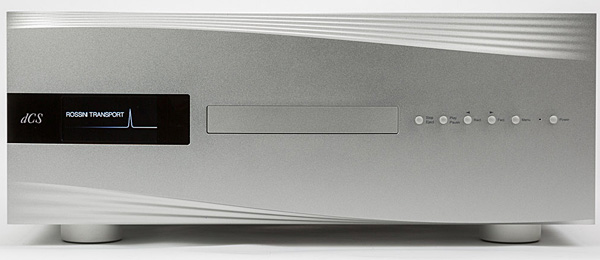
The good-sounding products that pass through a reviewer's system fall into three categories: those he liked but felt little sense of loss about when they were sent back to the manufacturer or distributor; those he loved and could afford to purchase; and those he loved but that were financially out of reach. The Rossini Player from British company dCS, which I reviewed along with the Rossini Clock in our December 2016 issue, was an example of this last category: the Player costs $28,499, the Clock $7499.
dCS Scarlatti SACD/CD playback system
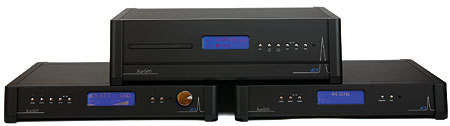
Is anyone in this economy shopping for a four-box, rack-swallowing, two-channel SACD/CD player contending for the state of the art and costing $79,996? dCS is betting that its Scarlatti will attract a small crowd of those wealthy music enthusiasts who, in any economy, reliably pony up for the best. For the rest of us, the Scarlatti will be a spectator sport.
dCS Verdi La Scala CD/SACD transport & Delius D/A converter

Giuseppe Verdi gave the world more than two dozen operas, some good sacred music, and one string quartet. He also provided the young Arturo Toscanini with one of his first big breaks—conducting the singing of "Va pensiero" at his burial procession—and gave the flagship consumer product from England's dCS Ltd. its name. That the latter two gestures were posthumous and unwitting does nothing to diminish their poetry.
dCS Verdi SACD transport, Purcell D/D converter, Elgar Plus D/A converter
Well into dCS managing director Mike Story's attempted explanation of upsampling, there came an epic moment when the ever-expanding universe of his thoughts—which we had been following to new heights of digital enlightenment—broke free of our collective grip, snapped back on itself, and caused a conceptual implosion of nearly cataclysmic proportions. The blank, spent expressions on the faces of the journalists gathered in the small attic-like meeting room at dCS's Great Chesterford (UK) facility all seemed to say, "What the hell was that? Was it just me, or did you feel that too?"
Esoteric DV-50 universal player

Ever since the introduction of high-resolution digital formats, audiophiles have been waiting for the smoke from the format wars to settle. What would the winning software be? DVD-Audio? DVD-Video? SACD? 24 bits at 96kHz or 192kHz? As new formats struggled to establish themselves, upconverting technology became commonplace for the playback of the familiar 16-bit/44.1kHz "Red Book" CD format. What to do? Invest large amounts of cash in a system that played "Red Book" (maybe with upconverting, but if so, by how much?) and one other format, and hope that you've bet right? And what about movies on them new-fangled DVDs, Tex?
Esoteric SA-60 universal player
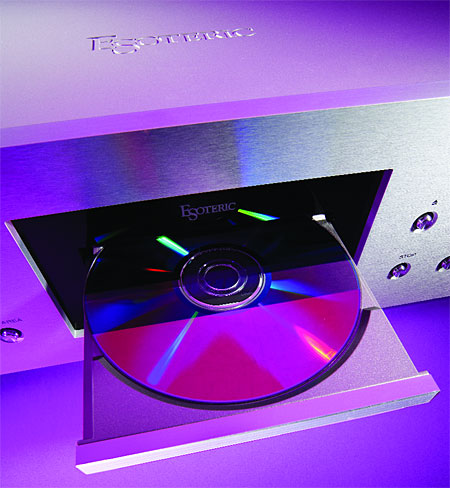
In the ongoing">http://www.stereophile.com/asweseeit/907awsi">ongoing debacle that has been the introduction and promotion of high-resolution digital audio and the record industry's struggles to engage the public's interest in it, two recent events stand out.
Krell Evolution 505 SACD/CD player

Spending $10,000 for a machine that spins CDs and SACDs may seem extravagant in an age when the latter format is pretty much dried up and the former seems headed there. But hold on—there are reasons for the Krell Evolution 505's five-figure price, and a payoff, too.
Krell SACD Standard multichannel SACD player

With the exception of dCS and Accuphase, you don't see anyone jumping on the bandwagon of $15,000-plus SACD players—and for good reason. Despite enthusiasm for the format within the relatively small audiophile community, high-resolution audio isn't exactly making waves on the front pages—or even the back pages—of the mainstream news media. And while ABKCO Records has sold millions of Rolling Stones hybrid SACD/CDs, and Sony is looking to repeat that phenomenon with the recent Dylan hybrids, what's being sold in both cases are CDs, not SACDs. The higher-resolution layer is simply going along for the ride.