

Lamm Industries L2 Reference preamplifier
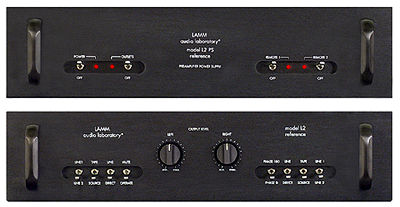
The L2 Reference sits at the top of Lamm Industries' preamplifier line. According to the manual, its "unique" circuitry uses specially selected, superlinear, high-voltage MOSFET transistors that ensure class-A operation from input to output, with no overall negative feedback at any stage. All stages, including the high-current output buffers, are single-ended.
Lamm Industries LL1 Signature line preamplifier
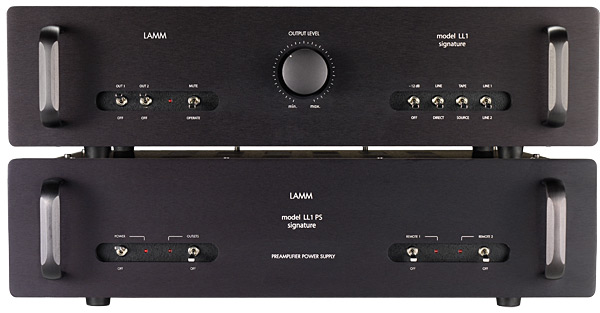
I've long been impressed by the design, construction, and sound of the tubed electronics produced by Vladimir Lamm, but I'd never had a Lamm Industries product in my house. So I asked for a review sample of Lamm's flagship line-stage preamplifier, the LL1 Signature.
Lamm Industries LL2 Deluxe preamplifier
On the first morning in June I opened all the windows in my listening room and played Classic Records' LP reissue of Dvorák's Cello Concerto (RCA Living Stereo LSC-2490), with Piatigorsky and the Boston Symphony Orchestra. The sunny weather put me in a fine mood, and so did the sound of my music system, which made me feel prouder than usual: Was ever a Linn record player more expertly adjusted? Wasn't I smart for keeping those Lamm monoblock amplifiers? Could a pair of Quads possibly sound better than mine?
Lazarus Cascade Deluxe preamplifier
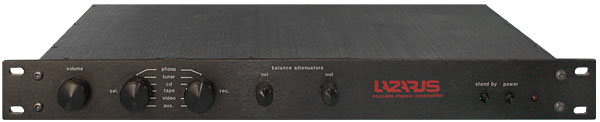
The Lazarus, a slim, quite elegant unit finished in black with red and gray legends, lived up to its advance billing: it literally rose from the dead! Out of its coffin (ie, shipping box) and plugged into the wall, it showed no signs of life. Troubleshooting revealed a blown AC mains fuse. That in itself was not a major problem, but what worried me was the root cause of the trouble. Preamplifiers as a rule are not power-hungry, so a current surge at turn-on sufficient to destroy the 250mA slow-blow mains fuse appeared symptomatic of a major circuitry failure.
Linear Tube Audio microZOTL2.0 line stage/headphone amplifier
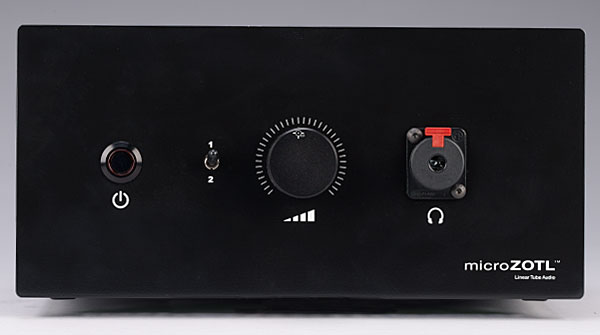
This is a true story about a surprising 1W integrated amplifiera push-pull, class-A, output-transformerless tube ampthat drove my DeVore Fidelity Orangutan O/93 speakers to 90dB average levels with grace, spiderweb detail, liquidity, andunbelievablya small degree of bass slam.
Luxman Classic CL-38u preamplifier
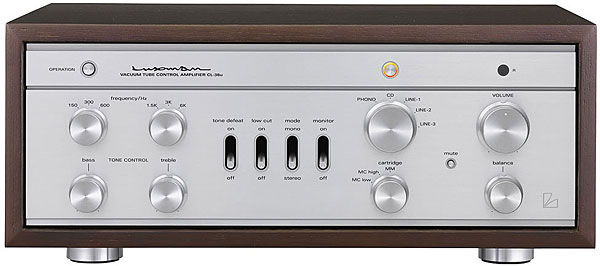
If you look at it from a distance and squint a little, Luxman's Classic CL-38u preamplifier ($4200) could almost be mistaken for that most classic of all classic hi-fi products, the Marantz Model 7C control center. The aluminum front panels of both models have, at their centers, a row of four distinctive toggle switches, flanked on each side by four control knobs. Even more noticeable are the stylish wood enclosuresstandard on the Luxman, optional on the Marantzwhich make both preamps appear ready for duty at the Playboy Mansion, ca 1963, or perhaps an appearance in a Life photo essay titled "At Home with Steve McQueen."
McIntosh C1000 preamplifier system

Still burning in my bank of childhood memories are misty images of the glowing green lettering on the McIntosh tube preamps and tuners that populated the windows of the audio stores that once lined lower Manhattan's Cortlandt Street. Leonard's and most of those other retailers are long gone—as are most of the audio brands that shared their windows with McIntosh, and that once symbolized the might of American innovation and manufacturing. Even the World Trade Center, the controversial complex that replaced Cortlandt Street's "Radio Row," where the hi-fi industry was born, is tragically gone.
McIntosh C12000 preamplifier

As I was talking with an audio-retailer friend recently, he reached for a Rolls-Royce metaphor to describe the McIntosh brand. Expensive? Sure, but not as expensive as some boutique high-end products. Fast? Sure, but there are faster thingsalso bigger things, smaller things, wackier things, and cheaper things.
But when you look at a Rolls or a Bentley, you immediately recognize it for what it is, and you want to sit down in it. And so it is with McIntosh, except you don't want to sit down in it; you want to sit down in front of it, between the speakers of the hi-fi system it occupies.
The C12000 is McIntosh's current flagship preamplifier. It's part of McIntosh's Hybrid Drive series of products that combine tubes and transistors in interesting ways.
McIntosh C2200 preamplifier
"It took long enough," as I said to Larry Fish and Roger Stockholm.
Miyajima Lab Wo-1 preamplifier
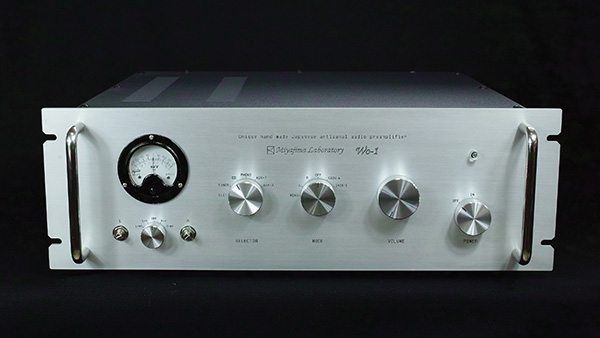
A phenomenon formerly unique to Japan, which in recent years has been emulated in cities around the world, is the jazz café (known as jazz kissa in Japan), where salarymen can find respite from their hectic lives, loosen their ties, and enjoy hi-fi jazz over coffee or a drink. Jazz kissaten are typically charming, smaller shops, traditionally furnished and paneled in beautiful wood, which serve superb artisan coffee in artful ceramic cups.
Such respect for artistry, craftsmanship, and attention to detailthe Japanese word is shokuninis reflected in many aspects of Japanese life. This is where you find double handrails to accommodate people of different heights, intricate, ornately designed manhole covers, and bento lunch boxes with hand-carved vegetable figurines. While upholding strict conformity to societal norms, the Japanese highly value creative individualism. This shokunin mindset underlies their reverence for artisanal expressionand their love for jazz.
Japanese audio, much like jazz kissaten, reflects the shokunin mindset: craftsmanship pursued with both pride and humility.