

Rega Apollo CD player

You've heard it said that the early bird catches the worm, which is all well and good if you like worms. If you're more interested in music, you might want to follow the lead of Roy Gandy instead: He's the managing director of Rega Research, a 331/3-year-old audio company that was the very last of its kind to enter the CD market. Rega's first CD player, the Planet of 1996, was a success in virtually every way.
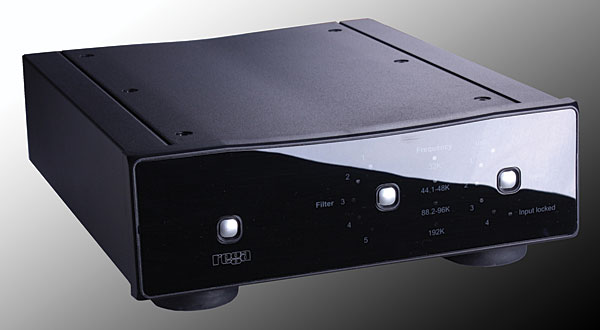
Rega DAC D/A processor
"We like to make things," Roy Gandy, Rega's founder and owner, once told me. "It's what we do." Or maybe it was Rega's chairman and chief engineering honcho, Terry Bateman. Rega products are designed and manufactured in the south of England. So far as I know, no one at the Rega facility, on the Temple Farm Industrial Estate, has committed suicide; the same cannot be said of workers at the factory in China where iPods are made. Al Gore is on the board of Apple. Al, what do you think?
Rega Mira integrated amplifier

The Rega Couple interconnect ($150/1m pair) comes in a plastic pouch rather like a Ziploc veggie bag—just the pouch and a printed card. How much could the packaging cost? Ten cents?
Rega P1 record player

For a word that first appeared in print only 35 years ago, prequel has a lot of impact—if only in a commercial sense. The television series Smallville has become a staple of American broadcasting. Film producers gambled millions on the chance that audiences would want to know what happened when Batman began. And while moviegoers have turned their backs on the apparently awful Hannibal Rising, the book of the same name is doing brisk business indeed.
Rega P3-24, RB301, & Elys 2 turntable, tonearm, & phono cartridge

It's now been eight years since a Rega P3 turntable passed through my listening room. While the new P3-24 superficially resembles the P3 (and virtually every other Rega 'table), the company has made some significant changes, including upgrading to the high-quality, low-voltage (24V), electronically adjusted motor used in the more expensive P5, P7, and P9. As in those models, an electronic circuit trims the phase angle of the P3-24's motor coils, thus substantially reducing motor vibrations. In 1998, during a factory tour, a Rega engineer demonstrated the circuit's effectiveness to me. As he adjusted the circuit board's pot, vibrations from the motor dramatically decreased, until it was difficult to tell if the motor was spinning or not. Back then, this "hand-trimmed" motor technology was available only in the P9. The P3-24 uses a less sophisticated version of the same basic idea.
Rega Planar 3 turntable

Among British turntables, there is the Rega Planar 3, which sells here for $550 (approximately double the UK price). I've owned a Rega for three years and know it well.
Rega Planar 5 & Planar 7 turntables
I saw it coming back in 1996. That was when Rega introduced their full-bore assault on the state of the art of record replay, the Planar 9 turntable. The P9 was and is a superb product, but because it sells for $3900—more than five times the price of the company's bread-and-butter model, the venerable Rega Planar 3—its introduction created an enormous price gap. And that's not to mention all the numbers between 3 and 9 that have languished for so long: How could you not expect Rega to fill in the blanks with Planars 4, 5, 6, 7, and 8?
Rega Planet CD player

At last—a CD player from a company that doesn't like CD.
Rega Research Brio integrated amplifier

"Looking back, my life's passions have mostly been sensual: food, females, fast cars, music, wine, sailing and skiing. My motivations, activities and work have stemmed from the need to fuel these passions rather than enjoyment of the process."
Who said this? John Atkinson? Art Dudley? Dr. Dre?
Rega RP-1 record player

I tried to name a high-end audio product that's been recommended more often than the Rega Planar 3 turntable. I failed.
The closest I could come was Rega's own RB300 tonearm, surely the best-selling perfectionist tonearm of all time. After that came the Rega Planar 2 turntable, a sample of which I owned and loved in the early 1980s. Next on my list was the original Rega Elys, a moving-magnet cartridge that sounded as chunky and direct as it was cheap and magenta.