

Listening #137
Except for a few titles I've combined with the ones in my listening room, and a few others that I intend to sell, the record collection I bought last year remains in three rows of boxes on the floor of our guest room. Because that room is spacious and comfortable, and equipped with a small refrigerator and a flat-screen TV, it is also the place where my 16-year-old daughter and her friends have their slumber parties and Dr. Who marathons. Thus, as you can imagine, I must sometimes explain to our young guests the Tao of collecting records.
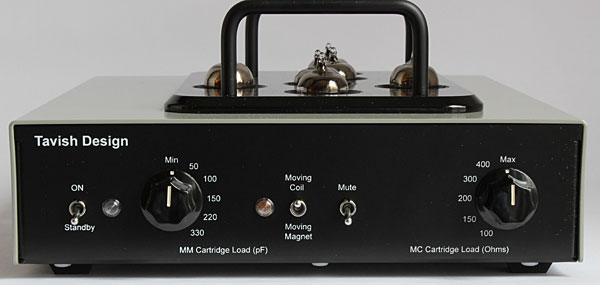
Listening #162: Tavish Adagio phono preamplifier
Though Westchester County, New York, seems a likelier locale for Bikram yoga studios, pet psychologists, and pricey restaurants specializing in "grain bowls" and fermented vegetables, the idea of manufacturing audio gear there is not without precedent. Cartridge manufacturer Micro-Acoustics (Elmsford, NY) thrived there for over two decades. George Kaye and Harvey Rosenberg's New York Audio Laboratories (Croton-on-Hudson, NY) assembled Moscode amplifiers there. Even the notorious loudspeaker manufacturer Fourier Systems (Yonkers, NY and Cocytus, Hell) got their start in the county that Hillary Clinton calls home, as needed.
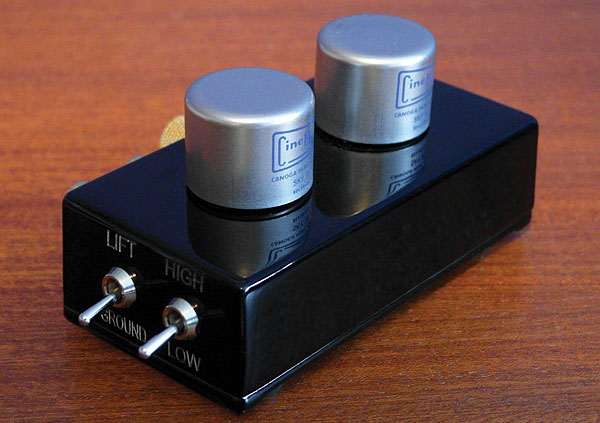
Listening #171: Bob's Devices Sky 40 transformer

In contrast with such line-level source components as DACs and CD players, record players generate a lower-voltage signal that requires extra gain from either a standalone phono preamplifier or the phono stage of another, more comprehensive component in one's systemtypically, a full-function preamplifier or an integrated amp.
But when the phono cartridge of choice is a moving-coil (MC) type, which generates even less voltage than its moving-magnet (MM) and moving-iron (MI) friends, even more gain is required. This presents the user with an additional choice: he or she can select from among the many standalone phono preamps that offer sufficient gain, or augment an existing phono or full-function preamp or integrated amplifier with a phono step-up transformer, which boosts gain passively, without using tubes or transistors.
Listening #176: MusiKraft Cartridge Bodies & EMIA Phono Transformer
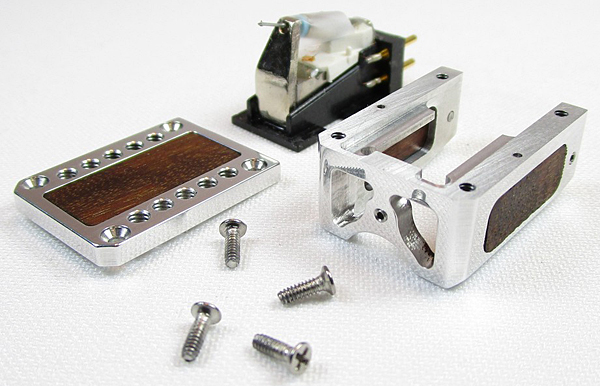
How can you tell a classic product from the hi-fi hoi polloi? One sure sign is when third-party developers spring up around the thing, offering parts and service intended to maximize its performanceor just to keep it on the road. Thus regarded, a few true classics emerge: Quad's ESL and ESL-63 loudspeakers. Altec's 802 and 806 compression drivers. The Linn LP12 and Garrard 301/401 turntables. The Rega RB-300 tonearm and its direct descendants.
Listening #195: Ortofon SPU Century & Grandinote Celio
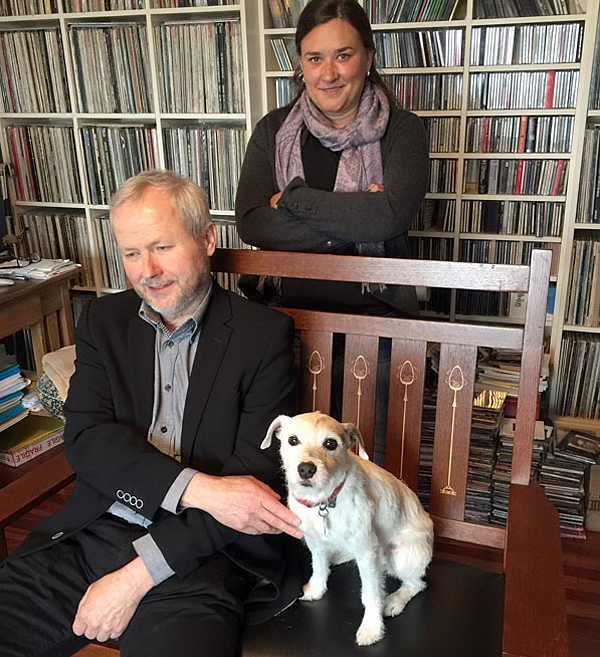
Easy pickup: Art’s Dog, Chatter, cozies up to Leif Johannsen of Ortofon A/S and Dee Hustinova of Ortofon USA. (Photo: Art Dudley)
According to the 2018 edition of the UN's World Happiness Report, Denmark is the third-happiest nation on Earth, trailing only its neighbors Finland and Norway.
I heard that yesterday afternoon, on NPR. The reporter even spelled out the word used by Danes to describe their feelings of happiness: hygge. Apparently, at present, Denmark is positively rotten with hygge.Listening #58
Is it my imagination, or has the low-power tube movement of the last 15 years gone hand in hand with a renewed interest in moving-coil step-up transformers? Trannies remain misunderstood or ignored by most of the audio press—requests for review samples continue to be met with genial shock, rather like tourism in the Budapest of the 1990s—but enthusiasm for the practice seems only to grow. That leaves me to wonder: Did the unquestioning use of active pre-preamps for so many years grow out of the same bad attitude that gave us all those awful-sounding high-power amps and low-sensitivity loudspeakers? You know the mindset: Parts are cheap. Gain is free. Do it because you can...
Listening #73
I was walking through the woods one day when I happened on a large, flat rock near the base of an old ash tree. Conditioned as I am from such rambles with my daughter, whose interest in wildlife echoes that of my own childhood, I bent down and lifted one end of the rock, hoping to catch a glimpse of some exotic creature or another: perhaps a delicate ring-necked snake, or a plasticky-looking red eft. The rock came loose without too much effort and teetered on its broadest edge, but before I could let it flip to one side, I recoiled in horror: There, amid the millipedes and ant larvae, was a cluster of teeny-tiny, nasty-looking old men, writhing in such a tangle that I couldn't even count them. They were bespectacled, to a one, and mostly bald—I could tell quite easily, despite the berets worn by some of them—and each pair of feet was shod in a teeny-tiny pair of off-brand Birkenstock copies, with thin, shiny black socks underneath.
Listening #90
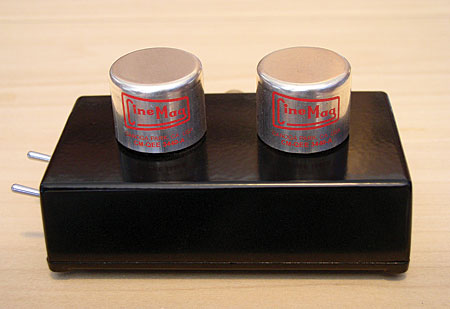
The best result of mathematics is to not need it.—Oliver Heaviside, 1850–1925
Luxman E-07 phono preamplifier
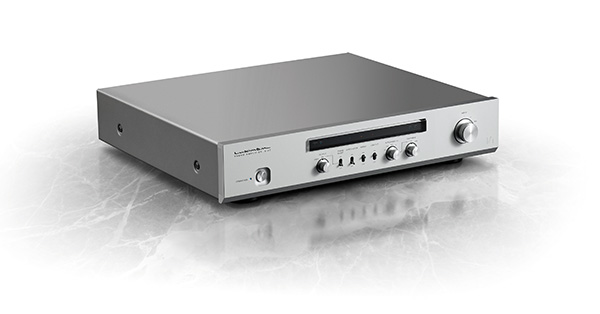
My DACs are taking naps. I have not played music from a digital source in at least 12 weeks. I'm having too much fun playing records from the '50s and '60s with period-correct phono cartridges and listening to 100-year-old 78s at the Hot Club of New York.
Luxman EQ-500 phono preamplifier
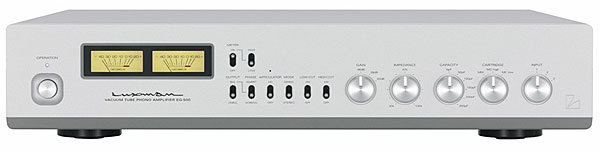
I still remember how difficult it was for me to transition from mass-market to high-end audio. The former, for all its flaws, gave me things to do: switches to flip, buttons to push, knobs to turn, meters to watch. I was in controland if my attention happened to stray from the music or the liner notes, I still had something to keep me busy. By contrast, the first perfectionist-quality amplifier I boughtan Amber Series 70was an oblong box with an on/off switch. Where's the fun in that?