

NAD M51 Direct Digital D/A converter
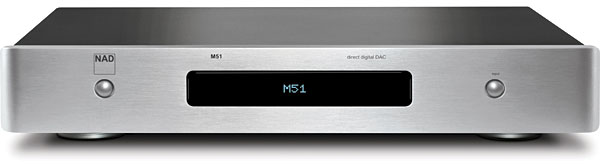
Who wants only a digital-to-analog converter when you can have a DAC with benefits? How about if those benefits also come with some high-resolution attitude?
That's what I pondered while setting up the NAD M51 ($2000). Sure, it's a basic DAC, but it also has extraslike HDMI inputs, remote-controlled volume, a polarity switch, and one of my favorite features on any DAC: a display that tells you which sampling rate the thing is locked to.
NAD M66 streaming preamplifier
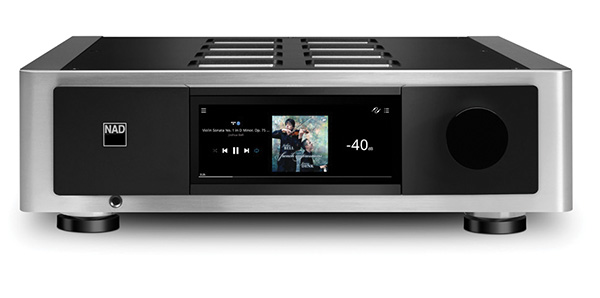
In my early years in audio, I witnessed the rise and fall of the AM-FM receiver, first in vacuum tube mono and later in solid state stereo. Some of them grew to be behemoths, supporting multiple inputs, equalizers, dual speaker zones, and powerful amplifiers. When radio sources receded in popularity and with the rise of CDs, cable TV, and DVD, radio receivers were replaced by A/V receivers in the mainstream market.
Today, the ascension of streaming as the conduit for both audio and video content has nudged these, too, from the center stage. One can stream content from the bewildering variety of products with internet access including cell phones, smart TVs, almost any computer, and of course, dedicated streaming devices from the cheap-and-cheerful to seriously audiophile. If your music is on the web or on a NAS, many of these will let you browse for it, find it, and play it.
Nagra DAC D/A processor
Without having intended to, I seem to have collected several "statement" products. I've already reported on the Weiss">http://www.stereophile.com/digitalsourcereviews/781">Weiss Medea and Theta">http://www.stereophile.com/digitalsourcereviews/204theta">Theta Digital Generation VIII digital-to-analog converters. I saw and expressed interest in the Nagra DAC at the 2002 Consumer Electronics Show, when prototypes of it were shown along with a forthcoming multichannel version, the Nagra Digital Audio Processor (DAP). The two units are based on the same chassis and interface, the DAP including additional modules and processing.
Okto dac8 Stereo D/A processor
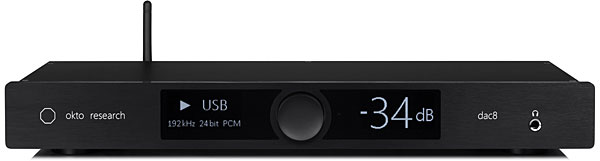
For his review of the Pink Faun 2.16x music server in the December 2020 issue, Kal Rubinson needed to use a Linux-compatible multichannel D/A processor. A little Googling uncovered the 8-channel dac8 PRO from Okto Research in the Czech Republic, so Kal borrowed one from the manufacturer. He found it to be a great-sounding DAC with an intriguing feature set. He purchased the sample.
Okto Research dac8 PRO D/A processor

For a couple of years, I have been following Prague-based Okto Research. At first, Pavel Krasensky, the founder and hardware developer, offered audio design ideas and DIY modules that I found tantalizing. For example, there was a dandy-looking ESS 9038Pro Sabrebased output module and some appealing power supply modulesbut to use those, the buyer had to manage inputs and integration on their own.
Then, finally, last year, Krasensky released the dac8 PRO, an 8-channel D/A processor with USB input and output, 8 channels of AES/EBU input, and 8 channels of balanced (XLR) analog output as well as a headphone output.
Parts Connection Assemblage DAC-1 D/A converter kit

"Dinner's fried chicken, honey."
Peachtree DAC•iT D/A converter
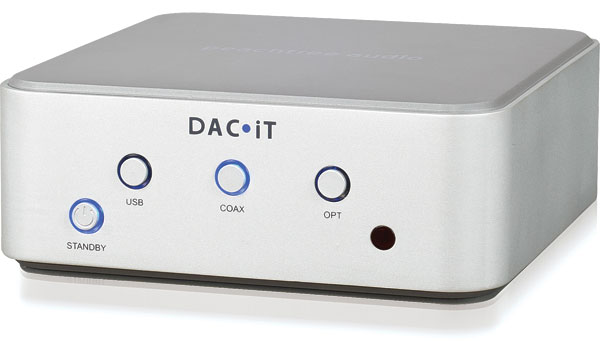
It's common knowledge that manufacturers tune the sound of each DAC model. There are the facts of product design and marketing: inputs, outputs, case materials, price points. After that, what's left are the trade-offs of different circuit designs and filter options, which are chosen with careeach has a subtle yet telling effect on a DAC's sound. Most designers try to go from bits to analog with minimal deviation from perfect. But when you look at the measurements and listen closely, you realize that perfect is elusive. One has to make choices.
Peachtree iDac D/A converter
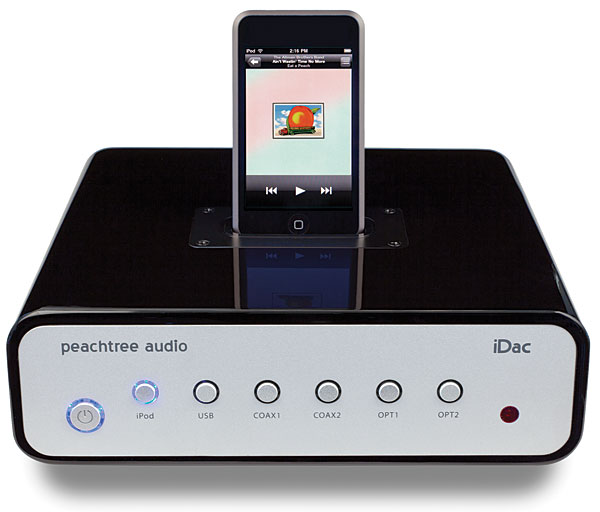
Oh boy, another new DAC review. Some folks think DACs, once you get past the features, all sound pretty much the same. I mean, it's just digital. Well, they're right. Pretty much. Just as two new cars of a particular make, model, color, and options package both look the same, sitting there on the lot.
But if you discover a ding in the door of one of them, where most folks still see only a new car, you now see the ding. It might have been there all along, undetected the first few times you walked around the carmaybe your buddy even had to point it out to you. It's insignificant in the scheme of all that a new car is, but once you've seen it, you always see it. Now you can easily tell the two cars apart, and we both know which one you'll drive home.
Perpetual Technologies P-1A D/D & P-3A D/A processors
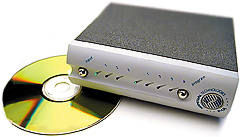
At the Consumer Electronics show in Las Vegas in January 1999, Mark Schifter, erstwhile president of Audio Alchemy, was handing out a press release announcing what seemed like a groundbreaking product from his new company, Perpetual Technologies. The product was the P-1A, a digital-to-digital processor that would do resolution enhancement, loudspeaker correction (amplitude and phase), and room correction—all for less than $1k. It sounded too good to be true.
Prism Sound Callia D/A headphone amplifier
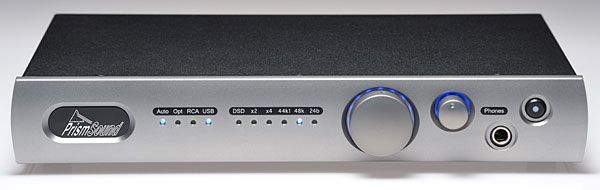
I have long been aware of English audio company Prism Sound, both from my use at the turn of the century of their excellent PCI cardbased DScope2 measurement system (footnote 1), and from some of my friends' enthusiasm for Prism's SADiE digital audio workstation. Prism Sound was founded in 1987 by two DSP engineers, Graham Boswell and Ian Dennis, who had first met when working at mixing-console manufacturer Rupert Neve, in Cambridge, England. From the beginning, Prism Sound operated exclusively in the world of professional audio, but a year or so ago I began seeing their first domestic audio product, the Callia, at audio shows.