

Fine Tunes #46
"Hi, Jonathan," Bob Matthews began his e-mail to "Fine Tunes" (matthewsr@hqamc-exchg.army.mil). "I enjoy reading your column every month, and enjoy hearing from other people about some of their cheap tweaks!"
Fine Tunes #47
Sometimes tweaks take on a life of their own. Take the one of using Armor All to keep speaker surrounds from drying out, which you can read all about in the November 2001 "Fine Tunes No.41" I recently got another e-mail on the subject from Dan Mazza at Arizona Hi-Fi, who agrees with Mark Gdovin's objections to using Armor All. (Read Mark's comments on the entire issue in the readers' letters linked to "Fine Tunes No.41.").)
Fine Tunes #48
In his first e-mail to "Fine Tunes," Rafael Teodoro (RBT@wolfenet.com) addressed a subject that Mark Gdovin, that faithful frequenter of the Stereophile soapbox, had already brought up. Mark had gone so far as to give readers sage advice from his brother, a materials engineer, regarding the dangers of applying Armor All to speaker cones and surrounds.
Fine Tunes #5
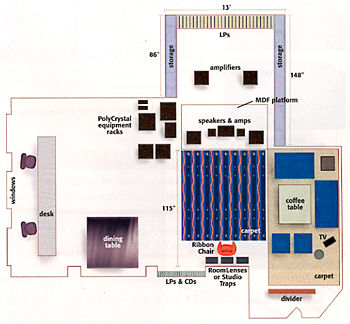
I've touched on loudspeaker placement in irregularly shaped rooms several times in the last few "Fine Tunes," but reader Peter Machare (Peter.MACHARE@usda.gov) wants more information about setting up L-shaped and other nonstandard listening areas. Here's how he describes his layout: "I have an L-shaped room. The speakers are at the bottom of the L and point up the long part of the L. Not all of us are perfect rectangles, you know."
Fine Tunes #6
One audio maintenance chore I dislike is getting down on all fours and cleaning the system's connectors—interconnects, speaker cables, and power cords. It's tedious, but the results can be spectacular. If you live in a relatively clean, dry environment, you might consider doing it every six months or so.
Fine Tunes #7
Let's talk cable dressing. Make mine vinaigrette! (And you thought I'd go for French . . . ) Cable dressing is actually a rather delicate issue that requires a certain leap of faith. The concept is so simple that even I can explain the science to you. But the leap occurs when you realize how the positioning of cables and interconnect can make a real difference in the sound of your system. In spite of this, I've seen power cords and interconnects tangled up in a hopeless mess at the back of some pretty serious components.
Fine Tunes #8
Bill Gates would have you believe we live in a plug'n'play world. Apple has proselytized same since day one. But I'm here to tell you it just isn't so for high-end audio. The orientation of a component's AC plug—even the quality of the wall receptacle itself—affects the sound! Oh no, Mr. Bill, not something else to futz with! Will it never end?
Fine Tunes #9
Okay, let's return to the power grid. In the February installment of "Fine Tunes", we learned that typical domestic 110V AC supplies are derived from that 220V transformer out on the pole. The center-tap 110V supply is unbalanced, but if you take 220V service, you're getting balanced power. One thing you can do is take 220V down to 110V with a step-down transformer. George Cardas swears by it. He's also experimenting with a Statpower Technologies Prosine 1000 Full Square Wave Converter hooked to a big mutha battery to power his front-end components.