

Magico QPods
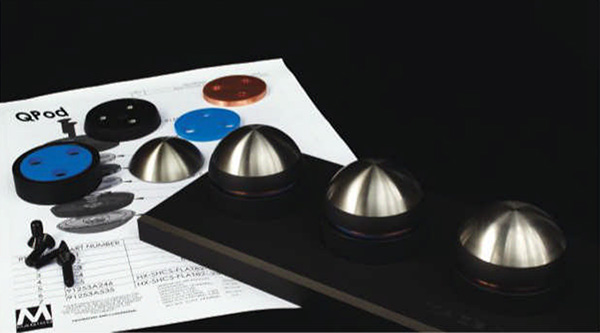
Audiophile young'uns, there actually was a time when cones and pucks and other under-gear accessories we now take for granted did not exist. Then, in the early 1980s, the Mod Squad's Steve McCormack developed and introduced Tiptoes.
Nordost QNet network switch & QSource linear power supply
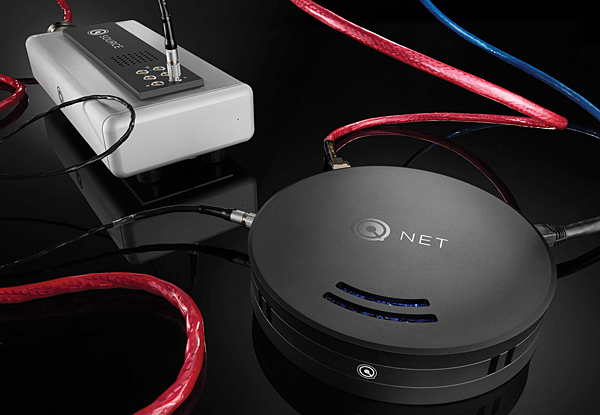
"A switch? Why do I need a switch?" That was my response to Meredith Gabor, head of marketing and PR for cable and accessories manufacturer Nordost, after she dropped the news. She had just arranged with Jim Austin for me to write a shorter, "ancillary" review of the new Nordost QNet Network Switch ($3199.99) with its optional QSource linear power supply ($2749.99) and premium QSource DC umbilical interface cables ($339.99 for 1m). Why did I need an expensive QNet switch when my router was functioning reliably? Good question.
Nordost QNet7 reclocking network switch
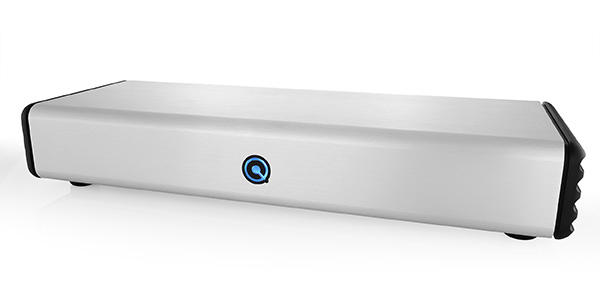
In the opinion of this hi-fi reviewer, the debate over the efficacy of audio-quality network switches should be over. As logic would dictate, when connections are made via a network switch, the quality of its inputs, outputs, oscillators (clocks), power supplies, and pathways affects the sound of everything downstream. It's clearly audible. Everything matters.
Revox A-77 open-reel tape recorder
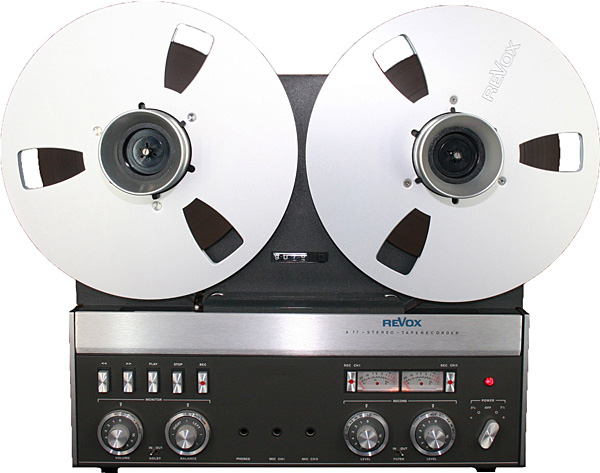
The Revox A-77 has extremely good speed regulation, vanishingly low wow and flutter, very low noise, superb tape handling, and the smoothest, widest-range frequency response of any recorder we have ever tested.
The portable version, with built-in monitor amps and speakers, is very compact for a machine with 10½ reel capacity, and is easily carried by one person. Now that the later version is equipped with a flutter-filtering tension arm, our only criticism of the A-77 is its use of three-circuit jacks for the micro phone inputs instead of the XLR-type receptacles that are considered to be "standard" in the US for on-location audio recording.
Revox G-36 open-reel tape recorder
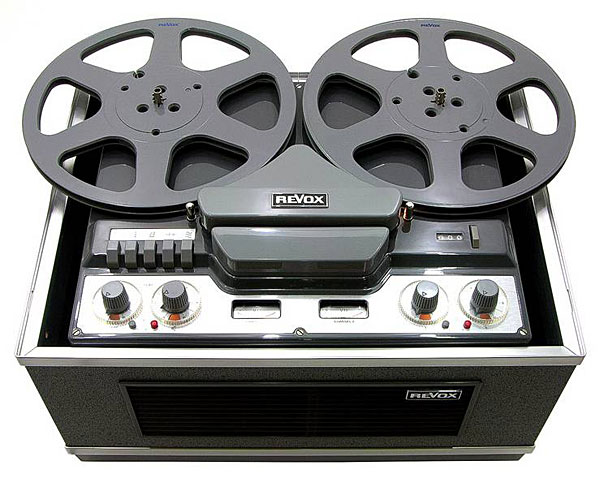
The Swiss-made G-36 recorder had earned an enviable reputation among perfectionists during the few years that it has been available in the US, and our inability to test one (because of a backlog of other components for testing) became increasingly frustrating to us with each glowing report we heard from subscribers who owned them. Now that we have finally obtained one through the courtesy of ELPA (footnote 1), we can see what all the shouting was about, but we also have some reservations about it.
Rocktron CS 5.2.5 Circle Surround decoder

Editor's Note: Published in 1998, this was the final review written by Stereophile's founder, the late J. Gordon Holt in the 37 years he was associated with the magazine. In it he expounds on his passion for experiencing recorded music in surround sound. Our continuing focus on two-channel products and recordings was one of the reasons Gordon eventually resigned, in August 1999.John Atkinson
Silent Angel Bonn NX network switch
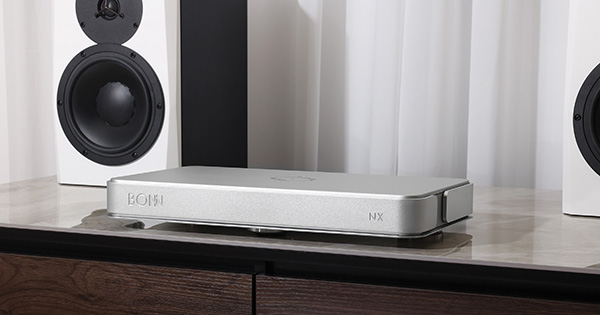
With every passing season, a new audiophile-grade network switch hits the market. These products, which can cost hundreds or thousands of dollars, do the same basic thing as network switches bought at Best Buy for $30 or so (except, in some cases, slower), but their manufacturers claim they are built to a higher standard to achieve better sound.
As with all signal-conditioning devices that operate completely in the digital realmespecially those that work at packet level (more correctly referred to as "frame-level" on the local side of the router, but that's a distinction that even few experts make)the sonic efficacy of audiophile network switches is debated, the debate being, as usual, mainly between those who insist they hear a difference and those who insist, on theoretical grounds, that no difference is possible.
Sony DTC-2000ES DAT recorder

Introduced nearly eight years ago as the first recordable digital format for consumers, DAT both failed to appeal to its target market and was blocked from formally entering the USA for four years by the RIAA, who feared for the copyright of its members' recordings. However, the DAT medium was enthusiastically snapped up by professionals and semiprofessionals, who found its combination of reliability, CD-compatible signal format, and editing ease ideal for mastering. Sony currently offers a small range of consumer models, from the diminutive Walkman-sized TCD-D-7 DATMan to four-head cassette-decksized machines for the so-called "prosumer": amateur recordists who make pin money taping local concerts. The DTC-2000ES is Sony's latest entry (footnote 1).
The Mod Squad Tiptoes

Photo: "Still Life with Tiptoes"John Atkinson
Memorandum:To: Steve McCormack, Chief Designer, The Mod Squad
Dear Steve: I cannot question the general value of Tiptoes in many specific applications. There are a great many areas where I, many other audiophiles, and a number of leading manufacturers have found that Tiptoes can improve any audio system in which the components are subject to. mechanical or acoustic vibration from speaker soundthat is, virtually any audio system.
Tice R-4 TPT & Coherence ElectroTec EP-C "Clocks"
Lars recently received a device that looks and works like a $25 digital alarm clock and is said to subtly improve the overall sound of one's system. It's the ElectroTec EP-C, from a company called Coherence Industries.