

Acoustic Geometry Curve System room treatments

For a few weeks each year in the high summer of Minnesota, the corn sold from rickety roadside stands is so sweet and tender it is best eaten unadorned. For the wise and lucky nibbler willing to forgo condiments, the rewards of eating these naked kernels are the pure taste of Midwestern soil and sun transformed into a juicy, golden confection. I've begun to wonder if the yearly encounter with this magnificent and ephemeral sweet corn reminds Midwesterners of the joys of simplicity and plainness. Though my hypothesis is a stretch, it sure would explain a great deal about the Midwestern mentality. Perhaps Midwesterners subtly learn from this corn that if we get too fancy or try too hard, we can often screw up what nature has already made perfect. Conversely, we learn that no amount of fancy accoutrements will make a bad ear of bland, mealy corn come alive in the mouth.
Acoustic Sciences Corp. Tube Traps
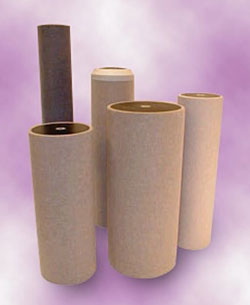
In my rather jaded report">http://www.stereophile.com/asweseeit/the_1986_winter_ces/">report from the 1986 Winter CES (Vol.9 No.2), I remarked that there was nothing really new in the field of high-end audio. Well, I was wrong. I overlooked the Acoustic Sciences Corporation Tube Traps, a patented new acoustic device designed by Arthur Noxon (president of ASC). The Traps represent the first practical and effective solution to a perennial audiophile problem: standing waves in the listening room.
Acoustic Sciences Corporation Studio Traps
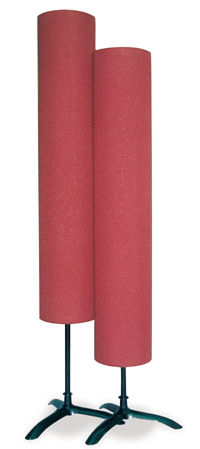
Over time I've successfully used a variety of tuning devices to refine the acoustics in Kathleen's and my listening room. But I've always suspected that Acoustic">http://www.stereophile.com/accessoryreviews/215">Acoustic Science's Tube Traps might be a good way to finish it off. I've occasionally asked visitors to stand in one spot or another behind the speakers as I listened for tergiversation (ie, "to change one's tune"; Hoo-hah!). I found several locations where a nice, dense audiophile body made an improvement to the sound.
Echo Busters Decorative Room Treatments

One of the biggest challenges in setting up any new listening room is getting the room to work with your equipment rather than against it. I faced this challenge in spades when Trish and I moved into our dream house in the California hills. What would serve as my listening room was a wonderful, open space with panoramic views of the surrounding hills—a space that bore no resemblance at all to a traditional, rectangular, dedicated listening room. Instead, there was a wall of glass, a huge marble-and-glass fireplace, a 20' ceiling—and did I mention that it isn't actually a "room," but one arm of a continuous flowing space?
IsoAcoustics Gaia loudspeaker isolation feet
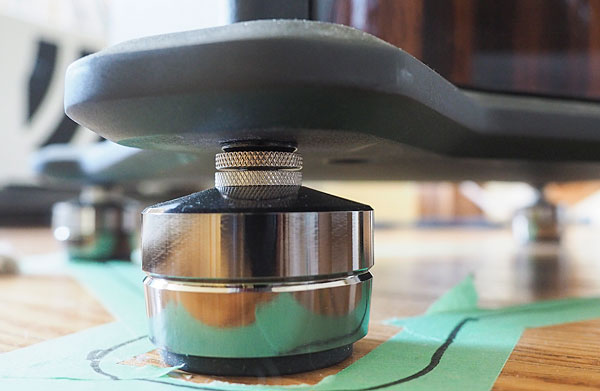
IsoAcoustics Inc. has its head office in Ontario and its manufacturing facilities in China, and is headed by Dave Morrison, who for 20 years has been involved in designing radio and television studios for the Canadian Broadcasting Corporation. The IsoAcoustics products are the result of this experience. Although relatively new on the consumer-audio market, IsoAcoustics' speaker-isolation products have gained wide acceptance in pro audio; their client list of recording and mastering studios includes Blackbird (Nashville), Mastering Palace (NYC), Flux (NYC), United Recording (LA), the Boston Symphony Orchestra, Skywalker Ranch, and Abbey Road.
Nucore Cathedral Sound Room Treatments
One of my favorite Charles Rodrigues cartoons, originally published in Stereo Review and reprinted in the book Total Harmonic Distortion (Perfectbound Press, 1988), shows a customer in the soundroom of an audio dealer, auditioning a pair of speakers. This is no ordinary soundroom: the floor, walls, and ceiling are completely covered with irregularly shaped boxes, apparently an extreme form of acoustical treatment. The salesman is saying, "Of course, you realize that it won't sound exactly the same in your living room, sir..."
Phantom Acoustics Shadow active low-frequency acoustic control
The acoustic environment for music reproduction is easily the most overlooked source of sonic degradation. Many fine playback systems are compromised by room-induced anomalies that severely color the reproduced sound. When we live in a world of directional wire, high-end AC power cords, and $4000 CD transports, paying attention to the listening room's contribution to the musical experience takes on greater urgency.
PSI Audio AVAA C20 electronic bass trap
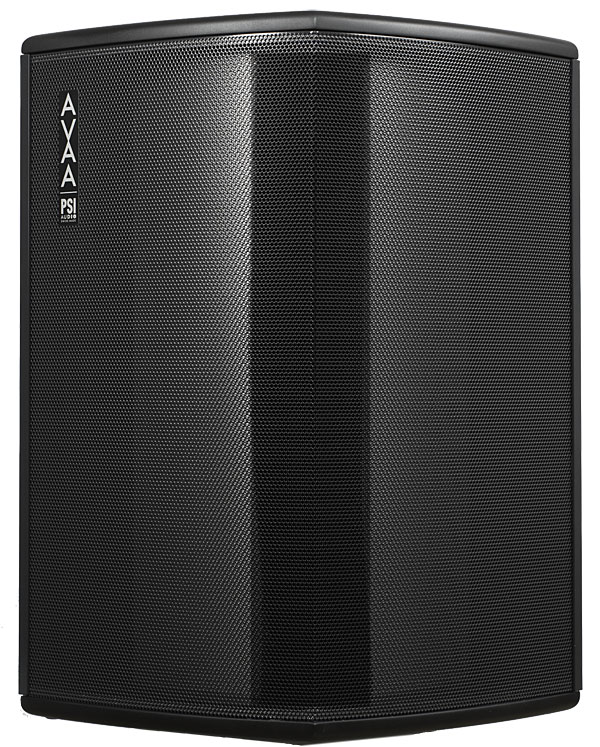
"Bassthe final frontier," declared Captain James T. Kirk. I have no doubt: The biggest problem in nearly every listening room is getting the bass to sound right. Today, we voyage to the frontier of bass response.
A Brief History of Time
Because my listening room is also a mastering room, it has to be as accurate as possible (see photo 1). The floor is a concrete slab, with solid-block wall construction and a cathedral ceiling 23' high at the rearthere are no floor-to-ceiling resonances. A bay window hidden behind the curtains disperses the lengthwise room mode by varying it between 18' and 20.6'. The curtains tighten the stereo image and damp the subtle resonant chamber that would otherwise color the sound.
Because my listening room is also a mastering room, it has to be as accurate as possible (see photo 1). The floor is a concrete slab, with solid-block wall construction and a cathedral ceiling 23' high at the rearthere are no floor-to-ceiling resonances. A bay window hidden behind the curtains disperses the lengthwise room mode by varying it between 18' and 20.6'. The curtains tighten the stereo image and damp the subtle resonant chamber that would otherwise color the sound.
PSI Audio AVAA C214 active bass trap
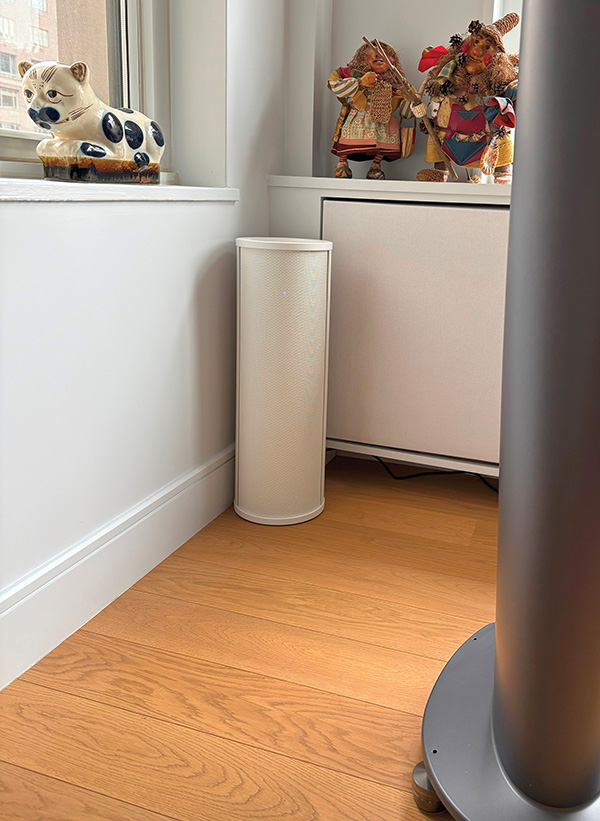
Ever since I became interested in—nay, obsessed with—high-quality music reproduction, my goal has been to attain the experience of being at a performance. Some audiophiles target the recreation of the event in their room—a "they are here" experience.
RealTraps MondoTrap room acoustics treatment
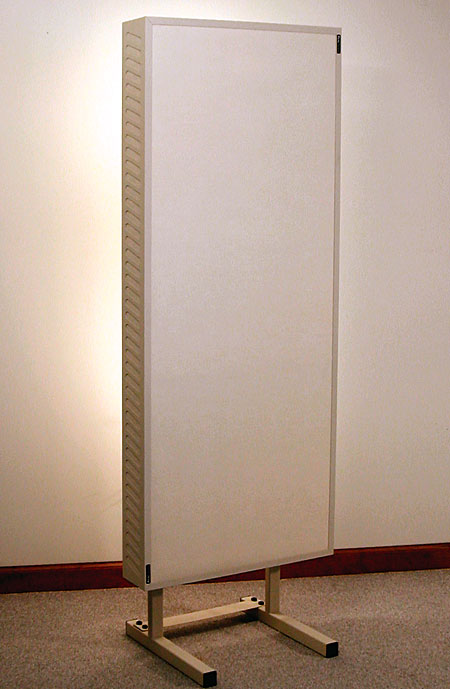
For a hobby based on science and technology, audiophilia has more than its share of unscientific elements. That's not necessarily a bad thing; not all of those elements are obvious snake oil, and there's more than science to creating—or re-creating—a musical experience. Still, for the more technical-minded it's a little disconcerting that even the most basic distinctions, such as why two CD players sound different from each other, are hard to explain using technical measurements and simple scientific concepts.