

ESP Loudspeakers Returns
Back in the 1990s, I lusted mightily for the large ESP speakers with their tall, slim shapes and their angled driver panels. A large-room demo of the Concert Grands with Sonic Frontiers electronics still reverberates in my memory. Unfortunately, just as I evolved to the point where I could consider buying a pair of Concert Grands, the company folded its tents. Recently, I heard a rumor that ESP might be returning, and an email exchange with founder and designer Sean McCaughan has confirmed the good news.
Essential Audio Hosts Aurender & Bricasti Design

Sunday, February 23, 125:30pm: Essential Audio (715 Braeside Place, Barrington, Illinois) will host an audio demonstration with Brian Zolner, president of Bricasti Design, for the grand opening of its remodeled, expanded facilities.
Estelon's Major Statement: The Extreme Loudspeaker
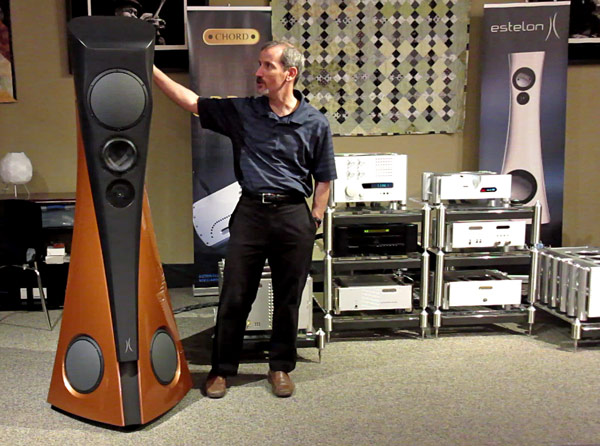
Extreme, perhaps, in size6'10" when fully extendedand certainly in price ($260,000/pair US price), the Estelon Extreme loudspeaker has arrived at its exclusive US dealer, Audio High in Mountain View and Los Angeles, CA. The brainchild of Estonian designer Alfred Vassilkov, 56, who describes it as the culmination of 30 years of research, each loudspeaker, pictured above with Audio High's Michael Silver, weighs 551.16 lbs (250kg).
Etown Pulls the Plug; Workers Locked Out
Consumer electronics site Etownhttp://www.etown.com/">Etown; has become the latest victim of the dot-com bust, dismissing its entire workforce of approximately 100 people in New York and San Francisco. The company had run out of money, according to chief executive Robert Heiblim. Etown, operated by Collaborative Media, Inc., has transferred its remaining assets to electronics retailer Best Buy, Inc. of Minneapolis, a major investor. The site was still active as of Sunday, February 18; whether Best Buy will simply shut it down or use it as a sales organ isn't known at present.
Etymotic Research Cuts the Cord
On November 7, Dr. Mead C. Killion, founder and president of Etymotic Research, invited Stereophile to experience the company's newest in-the-ear high-fidelity earphone, the ety-8. What was so special about these half-ounce 'phones? No wires—the ety-8's are the industry's first and only in-the-ear, high-accuracy, noise-exclusion earphones.
EU Commissioners Investigating CD Price-Fixing
Price-fixing by major record labels isn't confined to the United States. The music industry's "Big Five" (Universal Music, Sony Music Entertainment, Warner Music Group, EMI Group PLC, and the Bertelsmann Music Group) are now under the scrutiny of European Union antitrust investigators, who are looking into the possibility that the companies may have colluded to keep CD prices artificially high in Europe. The Federal Trade Commission (FTC) and music industry agreed to settlehttp://www.stereophile.com/news/10744/">settle; the American version of the issue in May 2000.
EU: No EMI for Time Warner
Citing the potential danger of "collective dominance" of the music business, European Commission members have nixed the proposed merger of American media conglomerate Time Warner and British music-industry powerhouse EMI. The $20 billion joint venture may still have some small chance at a future, provided the companies make further concessions to allay fears of monopolistic control of music prices in Europe.
Europe Gets More Protection
Maybe it's because those Yanks are so contentious, but it appears that most of the initial CD copy-protection activity is taking place in Europe (see previoushttp://www.stereophile.com/news/11113/">previous;). Last week, Phoenix, AZ–based SunnComm announced that it has reached an agreement in principle with Sonopresshttp://www.sonopress.de">Sonopress; of Germany for implementation of its MediaCloQ technology in manufacturing facilities located all over Europe.
European Commission Looking into MusicNet, Duet
The European Commission isn't especially fond of joint ventures by international media conglomerates. Last year, the EC successfully squashed a proposed merger of EMI and Warner Music Group on the grounds that WMG's parent company, AOL Time Warner (then simply Time Warner), combined with the UK's biggest name in music, would create "a virtual monopoly" of the European music market. A few months later, merger discussions between EMI and Bertelsmann Music Group (BMG) similarly went nowhere. EC investigators also looked into price-fixing in the European CD market early this year.
European Court Annuls 2004 Sony-BMG Merger
Even though the European Commission okayed the merger of Sony and the Bertlesmann Music Group (BMG) in 2004, Europe's second-highest court—the Court of First Instance—annulled the merger on July 13. The decision came about because of a challenge from independent record labels that claimed the EU regulators shouldn't have approved the merger in the first place. This is the first time a European Commission decision has been overturned and it requires the commission to examine the complex merger again.