

Miles Davis at Newport, 1955–1975
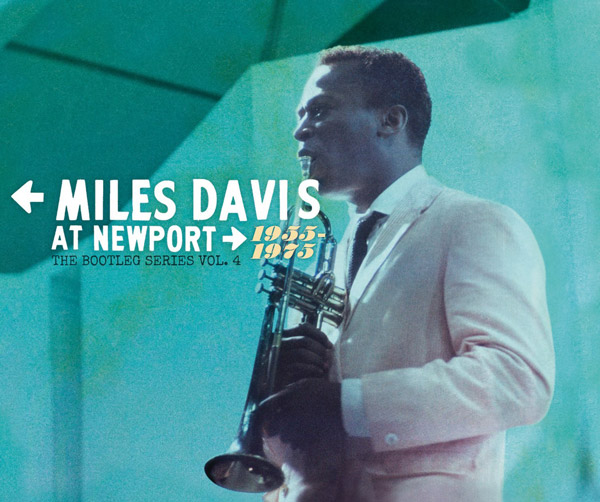
News of yet another boxed-set of previously unissued Miles recordings never fails to zap the juices of anticipatory pleasureand Sony's vaults, in particular, hold a lot of them. The latest, The Bootleg Series, Vol. 4: Miles Davis at Newport, 19551975 (Columbia Legacy), contains four CDs chronicling eight sessions from his appearances at the Newport Jazz Festival.
That's It!
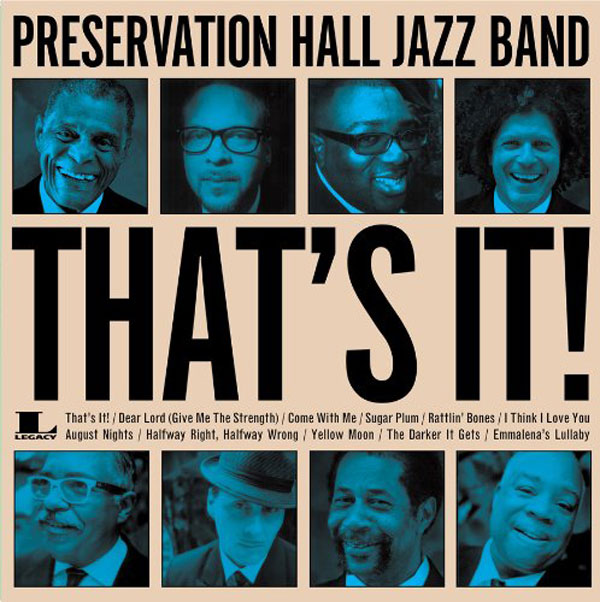
That's It! (Sony Legacy) is a hell of a fun album: the Preservation Hall Jazz Band, the treasure of New Orleans music, wailing with cylinders wide open.
Purists might protest. All the songs on this record are new (a first for the PHJB), and the solos tend more toward R&B riffs than trad-jazz polyphony. In short, the vibe seems to pulse more from the rowdy late-night clubs up on Frenchman Street than the band's usual stately sanctuary in the heart of the French Quarter.
The Blues and the Abstract Truth at 45
With Analogue Productions’ new 45 rpm vinyl pressing of Oliver Nelson’s The Blue and the Abstract Truth, we finally have a reissue of this great album that’s worth buying.
The New Standard (and Joe Ferla's last thing)
Joe Ferla is the preeminent jazz recording engineer of our timeor, I should say, was, as he recently decided to retire from the profession, after more than 42 years and nearly 400 albums, to run his attention to playing guitar. (I haven't heard him do that, but I hope he's good.) His last-released album, The New Standard, is out on CD and double-LP on the Rare Noise Records label, and it stands not only as another specimen of superlative sonics but also Ferla's return to analog.
The Shape of Jazz to Come in 45rpm

A little over two years ago, I raved in this space over Rhino's 180-gram vinyl pressing of Ornette Coleman's 1959 album The Shape of Jazz to Come, one of the greatest and most important in all of jazz. Now I'm here to rave louder still (with one frustrating caveat) about another reissue, mastered by Bernie Grundman at 45rpm for the audiophile label ORG.
The Shape of Jazz to Come on Rhino vinyl
 The folks at Rhino Records have just released a 180-gram vinyl reissue of The Shape of Jazz to Come, Ornette Coleman’s groundbreaking (and still riveting) album of 1959, mastered at RTI from the original stereo tapes. It sounds in every way better than the original pressing, which itself sounds quite good.
Everything is clearer, highs are extended, bass is more defined, dynamics are wider. Ornette’s white plastic alto sax has more of that palpable whoosh through the reed and horn. Don Cherry’s pocket trumpet has an airier mouthpiece. Charlie Haden’s bass—you can hear the wood vibrate. And Billy Higgins’ drum set has more sizzle and snap.
The folks at Rhino Records have just released a 180-gram vinyl reissue of The Shape of Jazz to Come, Ornette Coleman’s groundbreaking (and still riveting) album of 1959, mastered at RTI from the original stereo tapes. It sounds in every way better than the original pressing, which itself sounds quite good.
Everything is clearer, highs are extended, bass is more defined, dynamics are wider. Ornette’s white plastic alto sax has more of that palpable whoosh through the reed and horn. Don Cherry’s pocket trumpet has an airier mouthpiece. Charlie Haden’s bass—you can hear the wood vibrate. And Billy Higgins’ drum set has more sizzle and snap.
The Thelonious Monk Quartet: The Complete Columbia Studio Albums Collection

In a sense, I understand why Thelonious Monk's albums on Columbia, recorded between 1962 and 1968, have been neglected. His earlier sessions, on Blue Note, Prestige, and Riverside, were the ones where he introduced his classic songs, developed his eccentric style, and played with star-studded rhythm sections. The six quartet albums for Columbia feature a total of just six new Monk songs. And they find him playing with a working band of accompanistsno John Coltrane, Coleman Hawkins, Johnny Griffin, Art Blakey, or Roy Haynes here.
West Side Story on Analog Spark
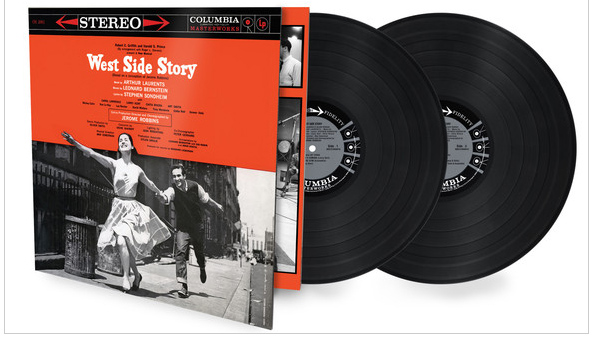
I wrote about the new audiophile label Analog Spark a few months ago, on its vinyl reissue of Dave Brubeck's oft-overlooked 1954 Jazz Goes to College. Now its proprietor, Mark Piro, has come out with a few Broadway musical soundtracks, the best of which is West Side Story, with its score by Leonard Bernstein and lyrics by a young Stephen Sondheim.
2011 Jazz Journalists Association Awards
The Jazz Journalists Association held its annual awards party at the City Winery in New York City Saturday afternoon, June 10. Here is a partial list of the winners, followed in parentheses by the musicians I voted for. The awards covered the period from April 15, 2010 to April 15, 2011. (The full list of finalists and winners can be found here and here.
RECORDING OF THE YEAR:
Winner: Joe Lovano's Us Five, Bird Songs (Blue Note). My Pick: Jason Moran, Ten (Blue Note). Lovano's Charlie Parker tribute is a good album, but Moran's is a masterpiece, the career highlight of the most impressive, versatile jazz musician of his age.
Winner: Joe Lovano's Us Five, Bird Songs (Blue Note). My Pick: Jason Moran, Ten (Blue Note). Lovano's Charlie Parker tribute is a good album, but Moran's is a masterpiece, the career highlight of the most impressive, versatile jazz musician of his age.
2012 Jazz Journalists Association Awards
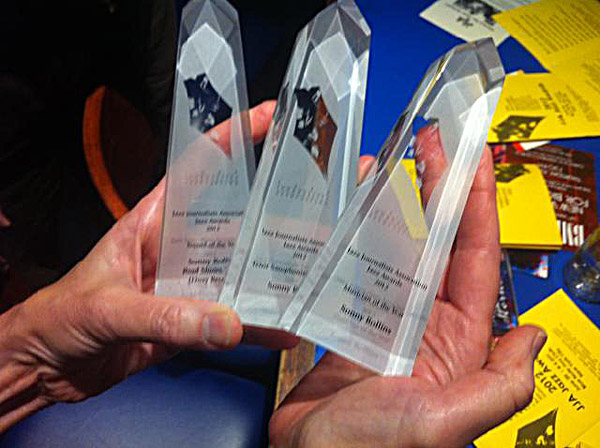
Three Jazz Journalists Association Awards for Sonny Rollins (Photo: www.sonnyrollins.com)
The Jazz Journalists' Association held its annual bash at the Blue Note jazz club in New York City Wednesday afternoon: crowded, boisterous, and, thankfully, air conditioned (it was 97 degrees out on the sidewalk).
The big winnerno surprisewas Sonny Rollins, who nabbed Best Musician of the Year, Best Tenor Saxophonist of the Year, and (for Road Shows, Vol. 2) Best Album of the Year. I voted for Rollins in all three categories as wella rare instance when I've been at one with the consensus on the top prizes.