

JH Audio's JH 5 Pro

JH Audio, founded by Jerry Harvey (formerly of Ultimate Ears, and also known for his work as Van Halen’s audio engineer), had on display an entire line of in-ear monitors, from the single-driver JH 5 Pro ($399) to the 3-way JH 16 Pro ($1149). I listened to a bit of Tool’s “Schism,” from the album Lateralus (a John Atkinson fave), through the Ray Samuels Emmeline The Shadow (which was cute as heck), playing from an Apple iPad, and the JH 5. Nice! I was struck by the deep, grumbling lows, the expressive, truthful guitar tones, clarity of the voices, and the pure drive and impact.
Jolida's Big System
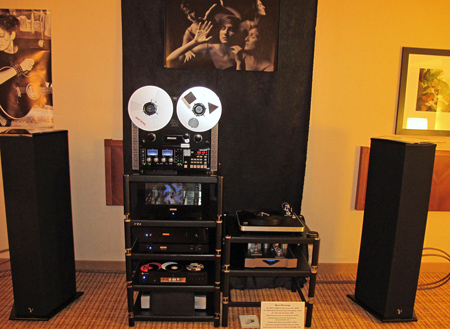
Big does not mean five figures in Jolida's book. The most expensive equipment in their main exhibit on the second floor of the Marriott Tower were the Phase 6 Tape Deck from United Home Audio ($15,000) that was playing master tapes from The Tape Project, the Von Schweikert factory-direct VR33 loudspeakers ($3750/pair), and the Fosgate tube phono preamp ($2500).
Jolida's Small System Knockout
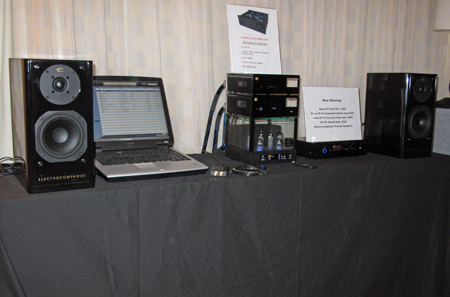
Jolida of Maryland sure knows how to produce good sound for people with limited budgets. Playing Leonard Cohen's classic "Back on Boogie Street" through iTunes, with all the sonic compromises that Apple's music server imposes on a system, Jolida's Glass FX tube DAC ($350) and Glass FX 25 Integrated hybrid amplifier ($350) still sounded great. This was not toy hi-fi; it was an indisputable portal into the real thing, with a musicality that put to shame some much more expensive systems I encountered at RMAF.
Joseph Audio = Happiness
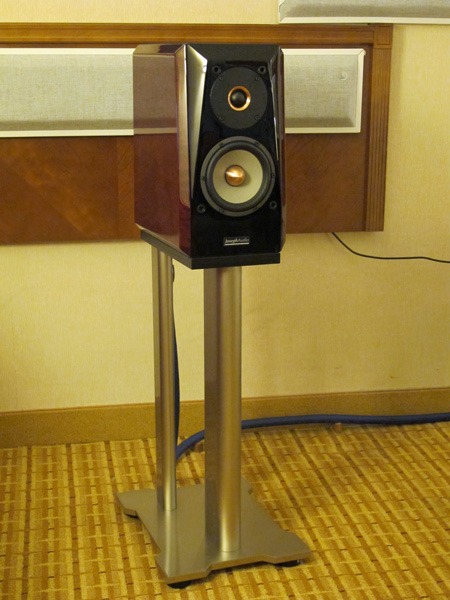
Since my earliest visits to the Stereophile Show, well before I began writing for the magazine, I have always left Jeff Joseph's speaker displays with a smile on my face. This show was no different. Displaying the lovely Joseph Audio Pulsar ($7,000/pair) with not-yet-released-or-priced Pulsar stands, the combo with Ayre electronics (including the QB-9 USB DAC—$2750) and Cardas Clear cabling was a joy.
Jude Mansilla’s System
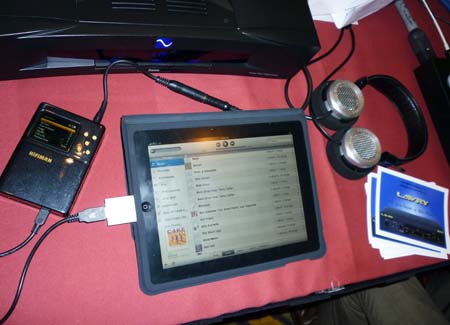
Here’s a look at one of Jude Mansilla’s systems: Apple iPad, Head-Direct HiFiMan HM-801 portable music player, Grado Head-Fi Series HF-2 headphones. I took a quick listen and enjoyed the liquid midrange, the smooth, easy sound.
Jumping Cactus Loudspeakers
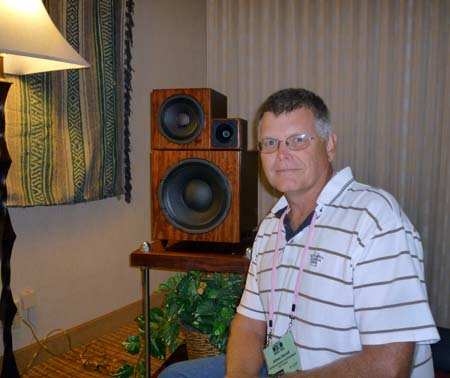
James Harrell’s Jumping Cactus Loudspeakers are high-efficiency designs (94dB) with isolated aluminum enclosures. The speaker’s front panels are finished in Bubinga wood, while the aluminum portions feature a nice satin black power coat. All three drive units are from Eminence. That’s a 10” paper cone woofer, a 6” paper cone midrange unit, and a 1” phenolic dome tweeter. The midrange and tweeter are secured atop the woofer enclosure via Velcro, and can be angled or moved back and forth. A passive Butterworth 1st order crossover is in its own enclosure and is velcro’ed onto the back of the speaker.
Kaiser Kawero/Echole/Absolare/Bybee/Concert Fidelity/Silicon Arts
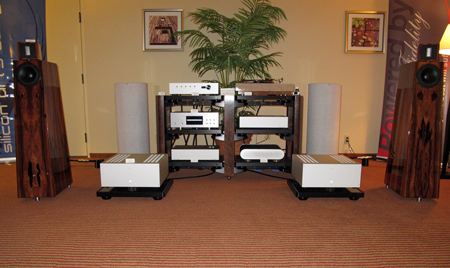
Elsewhere">http://blog.stereophile.com/rmaf2010/physical_sound_from_kaiser_gte_aud… in this blog, Stephen Mejias enthuses about the Kaiser Kawero loudspeakers ($66,000/pair). I first encountered these loudspeakers at RMAF 2008's Kaiser/Echole exhibit extension in the nearby Hyatt, and have coveted them ever since. Optimally paired and internally wired then and now with Echole's excellent cabling, as well as with modded tube amps that had been re-wired with Echole, the sound of this system was so large, rich, and true that it blew me away. Stephen's summation—"This system, more than any other I heard at RMAF, seemed to bring the musicians and instruments into the room with really impressive body and force"—rings true.
Kosmic Sounds
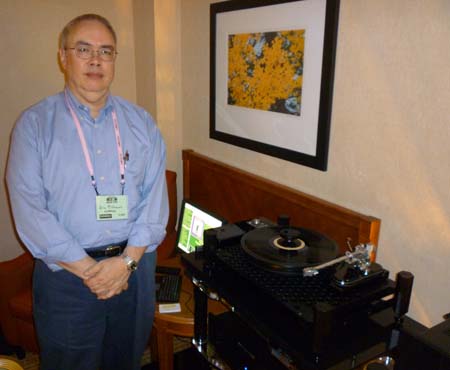
Kosmic’s Joe Pittman stands beside a Sota Millenia turntable equipped with a Kosmic tonearm and Magic Diamond cartridge, sitting atop a Kosmic equipment rack. Kosmic, a company that was new to me, manufacturers a tonearm, a music server, and equipment racks, which seemed like a strange product line. When I asked Pittman about it, he simply replied that all three areas are integral to the overall performance of any system. The Kosmic Server ($2295 with 500GB hybrid drive) stores approximately 1600 CDs in FLAC format, and provides FireWire and USB 2.0 output up to 32-bit/384kHz sampling rates and TosLink up to 24/96. Kosmic is located in Seattle, WA, and is also a dealer for Genesis loudspeakers.
Lansche & Ypsilon
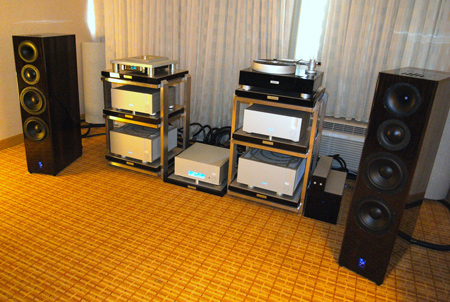
Also distributed in the US by Aaudio Imports, the German Lansche speakers feature a horn-loaded ionic "singing flame" tweeter similar to that used by Acapella, also from Germany. In an off-site demonstration Friday night, I listened to the company's impressive-sounding flagship, the $80,000/pair, 243-lb Cubus, which combines the ion tweeter with a horn-loaded midrange unit and an 18", reflex-loaded woofer. The Lansche display at RMAF featured the somewhat more affordable three-way No.5 speakers ($40,000/pair), driven by the Ypsilon Aelius monoblocks ($34,000/pair) and PST-100 tube preamplifier ($37,000). Cabling was by Stage III, power distribution by Weizhi, and the front-end was either a Bergmann Sleipner Reference turntable and tonearm ($54,000) or the Ypsilon CDT-100 CD transport and DAC-100 D/A processor. As with many of the rooms in the Tower, the room acoustics cramped what this expensive system was undoubtedly capable of producing. But I was sufficiently impressed by the presentation that I have asked for a sample of the Ypsilon preamp for Michael Fremer to review.
Lies, Damned Lies, and Specifications...
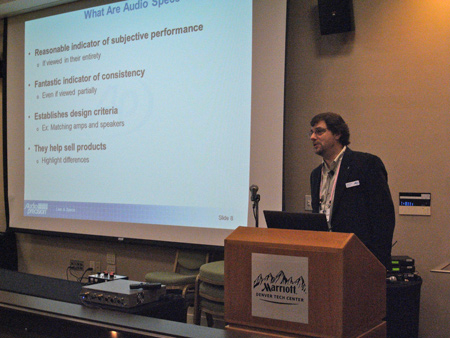
...was the title of the seminar presented Sunday afternoon by Audio Precision's Jonathan Novick. Audio Precision manufactures high-performance test gear (including the systems used by Stereophile for its reviews) and Novick's presentation concerned, among other things, how graphs, as published by Stereophile, are more meaningful than single figures of merit and how conventional measurements can miss problems with amplifiers that are undoubtedly audible. I came away from this presentation with some ideas on how to improve the magazine's test regime, but most telling was Novick's final slide which paraphrased Albert Einstein: "Not all that matters can be measured. Not all that can be measured, matters!."