

Magnepan MG3.7
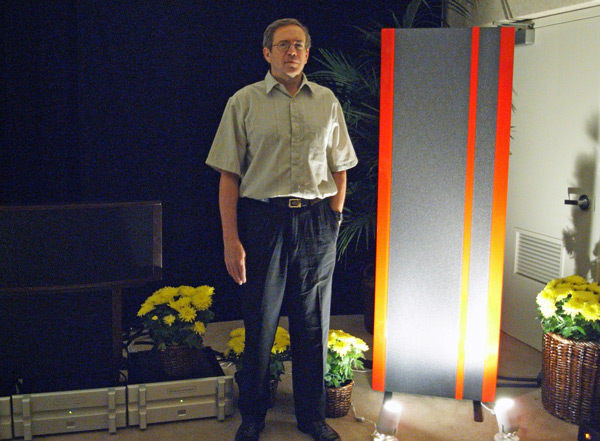
“Trickle-down effect” is an expression manufacturers often use to describe the application of lessons learned in developing a flagship model to the development of lower-priced products. However, according to Wendell Diller of Magnepan, in developing the new Magneplanar MG 3.7, what has taken place is a trickle-up effect. (Wendell celebrates 36 years marketing Magnepan this year!) The lessons learned in going from the MG 1.6 to the MG 1.7 were applied to the more expensive flagship MG 3.6, with what he says are results that represent at least as much of an improvement as the change from the MG 1.6 to the MG 1.7. I’ve been quite impressed with the MG 1.7 on previous occasions, and listening to the MG 3.7, driven by Bryston electronics at T.H.E. Show, made me think of the MG 1.7, except for greater bass extension and dynamics. Magnepan has kept the price at $5495$5895/pair, which must represent a bargain for a planar speaker of this performance and pedigree. Standing proudly next to the MG3.7 in JA's photo is Mark Winey, son of founder Jim, who now runs the Minnesotan company.
Major Changes for YG Acoustics
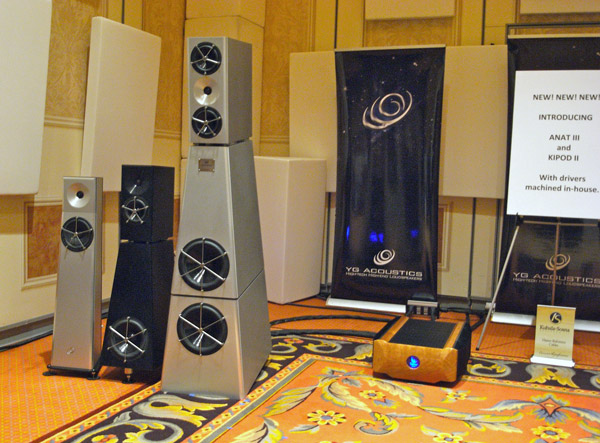
If you look closely at the easel to the right of the photo of the YG room at the Sands/Venetian Convention Center, you can see the text "with drivers machined in-house." Usually, this means that the manufacturer has machined the baskets and polepieces, but in the case of YG, they are also talking about the cones!
Called "BilletCore" by the Colorado company, the aluminum cone for the midrange and low-frequency drive-units used in the top-of-the-line Anat III Reference ($111,000/system) and the smaller three-way Kipod is milled from a solid block of aluminum. In the case of the Anat subwoofer, the starting point is a billet of aluminum 2.5" thick weighing 16 lbs, compared with the finished cone after a day of work, which is 0.008" thick and weighs less than 1 ounce. Stiffening ribs are left on the rear of the cone and the final step is to black-anodize the aluminum. The benefit of machining the cone is said to be improved unit-unit consistency and rigidity compared with a conventional spun, cast, or pressed metal diaphragm, which pushes break-up modes even farther out-of-band.
Though YG was in the same room as in previous CESes, they had taken heroic measures this year to tame its acoustics, as can be seen from the photo. The result was worth the effort. In a system that included dCS Scarlatti digital front-end, a Veloce battery-powered preamp, Tenor 350M monoblocks, and Kubala-Sosna Master Reference cables, the Anat II Reference produced a warm, detailed, full-range sound. Particularly impressive was a version of Sting's "Roxanne" from Italian singer Petra Magoni of Musica Nuda. Both the voice and the solo double bass accompaniment had a palpable presence but without sounding forced or exaggerated.
Mark Levinson & Revel
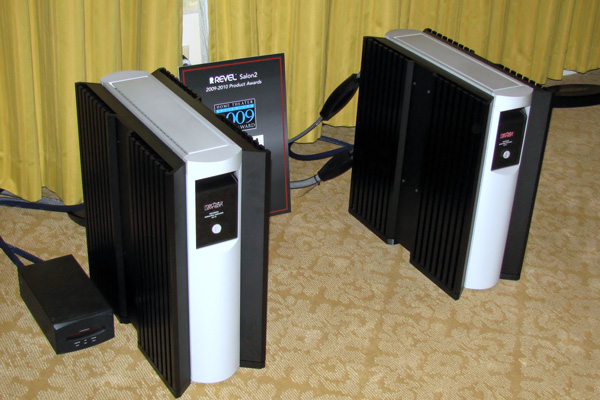
My most emotional moment at the 2011 CES came in the Harman suite on the Venetian’s 35th floor. I finally got to meet Kevin Voecks, Revel Loudspeakers’ head honcho, and he is every bit the gentleman people told me he would be. Playing in one room of the Harman suite was a system comprised of Mark Levinson digital and amplification gear including the new No. 53 monoblock amplifiers ($25,000 each) and the Revel Ultima Salon2 loudspeakers. The No.53 is Levinson’s first digital switching amplifier. One of the inherent problems of a switching amp is that it creates dead bands in the audio signal when the output devices cross over from a positive voltage to a negative one. Levinson says they have eliminated this problem through a patented technology that allows both sets of output devices to be on simultaneously for short periods of time. This is designed to be done without damaging the output devices or reducing their life expectancy.
After listening to a bit of the sample CD they had playing in the room, I thought I would play the opening cut, Eric Whitacre’s “Lux Aurumque,” from the CD While You Are Alive, which I had produced with John Atkinson engineering. It was the best I had ever heard it. I sat there listening to this recording, into which I poured my soul, next to Kevin, who headed the speaker’s design team, that delivered my vision back to me in a way I’d not realized was possible. I felt so lucky and thankful that I live in a world where designers like Kevin, and so many others who show their heart’s labors at CES, can help artists connect to listeners and listeners connect to artists. All I could do was thank Kevin and give him a copy of the CD, as he clearly enjoyed listening to it almost as much as I did. I only wish I could have played him the high-resolution master files.
I told Kevin that JA and I mixed While You Are Alive on a pair of Revel Salon2s while John had the speakers in-house for review. Kevin looked at me with a smile and told me that I was listening to the very speakers John had in his house. Life is magic sometimes.
The No. 53’s were clearly doing a great job, outperforming JA’s Mark Levinson No.33Hes we had used during the mixing. I gotta stop dissing the digital amps.
Marten & Marten

At last year’s CES, many of my favorite rooms featured Sweden’s Marten speakers. The same held true this year. I expected good things when I stopped by Marten’s own room at the Venetian. Not only where they showing off the new version of their Coltrane 2 speaker ($95,000/pair) but also their first amplifier design, the M Amp ($45,000/pair). These monoblock amps have scary low distortion0.05% at 400W into 8 ohms and use a class-D stage that switches at 600kHz. The amp can output 550Wpc into 8 ohms, 1000Wpc into 4 ohms, and 1700Wpc into 2 ohms.
The folks in the Marten room seemed in dire need of some good music when I came in, having suffered through too much audiophile approved crap during the show. I handed them a CD of the XX, a band I love, and we all bobbed our heads to this sparse but funky Pop. I find this album doesn’t work at all if a system cannot get the interplay between the bass guitar and kick drum right. The Marten system did this very well, sounding rich and articulate. The M Amps never let on that they were class-D amps, sounding more like super powerful tubes or a richly voiced class-A amp. I was thanked for playing some sweet cuts off the XX’s album, and I thanked them for making it sound great.
mbl Corona C31 CD Player

mbl products always make you wonder, is it technology I'm looking at or art? Their new Corona Line continues this tradition with, depending on your taste preferences, some of the most drop-dead gorgeous casework you'll see in the audio world, or some of the most over-the-top gratuitous metal (choose between gold or palladium alloy palinux), paint (white or black) and gloss this side of a Kustom Kar show.
Nonetheless, you can't argue with how carefully these products are made. The C31 wil be available sometime this summer for around $8,000 (depending on exchange rate at the time) and has coax, toslink and USB inputs in addition to its disc playing function. The C31 can also communicate with the other products in the Corona line via the SmartLink ethernet connector on the back
Meridian Media Core 600
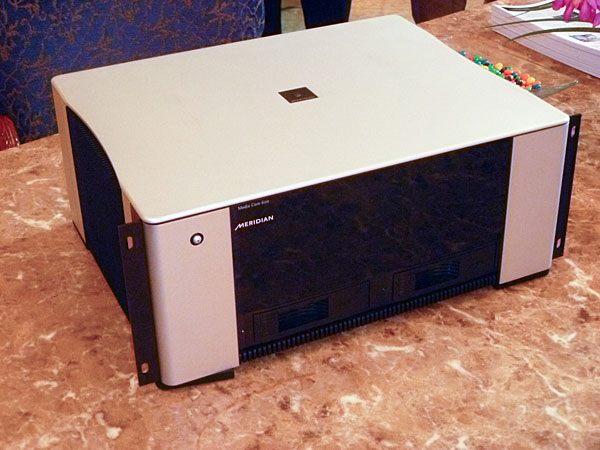
For those looking to set up the full-featured Sooloos system, Meridian will be releasing the Media Core 600 sometime in the near future for a price still to be determined.
What we do know, however, is that it will have 6 zone outputs each with S/PDIF, SpeakerLink, and fixed and variable analog outputs. Each zone also has an independent clock which means different sample rates are possible at the various outputs. The multiple zone clocks are also slaved to a central clock, keeping the multiple zones in synch in case sound bleeds from one to another.
Meridian Sooloos Media Core 200 Digital Media System
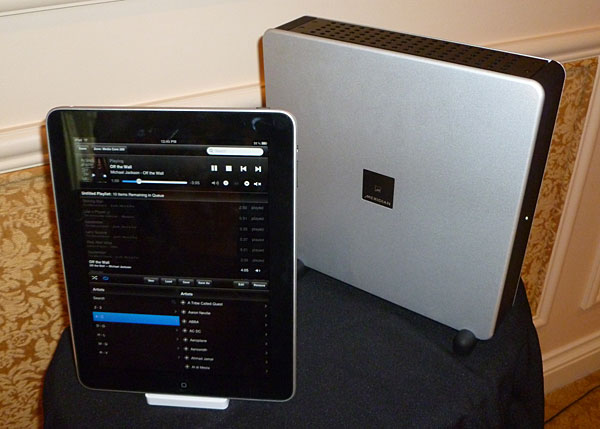
Meridian keeps slimming down the original Sooloos system not only reducing the price but also its footprint. The Media Core 200 looks like a slightly puffed Mac Mini sat on its side, and requires only an iPad to complete the system, though it can also be connected to the company's Control 10 or 15 touchscreens.
The MC 600 contains a 500GB hard drive, analog, SPDIF and Meridian SpeakerLink outputs and has a retail price of $4,000. Available within the month.
Meridian Sooloos Media Source 600
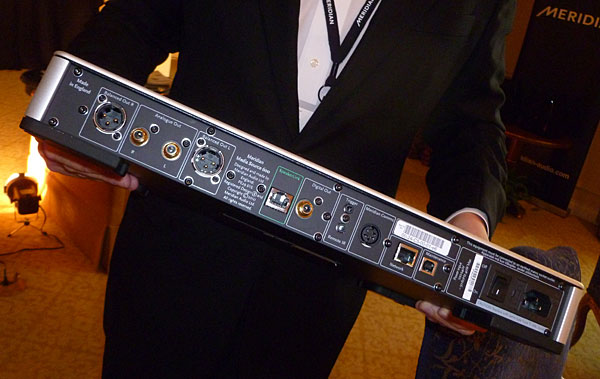
Here is the back panel view of the Media Source 600 which acts as a network endpoint and DAC for your most critical listening zone in a Meridian Sooloos system. It can be combined with the Media Core 600 in an elaborate multi-room network.It has both balanced and unbalanced outputs in addition to Meridian SpeakerLink.
MIT’s New Matrix Line
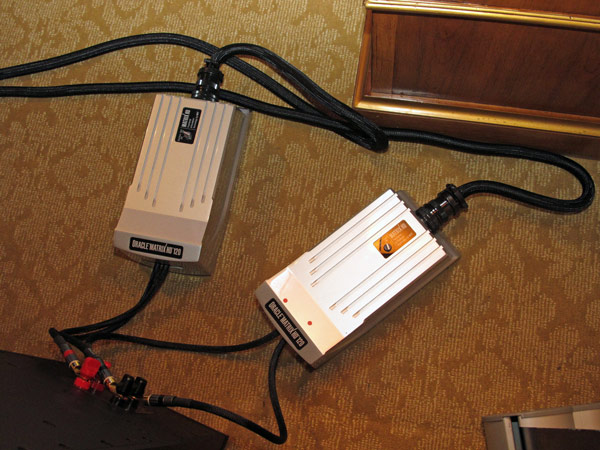
Steve Holt, global sales manager for MIT, proudly introduced me to the company’s brand new Matrix line of cables. Designed by Bruce Brisson, the cables retail between $9999 and $21,999, and are part of the company’s reference line.
The new speaker cable comes in three flavors: Oracle Matrix HD 90 ($9999/8ft pair), Oracle Matrix HD 100 ($14,999/8ft pair), and Oracle Matrix HD 120 ($21,999/8 ft pair). There is one interconnect, Matrix 50 ($4999/1m pair, $5999/1m balanced pair). For digital cabling, one needs to go up one step in the reference line to Oracle MA-X digital ($3495/1m RCA or BNC, $3995/1m AES/EBU)
These new cables use MIT’s multi-pole technology. “We talk about poles of articulation,” said Holt. “There are electronics inside our boxes on the cables to provide wider bandwith coverage to power, so that sounds at either end of the spectrum won’t be rolled off as quickly.” The Matrix cables also employ a new technology called F.A.T. (Fractional Articulation Technology) that helps maintain the harmonic structure of audio signals.
In the Magico room where they were displayed, the new Magico Q3, Soulution amplifiers, and files from Paul Stubblebine’s Tape Project made wonderful music through Oracle Matrix HD 120 speaker cable and the Oracle MA-X interconnects (start at $8495/1m pair). You can see the Oracle Matrix HD 120 boxes in the above photo, which was taken behind one of the Magico speakers. If other rooms hadn’t called, I would have dropped everything then and there and stayed for hours.
Monitor Audio's New Gold GX speakers
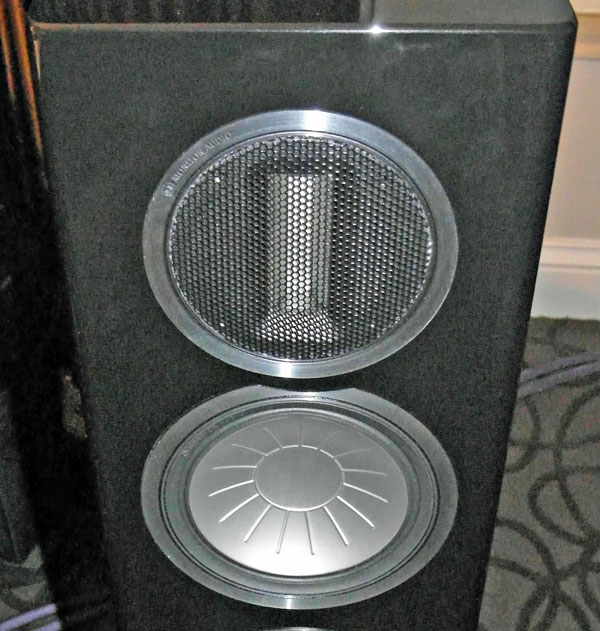
I was very impressed with the Monitor Audio PL200 that I reviewed last April; apparently, so were a lot of other audiophiles, but many were put off purchasing the speakers by the $8000/pair price. The new Monitor Audio Gold GX series is intended to appeal to these folks. The GX series offers most of the technology and aesthetic appeal of the Platinum, but at substantially lower prices. The GX300 is broadly similar in appearance and driver complement to the PL200, but costs an easier-on-the-wallet $5500/pair. It was making fine sounds at CES with Simaudio electronics and Simaudio digital source.