

CES 2011: Easy Registration, Challenging Assignment
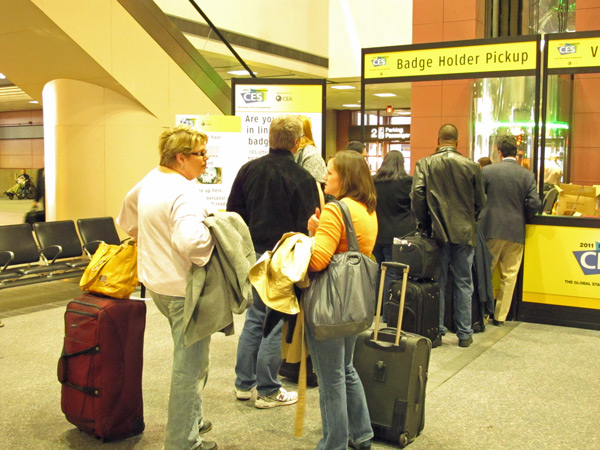
The Consumer Electronics Association made the final step of registration, badge-holder pick-up, easier for CES attendees this year. In addition to registration sites at the Venetian, Las Vegas Convention Center, and a number of hotels, a registration booth was set up in the baggage claim area of Las Vegas’ McCarran International Airport. The line may have been 25-people deep when I approached on Wednesday around noon, but it moved quickly.
CES Unveiled
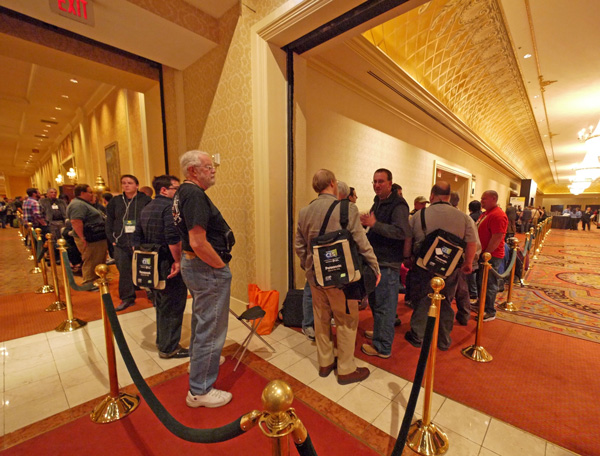
“CES Unveiled” is the name of an event that’s presents a sort of preview of CES itself, featuring products that had been given awards for innovation. It takes place on the day before the CES Press Day, two days before CES is open. I normally don’t get to Las Vegas early enough to attend, but I did this time, so I thought I would check it out.
I got there nearly an hour before the four o’clock opening of CES Unveiled, and there were already hundreds of peopleall accredited members of print or internet media or bloggerswaiting to get in. Were they expecting to get some valuable swag (promotional item), like an iPad? I checked at the entrance, and, indeed, there was some swag that was to be given to each person attending: not quite an iPad, but an external battery for an iPhone/iPod. Hmm. . .I recently bought an iPhone 4. I could use a battery for it. But there was no way I would wait that long. I wandered away, and came back at about a quarter to four. The line was then much longer, and I still ended up waiting about three-quarters of an hour before I got in. Andguess whatall the iPhone batteries were gone. I’m told they had 800 of them. Total attendance of the "CES Unveiled" event must have been over a thousand. It’s going to be a busy CES. . .
But I did get a little gift: an iPhone 4 case in shocking pink. Now I just have to find someone I can give it to.
Classé Unveiled
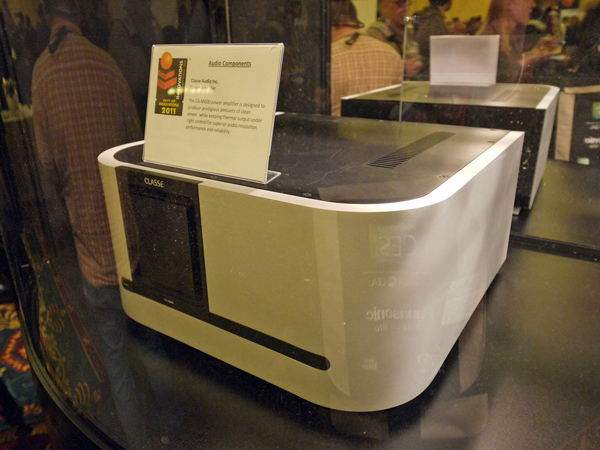
CES Unveiled turned out to have little of interest to Stereophile readersexcept those who are general technical geeks. (Not that there’s anything wrong with that!) Most of the products on display involved mobile computing, computer peripherals, etc., and the exhibits were simple table-top setups. Major CES exhibitors like Sony and Panasonic were conspicuous by their absence. Samsung just had some of their small digicams. I guess the high performance audio community decided to pass on this event, and it makes sense: what makes these products special can’t be evaluated by just looking at them.
Conrad-Johnson HD USB3 DAC

Lew Johnson has been bitten by the computer audio bug and was proudly displaying Conrad-Johnson's new USB-only DAC, the HD USB3. While the digital portion was designed by Kevin Halverson of Muse, Johnson emphasized that their own designers spent quite a bit of time getting the analog part of the DAC just right. He likened the analog circuitry and its importance to final audio quality with the vital function a phono preamp plays in a vinyl playback chain.
The new DAC should be available in late February for $3,000. Johnson added that maybe they will also include a C-J logo on the front panel for the final product.
Conrad-Johnson's new ET5
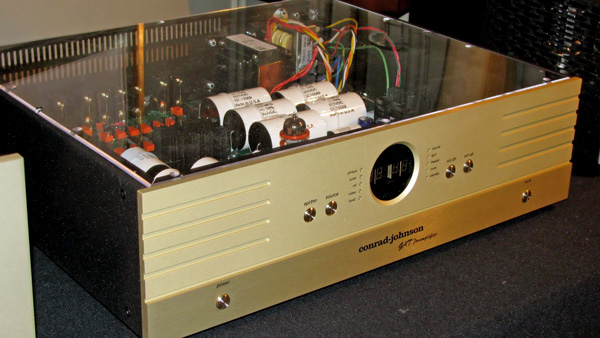
Conrad-Johnson introduced their new ET5 line stage preamplifier. According Bill Conrad and Lew Johnson, the ET5 is a scaled-down version of the GAT preamp (the silk-screening you see here labeling the ET5 as a GAT is an error). The ET5 shares all of the same parts as the GAT but is a stereo design instead of the GAT’s dual-mono layout. The ET5 uses Vishay resistors, CJD Teflon capacitors, gold plated OFC I/O connectors and vibration-isolated printed circuit boards for the gain circuit. The ET5 ships this month and will cost $9500.
Constellation Cygnus Transport/DAC/File Player
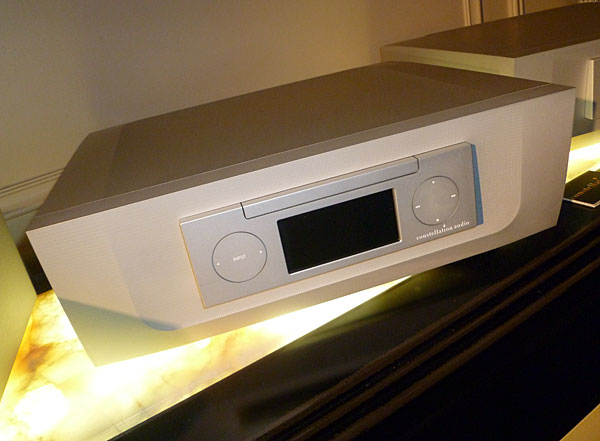
Constellation's Peter Madnick and Dr. Murali Murugasu return with a new digital source component which, at the moment I had walked in the room, had not yet received a name. But by the time I left was dubbed the Cygnus.
Projected price is somewhere between $15-20k with availability in May. Conceived as a do-everything stereo digital source, the Cygnus will play CDs and SACDs as well as files served from connected drives, computers, etc. and also function as a 24/384 DAC.
As always, case design is exquisite.
Constellation’s Hercules amplifiers

“Go check out the Constellation Audio room,” said Jon Iverson. So I did. As I entered the room filled with unworldly looking gear I spied Michael Fremer, engrossed in one of his famous mix CDs, burned from his vast vinyl collection. Michael, ever the gentleman, relinquished the sweet spot to me and both of us took in some big, clean, transparent sound. Driving a pair of $150,000 Tidal speakers was Constellation’s Hercules amplifiers ($70,000 each), which are each able to put out a kilowatt of juice into 8 ohms and runs its first 250W in class-A.
The visual design of the amps is both striking and understated, clad in an all aluminum chassis. Each side of the amp has a diffuser grid which hides the amp’s heatsinks and allows for a chimney action to help cool the amplifier. All that aluminum also serves the purpose of mass-loading the amps to control vibration. Internally the amps mechanically float the sensitive signal carrying parts. That attention to vibration damping could be heard as stillness and ease, particularly when I played a high-resolution file of Robert Silverman playing the final fugue from Brahms’ Variations on a Theme by Handel. My time in the Constellation room was stellar.
Creek Wyndsor Phono Preamp

I finally got to meet Roy Hall of Music Hall. I, along with many of you, have been recently delighting in his colorful and off-color manufacturer’s comments in the pages of Stereophile. New to the stable of products Roy distributes is Creek’s Wyndsor phono preamplifier ($2495). This is a fully adjustable phono preamp with all of the settings available as you scroll through the on-screen menus. The preamp is powered by an external power supply and has just started shipping.
Critical Mass Systems Stands

Joe Lavrencik, owner of Critical Mass Systems, designs all Critical Mass Systems Precision Component Support Systems. All of the company’s products are built in the Chicago area.
The newest Critical Mass product is Maxxum ($5650 per shelf), a precision component-support system. The shelf and rack architecture operate together to mitigate vibration in the floor, the rack, the shelf, and the component at the same time.
“We do more than isolate,” the sleep-deprived designer offered by way of explanation. “We give energy in the air a pathway out of the component so that components are not saturated with vibration from the loudspeakers.”
Lest you think Critical Mass Systems only manufactures high-priced products, prices start at $195 for a set of four MXK spikes, and $195 for a basic shelf. “Even though we’re very expensive, we start very low,” says Lavrencik.
At CES 2011, Critical Mass Systems products were used in the Lamm, Hansen/Tenor, and BAT rooms. In the photo, Lavrencik kneels near his Maxxum amplifier/component stands ($5650/each) and the Lamm ML3 Signature monoblocks ($139,290/pair) being used to drive Wilson Alexandria II speakers.
Dan D’Agostino's Momentum

Dan D’Agostino is no newbie to high-end audio, but his namesake company is. In the new company’s first showing at a CES, Dan brought in his new Momentum monoblock amplifiers ($42,000/pair). The amps, visually inspired by Swiss watch design, are among the most distinctive and beautiful pieces of equipment I’ve seen. The sides of the amplifier are made of copper, which not only gives the amps a lustrous, glowing color, but also serve as very efficient heatsinks for the 28 output transistors.
The amplifier is completely made in-house, including such things that are usually handed off to subcontractors, like stuffing the printed-circuit boards. There are no surface-mount parts used, Dan feeling that traditional through-hole parts offer better long-term performance consistency.
A 1.2kVA power transformer is packed into the compact chassis and in the tradition of Krell, the company that he cofounded 30 years ago, the new amplifier puts out 300W into 8 ohms, 600W into 4 ohms, and 1200W into 2 ohms, all with class-A/B biasing. Yet, there was nothing about this system that sounded like class-A/B amplifiers. Driving Wilson Sashas, the sound was warm, fast, open and generoustonally and spatially. Voices all sounded balanced, life-like and three-dimensional. Dan told me a matching preamplifier is on the way.