

The Atlanta Audio Video Club
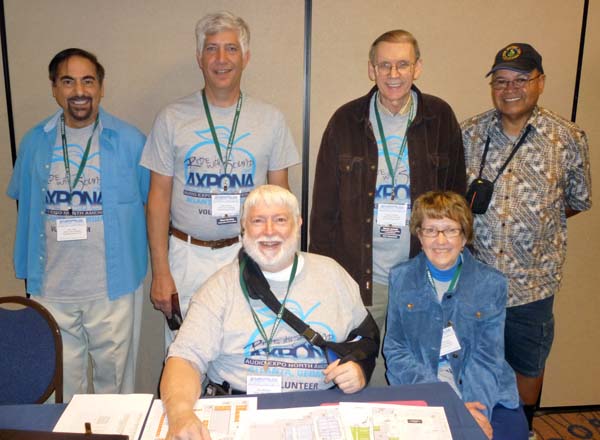
One of my favorite experiences of the show was getting to meet and speak with members of the Atlanta Audio Video Club (from left: Ken Green, Steve Gooding, President John Morrison, Dennis Juranek, Jennifer Dickinson, and a prospective member and longtime Stereophile reader whose name I regretfully cannot recall).
All those who attended Axpona were fortunate to have the Atlanta AV Club on hand, volunteering their time and providing many kind smiles. Members were stationed at desks throughout the exhibit areas, directing attendees to showrooms, answering questions, promoting raffles, and simply adding cheer to the event.
It was immediately obvious that members of the Atlanta AV club were eager to share their enthusiasm for hi-fi and music. Surrounded by this sort of passion and dedication to music and sound, we can be sure that the hobby is in very good hands.
The Audioengine A5, in bamboo

My review sample of the Audioengine A5 was dressed in a clean, handsome satin black, but the speaker is also available in what the company calls “caramel,” a carbonized solid bamboo, which adds elegance to the look and $100 to the price. In bamboo, the A5 costs $449.
The BAT-Scaena Room
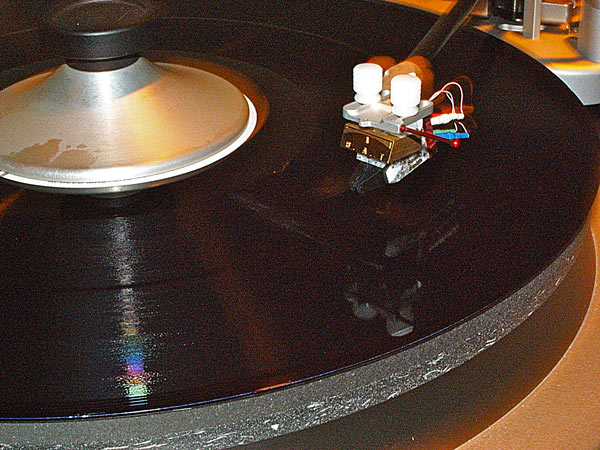
Though I have shown in the photo the prototype of the new BAT P1 phono cartridge, developed by Peter Lederman but with a feature unique to BAT that is said to reduce stylus jitter, the star of this large room was the pair of Scaena line-source speakers ($66,000/system) that were driven by BAT's new Rex tubed amplifier ($15,000, used here bridged for mono) but also proved unphotographable (at least by me). (You can find Jason Serinus' photo of the speaker at the 2010 Axpona here.)
The rest of the system included a Silver Circle Pure Audio 5.0 AC conditioner, Kubula-Sosna Master Reference cables, Critical Mass Systems stands, BAT VK-P10 phono preamp, BAT Rex line stage, Scaena subwoofers, and a Spiral Groove SG-2 turntable and Centroid tonearm. Listening to Marc Cohn's "Riding on a Ghost Train" and Miles Davis's "So What" from LP, it was though I were hearing these familiar pieces for the first time. There was a stability to the high frequencies, a clarity to the midrange, a depth to the low frequencies, that thrilled.
The Daniel Hertz M1

The Daniel Hertz M1 ($100,000/pair), designed by Mark Levinson (the man), uses a high-frequency horn, a 12” mid-woofer, and an 18” woofer. The stainless steel frame surrounding the horn is said to optimize waveform termination and imaging quality, while those frames surrounding the woofers are used to increase the rigidity of the drivers. The speaker is divided internally into two sections: One section for the horn and 12” driver, damped using sheep’s wool for its high mass and absorptive properties, and one section with two tuned ports for the 18” driver.
As seen here, the M1 is designed to be powered by four Telikos M5 Mono Reference amplifiers ($8000 each): Each channel uses one M5 switched to frequencies above 80Hz and one M5 switched to frequencies below 80Hz. Also in the system was a Telikos M6 preamp ($10,000). The source was a $400 laptop running WAV files from iTunes.
Interesting story: Daniel Hertz (the company) takes its name from the two sides of Mark Levinson’s family. Daniel Levinson was Mark’s father, while Heinrich Hertz (1857-1894), a German physicist and the first to demonstrate the existence of electromagnetic waves, was Mark’s great uncle on his mother’s side.
The Hartsfield from Classic Audio Loudspeakers
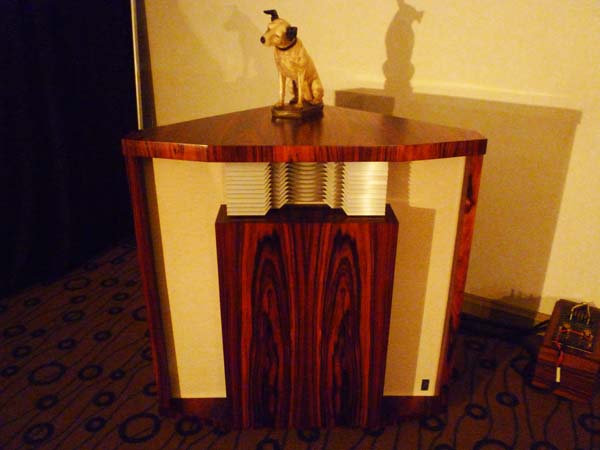
Take a look at this beauty, the Hartsfield from Classic Audio Loudspeakers, a tribute to the original Hartsfield, introduced in 1954 by the James B. Lansing Sound Company. In John Wolff’s version, a 15” low-frequency driver couples to a long exponential horn; above 500Hz, a 2” midrange unit couples to a horn-lens assembly, designed to provide wide dispersion and uniform high-frequency sound distribution.
Something about this speaker gets people feeling all romantic. When I walked into the room, I sat down behind a couple whose hands were joined and whose arms swung in the space between their separate chairs, happily and slowly, in time to the music. After they departed, their places were taken by a second couple. This time, however, the woman simply moved her seat as close as possible to her companion’s, creating a virtual love seat, so that the two could hold each other while the music played.
What the hell? Was this a hi-fi show or some sort of love fest?
I couldn’t blame them, though. The system was playing some extremely gorgeous, palm-in-eye-socket piece of violin music, and it sounded sweet, inviting, and nearly rapturous, with delicate, extended highs and easy, voluptuous mids.
Designer John Wolff said something about field-coils and 106dB...
The Legacy Whispers
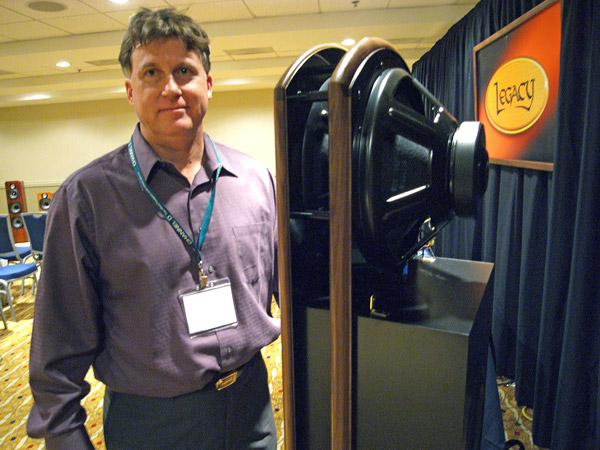
Legacy's large Whisper speakers ($20,900/pair with digital-domain crossover and four channels of ICE-Power amplification for the woofers) had been one of my best sounds of the 2010 Axpona in Florida. However, the Whisper hadn't sounded as good as I was anticipating at this year's Montreal Show, where they were being demmed in too small a room and loading up the room with low frequencies as a result, even with room correction applied and the speaker's unique woofer alignment. At the 2011 Axpona, the Whisper, seen here with designer Bill Dudleston who is showing off one of the speaker's dual-woofer cardioid bass sections, the company had the opposite problem, witht he speakers being demmed in an enormous, live-sounding room. Even so, driven by Coda CX amplifiers, a Coda CL preamplifier, and an Ayon tubed CD player, the Whispers almost managed to fill that room with high-quality sound.
The Linkwitz Lab Orion 4
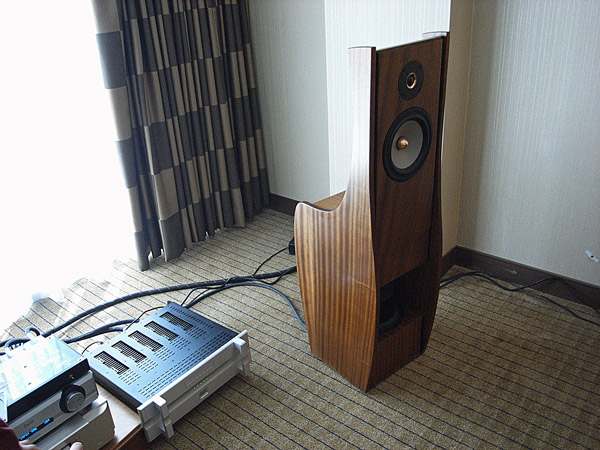
Definitely one of my two best sounds at Axpona, along with the BAT-Scaena room, was the Orion 4 dipole speaker (from $14,750/pair with analog line-level crossover), designed by Siegfried Linkwitz and with custom enclosures made by Wood Artistry. Quad-amped with two Bryston 9B four-channel amplifiers, a Pass Labs preamp, and a Marantz CD player, the "William Tell" section from Shostakovich's Symphony 15 had superb dynamic range, with a "quiet" quality that seemed like there was a lower level of spurious behavior from the room. This allowed a wealth of detail to be perceived even when the music was itself quiet.
Each Orion 4 weighs 85 lbs and uses five SEAS drive-units: two soft-dome tweeters, a magnesium-cone midrange unit, and two long-throw 10" woofers especially developed by SEAS for the open-baffle loading used by Linkwitz. The crossover frequencies are 90Hz and 1440Hz and the tweeters, the midrange unit, and each woofer are driven independently, though the woofers can be paralleled to allow tri-amping if only six amplifier channels are available.
The Orion 4 from Behind

You can see here the dipole nature of the Orion 4, with the rear-firing tweeter, the back of the midrange unit, and one of the woofers.
The Perfect Nightcap
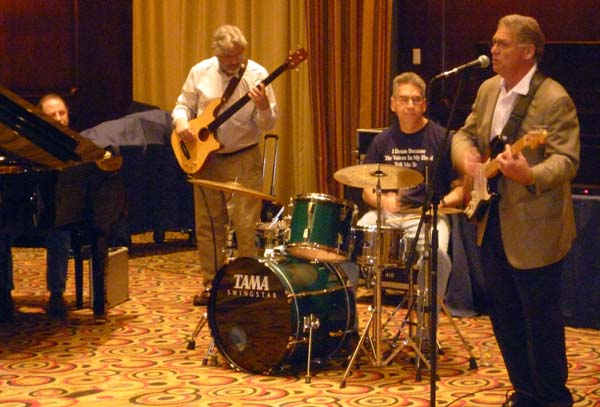
Pretty freaking drained at the end of a very long Saturday, I walked into the Capitol Ballroom and was surprised to see a live band—from outside the room, I had wondered if the music was being produced by some very fine hi-fi that I had somehow missed. (Funny, huh?)
Even more surprising was to see John Atkinson on stage, playing a smoking blues riff on the fretless bass. Joining JA were John Yurick on piano, Spiral Groove’s Allen Perkins on drums, and show organizer Steve Davis on guitar and vox.
After a few rocking numbers, Balanced Audio Technology’s Geoff Poor strolled up to the mic and let loose a few jazz standards. “This next song requires some audience participation,” Poor said. “It requires you to drink.”
Ready for a beer, JA gave way to Dean Peer on bass, and the band continued to rock and sway, providing the perfect nightcap to a long day.
The Rives Room Acoustics Seminars
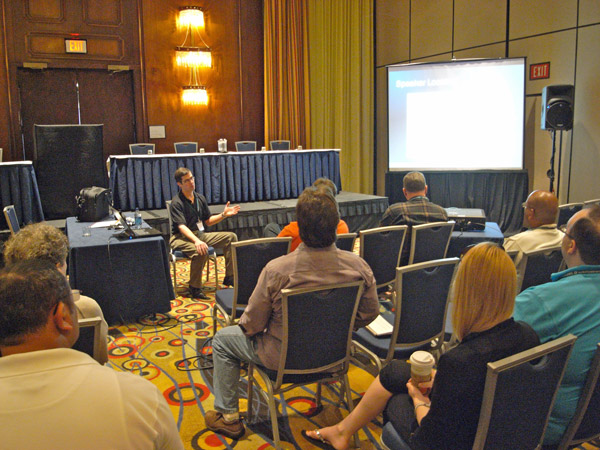
One of the things I like about audio Shows is when they have a full program of fringe events. The 2011 Axpona continued this tradition. Not only did Michael Fremer demonstrate how to set up turntables and Dean Peer talk about his experiences as a recording musician, but Channel D's Rob Robinson shows Showgoers how to rip their LPs to their PCs, author Jim Smith explained how to get better sound from your system, Mark Waldrep of AIX Records demonstrated HD music in full surround with 3D video, Enjoy the Music's Steve Rochlin gave talks on the state of the industry, I explained how I measure loudspeakers and what the measurements mean, and Rives Audio's Richard Bird, shown here in action, talked about how best to cope with the acoustics of the listening room. Good, essential stuff.