

Polk's LSiM 707

Although I had seen the 4-way, floorstanding Polk LSiM 707 ($4000/pair) at the Montreal Show in April, they weren't being demmed in an optimal room. But driven at Capital AudioFest by an Audio Research stackCD8 CD player, Ref3 preamplifier, and VS110 power amplifierand hooked up with MIT cable, they gave great sound on Keb Mo's version of "It Hurts Me Too" from his The Door CD, with extended low frequencies and impressive dynamics.
Soundfield Audio
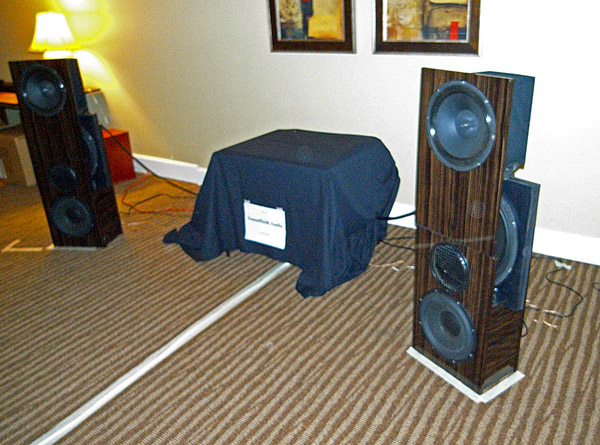
"Where's the tweeter?" I asked after a listen to the 97dB-sensitive Soundfield speakers, shown at Capital AudioFest in prototype form. It turned out the top drive-unit is a 12" coaxial unit, with the HF unit mounted where the dust-cap would be. "So the big-ass 18" dipole unit is the subwoofer?" No, it was explained, the18" unit in the speaker's center, behind the grille, is the woofer, covering the range from 50200Hz. The bottom 12" unit, mounted in a sealed enclosure is the subwoofer, handling frequencies below 50Hz. With the coaxial and 18" drivers operating as dipoles and the bottom12" unit omnidirectional, by varying the crossover between the low-frequency drivers, the speaker's radiation pattern can be made cardioid in the region where room acoustics might benefit. I had seen a cardioid subwoofer designed by Ken Kantor many years ago at a CES, and had wondered why no-one else had experimented along these lines.
Surreal Sound

The Surreal Sound Speaker ($10,000/pair) is the small, three-way floorstander finished in cherry, not the massive bass bin behind it, which belongs to the GOTO Horns speaker (see next story). Surreal Sound's Ralph Helmer is passionate about midrange, feeling it is in the midrange where the music truly lives. To that end, his speaker features a beryllium-disc midrange unit, mounted in an open baffle. A Heil Air Motion Transfomer supertweeter and three spider-less, aluminum-alloy, 10" cone drivers for the bass, all also mounted in open baffles, complete the drive-unit line-up. Mr; Helmer believes that one of the advantages of his dipole speakers is their high Wife-Acceptance Favor, in that they are smaller than expected for same amount of bass.
Synthesis—Tube Porn #2
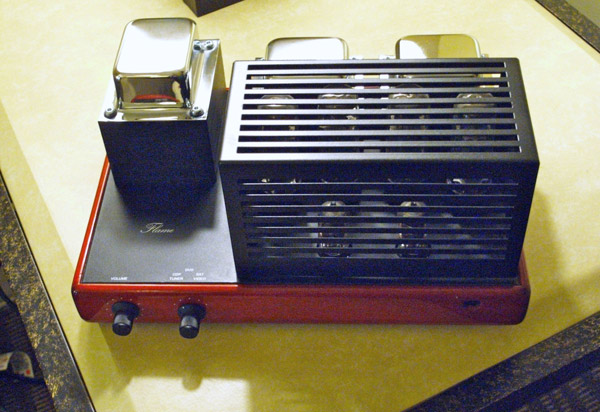
There was no information available on this cute tube integrated from Italy, the Synthesis Flame, except that it has remote control and costs between $1500 and $3000. But it sure is pretty! Check out www.synthesis.co.it.
TapePath Revives Recorders
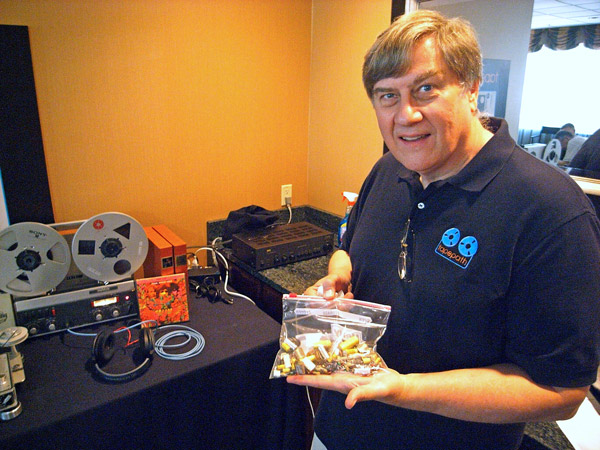
Ken Swauger runs a Baltimore-based company called TapePath (www.tapepath.com) that specializes in restoring classic open-reel tape recorders, especially ReVox A77s. Ken is shown here in the vestibule to the Polk room, holding a baggie with all the parts from an A77 that he replaces and upgrades. I still have an A77 in storageperhaps I'll send it to Ken to have it brought back from the dead!
The Salk StreamPlayer
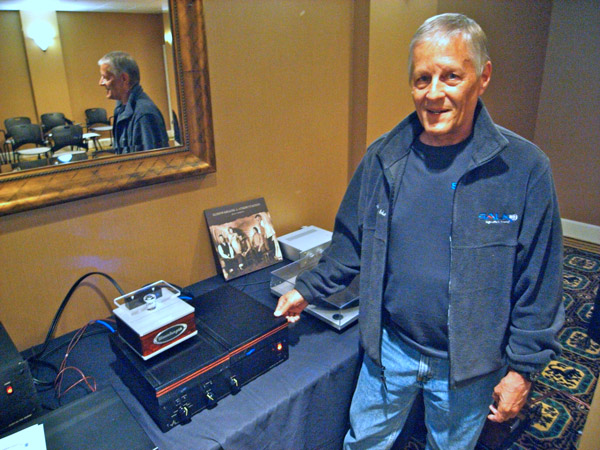
Listening to the Philharmonic speakers, I couldn't see a source. There was an AVA CD player but its display said "No Disc." There was a turntable but no LP playing. Then I saw an iPad in someone's hand. It was controlling Jim Salk's new StreamPlayer ($1295), the rightmost of the two small red-line-fronted boxes on top of the preamp in the photo. This is similar in concept to the Bryston BDP-1 we reviewed in June, in that it is a PC running Linux that is optimized for streaming audio from an external source, in this case Salk's own NAS drive (the left-most box), connected by Ethernet cable. Whereas the Bryston offers control buttons and a display, the Salk is controlled by a remote client running on an iPad, iPod Touch, Android phone, etc. The Salk StreamPlayer, which was sending audio data via USB to a Wavelength Cosecant DAC, will be available in October.
The Second Capital AudioFest...
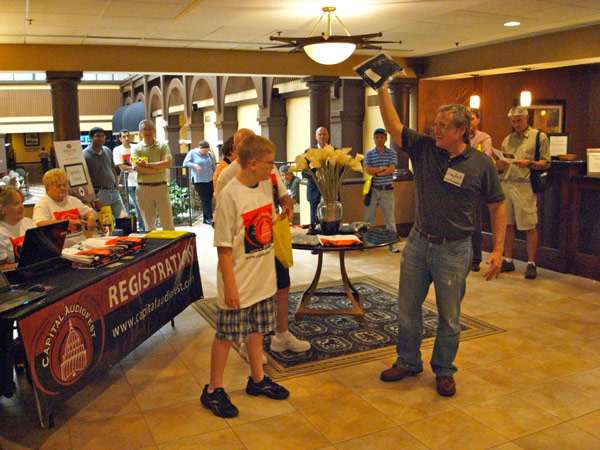
... may have been fairly small as these things go, with just 28 exhibitor rooms, which is way fewer than THE Show Newport Beach a month ago. However, that is still 6 more rooms than the Axpona NYC just two weeks ago, with about the same number of marquee brands, in a hotel with generally better-sounding rooms than New York's Affinia. Show organizer Gary Gill, shown here giving away the prizes at the first of the nightly raffles, took a big gamble moving last year's intimate show into a hotel venue, but it seemed to have worked: both exhibitors and attendees seemed very upbeat about the event. Attendance on Saturday evening was a hair short of 700, meaning that possibly 900 or even 1000 people had packed the rooms of the Rockville Crowne Plaza by the time the Show closed Sunday evening.
Are regional shows like Gary's the future of the audio market, as Classic Speakers' John Wolff believes, or will we return to the days when there were just one or at most two large shows each year? That is going to depend on the resources of audio manufacturers and retailers and their willingness to spend more time on the road. But the 2011 Capital AudioFest certainly proved that if you hold it, audiophiles will come.
The Signal Collection
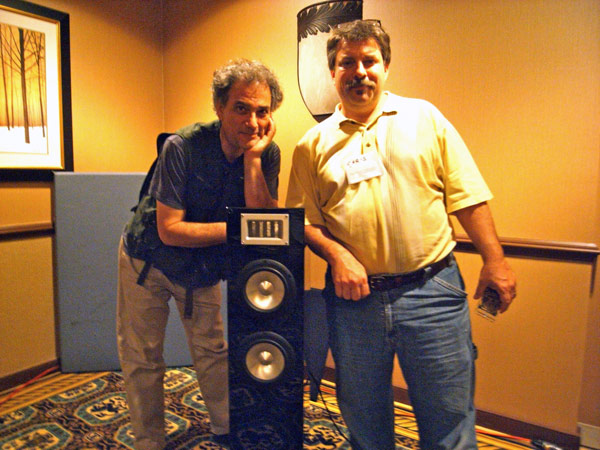
One of the first rooms I went into was that featuring products from The Signal Collection, the distribution company run by the affable Chris Sommovigo (right). Also in the room was Todd Garfinkel of MA Recordings (left), who was using Chris's system to play the masters of some of his excellent-sounding recordings. (I mentioned below that MA had made a sampler CD to be given ever attendee.) The speaker featured in the photo is the M3 Mk3 ($6499/pair) from Swedish manufacturer Transmission Audio, a floorstanding sibling of the standmounted M1i Ribbon Mini I had auditioned at the Atlanta Axpona last April. The M3 used two of the metal-cne woofers developed by Bo Bengtsson and Ted Jordan. Each woofer is loaded differently to give a two-a-half-way design. The crossover to the ribbon tweeter is set at 3kHz.
With the speakers driven by Klimo Tine class-A tube monoblocks ($8999/pair), a Klimo Merlino preamp ($6699), hooked up with Stereolab interconnects and speakers cables, I listened to some of Todd's DSD masters played back on his Korg MR2000 recorder, as well as a Red Book WAV file of a track from MA's well-regarded Calamus: The Splendor of Al Andalus. Despite competing noise from a live band playing in an adjacent ballroom, the sound was open, and clear., with a wide soundstage.
The Voice That Is...Tidal, dCS, Argento

"The Voice That Is" is the name of a Newtown Square, PA, retailer and when I walked into their room, I had no idea what equipment I was listening to, as it wasagaintotally dark! (I had to set my camera's "film speed" to a noisy 1600 to get a photo at all.) But the music playing, Stevie Ray Vaughan's "Tin Pan Alley" took me back a quarter century, when all you heard at audio shows was this cut. But it never sounded this good back then!
As my eyes accommodated to the darkness, I could make two pairs of Tidal speakers, the floorstanding Piano Diaceras ($37,690/pair) behind stand-mounted Ameas ($18.990/pair). Both feature ceramic-cone woofers and a diamond-dome tweeter but it was the Diaceras that were playing, connected with Argento cable to a Tidal Impact 140Wpc stereo amplifier ($35,990) and a Tidal Preas preamp ($27,990). Source was a MacBook Pro feeding USB data to a dCS Debussy D/A (my current reference, it shall be said, though in May I loaned it to Erick Lichte, who doesn't appear to want to send it back any time soon).
As if to confirm that it was 1987, the next track played was "Le temps passé" from the Michel Jonasz CD L'Histoire de Monsieur Swing. This is what I am talking abouta huge, stable soundstage, extending way beyond the speaker positions; smooth, grain-free highs, tight, tuneful, deep lows, and a pure, coloration-free midrangeand all of this in service of the music, adding to the experience instead of substituting for it. It doesn't get much better than this!
United Home Audio
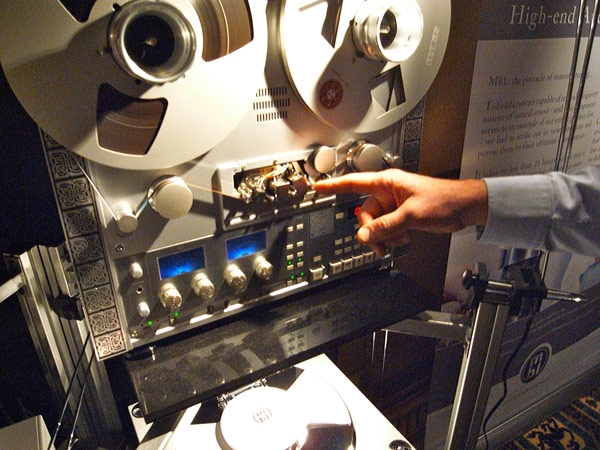
As well as listening to hi-rez digital files on the MBL system, I auditioned 15ips open-reel tapes from the Tape Project on a much modified Tascam recorder from United Home Audio. UHA's Greg Beron (that's Greg's hand in the photo) replaces the heads with low-impedance ones sourced from the company that supplies Abbey Road Studios in London, wired with single-crystal cable and silk-dielectric caps. A UHA machine costs $8000$17,000 depending on the level of work the customer needs, and the machine is lined-up to be compatible with Tape Project tapes. Listening to a Decca orchestral recording of Suite Espanole, I was reminded how good analog tape playback could be. Even a mono Thelonious Monk cut from 50 years ago sounded fresh.