

And That Was the End of the 2013 CES

And then there were five. At the end of the show on Friday evening, the remaining members of the Stereophile crew met for dinner at the same BLT Burger restaurant at the Mirage where they had eaten the night before the Show opened. Larry Greenhill, Michael Fremer, Kal Rubinson, Jon Iverson, Tyll Hertsens, and Jason Victor Serinus had already departed, so remaining were (left to right) myself, John Atkinson, Michael Lavorgna (AudioStream.com), Stephen Mejias, and Tom Norton (Home Theater, erstwhile Technical Editor for Stereophile). We don’t even look too tired!
And all that (Nagra) Jazz
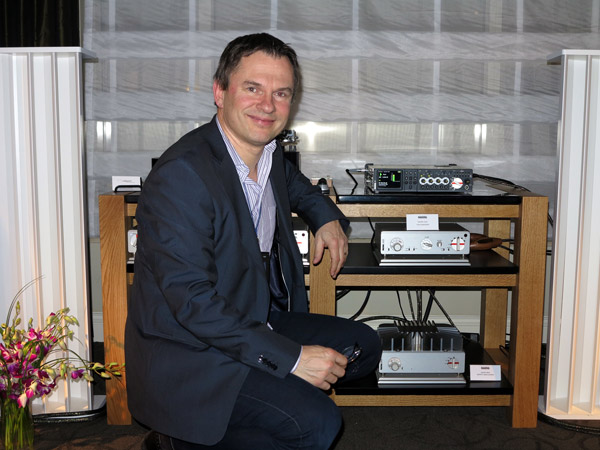
Nagra of Switzerland debuted its new Jazz preamplifier complete with ACPS II power supply ($12,500). This replacement for the PL-L line level preamplifier, shown with the company's Hi-Fi Director Jean-Pascal Panchard, melds tube technology with an improved circuit design that is said to yield more open and detailed sound. As important, the input and output jacks are now on the back panel instead of the sides! A review of the Jazz is scheduled to appear in the April 2013 issue of Stereophile.
Another Year, Another CES

Photograph: John Atkinson
Las Vegas? Why bother to fly across the country or around the world when you can visit New York City, Venice’s Grand Canal, and Egypt’s Great Pyramid in one easy, smoke-filled, retail therapy-rich, constantly stimulating stop? Why search out music on the net when, in Las Vegas, it constantly bombards you in elevators, from outdoor loudspeakers, and at your free lunch at T.H.E. Show? Ah, Las Vegas. In his wrap to CES 2012, Stephen Mejias did a beautiful job of asking the simple but profound question, “Why?” Why, of all the god-forsaken places on Planet Earth, has the Consumer Electronics Association chosen this compulsion-driven, ecologically devastating, one-stop tourist and gambling destination as the site for the largest industry trade show in the US?
Antelope Rubicon Atomic AD/DA Preamp

I was looking forward to seeing Antelope's recently announced Rubicon Atomic AD/DA Preamp at CES, but so is the company. At the time I visited the room, DHL still hadn't found and delivered it, so we have Director of Sales and Marketing Marcel James standing next to the poster.
April Music: Aura and Stello
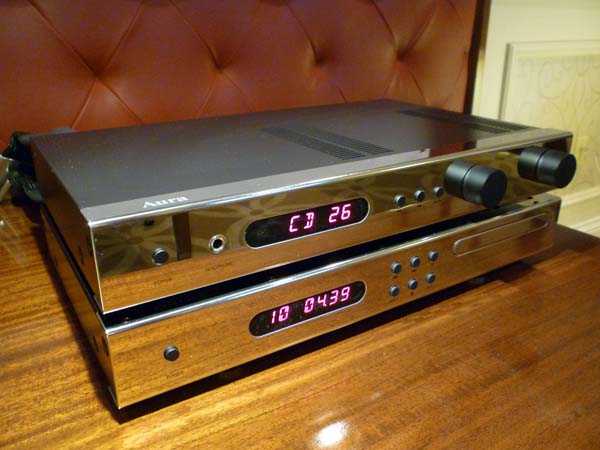
Distributed in the US by April Music, the 50Wpc Aura Vita receiver ($1245) was mated with Aura’s matching Vivid CD player ($995).
Aragon Lives

Many, many moons ago, in the days when Stereophile was a small digest rather than a full-sized magazine and lively website, I owned an Aragon 4004 dual-monoblock amplifier. Oh how I wish I had never sold my 4004, with circuitry designed by Dan d'Agostino, and instead mated it with a front end, speakers, and cabling that could have revealed all that it had to offer.
You, thankfully, have an opportunity to find out just how good the circuitry is. The just-introduced Aragon 8008, a software-upgradable, 200Wpc dual monoblock amplifier ($4999) with dual, symmetrical power supply and ethernet-based control and status monitoring, is now produced by Indy Audio Labs, who bought the brand from Klipsch in 2009.
Arcam rBlink Bluetooth DAC

It's a simple idea really. Make it easy for anyone at your home to pull out an iDevice and play what's on it over your audio system without having to fiddle with cables and the proper connectors and then a compatible USB port. Some products, such as the Musical Fidelity M1SDAC have this already built in, but if you don't have it, here's an easy way to add it.
The $249 rBlink gives you the ability to connect any Bluetooth device like an iPhone wirelessly to the system. Plug the rBlink into an extra input on your stereo, and then have the Bluetooth enabled iDevice add it from their menu. Maybe not the best sound in the world (though better than it used to be with Bluetooth), but easy for your pals and great fun at parties.
Arcam Sonlink DAC

Aimed straight at the Sonos owner, Arcam's new DAC has a form factor similar to a Sonos ZP90 and plugs right in. It forms a base for the Sonos to sit on and is similar to the company's rLink DAC with TI PCM5102 chip, supporting streams up to 24/192. Retail price is $299 and it is available now.
Arcam's Solo Neo and New FMJ A19 integrated amplifier

The Solo Neo now has networking capabilities and uses an upgraded disc transport. At $2000, it might seem a little pricey to a young or beginning audiophile, but considering that it combines tuner, preamp, power amp, and disc player in a clean, stylish enclosure, the Solo Neo represents great value.
Audio Arts & the Zellaton Grand

Manhattan retailer/distributor Audio Arts was showing the Zellaton Grand loudspeaker ($39,750/pair). This combines a tweeter and two 7" mid-woofers using aluminum foil-faced rigid-foam diaphragms first developed in 1935 by Emil Podszuswhich I had first seen and heard in the Pawel Ensemble minimonitors from 20 years agowith a downward-firing woofer in a cabinet that is open to the rear.