

Siegfried Linkwitz's Orion 4

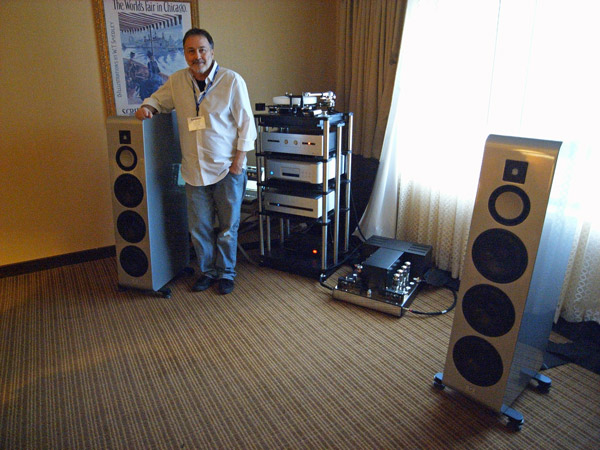
I first heard the dipole Orion 4 speakers ($14,750/pair with Analog Signal Processor), designed by Siegfried Linkwitz and manufactured by Wood Artistry of Healdsburg, California, at the 2011 AXPONA in Atlanta, where they were one of the best-sounding rooms at the Show. They were in too large a room in Chicago, but still managed to sound clean and natural, with a full range of frequencies, driven by Pass Labs amplification with DH Labs cabling. I refer you to me 2011 report for details on the speaker's design but new at Chicago was a refined version of the Analog Signal Processor, with closer-tolerance crossover components, and an amplifier/processor that obviates the need to drive the Orions with 6 or 8 amplifier channels and the resulting confusion of cables.
Silnote Audio Cables
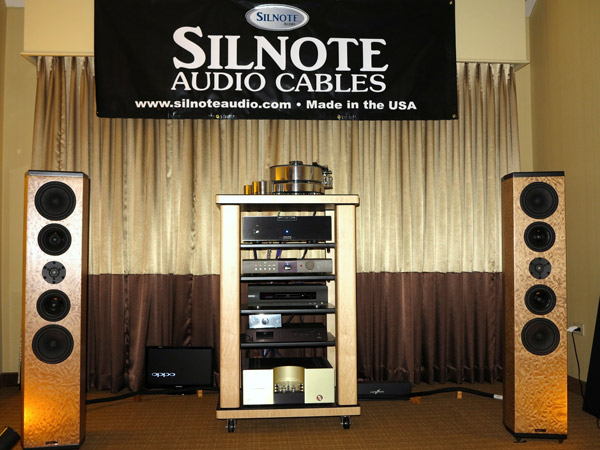
It's always a challenge, in a room filled with unfamiliar equipment, to pinpoint what's causing what. All I know is that on the 7th floor, in the room wired with $8000 worth of Silnote Audio Cables, the midrange on a recording of the Talking Crows was simply beautiful, if a bit dry.
Sony, Hegel, and Friends
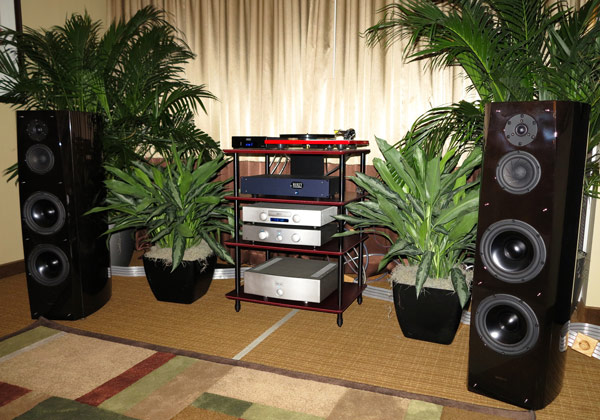
In the room set up by Holm Audio of Woodridge, IL, Sony SS-AR1 loudspeakers ($27,000/pair) dominated a system in which Nordost Odin cablingOdin power cord ($15,999/2.5m), interconnects ($19,999/2m) and speaker cable ($25,999/2m)transmitted signals from a Rega RP6 turntable ($1990 with Rega Exact cartridge), Hegel HD25 32-bit DAC ($2500), Manley Chinook phono preamp ($2250), Hegel CDP2A ($2650), Hegel P20 preamplifier ($2900), and Hegel H20 amplifier ($5750). On Randy Crawford's CD, We'll Fly Away, the sound was very smooth and non-fatiguing, but lacked sparkle.
Super Salk
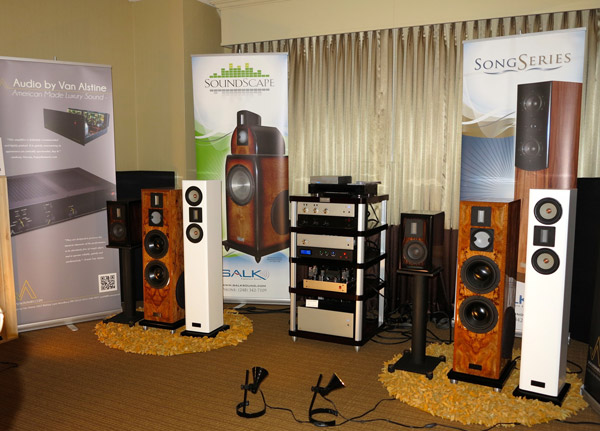
Bob Walters of the Bay Area Audiophile Society often refers to Jim Salk's loudspeakers as one of the best buys in high-end audio. Certainly I have never heard them sound better in a show context. Using an AVA ABX switch ($1499), Salk Audio switched between three of its speakers: Salk Silk Bookshelf ($3499/pair), Salk Supercharged SongTowers ($3495/pair), and, the largest Salk SoundScape 8s ($7995/pair). The 8 uses the same RAAL ribbon tweeter, Accuton midrange, and 12" passive radiators as in the two larger SoundScape models (not shown), albeit with two 8" drivers.
Super Soundsmith
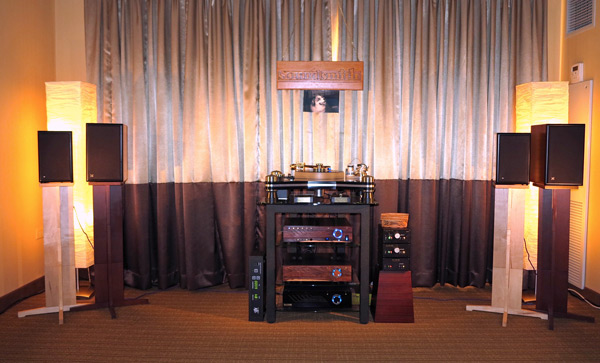
Although Soundsmith brought to Chicago the very same system it exhibited at RMAF in Denver last October, there was nothing has-been about the sound. In fact, sonics that I often find enticingly romantic, as on the slightly warm side, this time sounded far more neutral, yet infused with the glow that makes Peter Ledermann's cartridges and electronics so special.
The Benchmark DAC2 HGC

With Benchmark's high-value DAC1 D/A headphone amplifier getting a little long in the toothour original review was in July 2003it was good to hear the new DAC2 HGC ($1995) at Axpona. The DAC2 uses an asynchronous USB2.0 interface, will decode DSD files, has five digital inputs, two single-ended analog inputs, balanced and singled-ended analog outputs, two headphone outputs, and features a hybrid analog/32-bit digital volume control that preserves resolution. Analog signals are never digitized; digital signals never pass through an analog potentiometer; yet both analog and digital volume are controlled with a single knob.
The Marten Djangos
In the second Kyomi Audio room, E.A.R. USA's Dan Meinwald was doing an effective dem of the Marten Django XL speakers ($15,000/pair) that Erick Lichte favorably reviewed in September 2012. He used a prototype CAT tube amplifier, a CAT SL1 Renaissance tube preamplifier, and an Esoteric K-1 DAC with standalone clock fed audio data from Amarra. Cabling appeared to be all Magnan. With the Swedish speakers set up firing along the room's diagonal, low-frequency room modes were tamed and vocal music blossomed, whether it was Peggy Lee singing "Fever," Paul McCartney singing a demo of "Mother Nature's Son," or Neil Young live from Massey Hall.
The Real Thing

Allowing Showgoers to calibrate their ears as he has done at prior AXPONA shows, pianist John Yurick did a great job in the DoubleTree's lobby. Sunday afternoon, as I was leaving for the airport, John was joined by someone playing standards from the American songbook on a chromatic harmonicluvverly music!
The Success of the First AXPONA Chicago
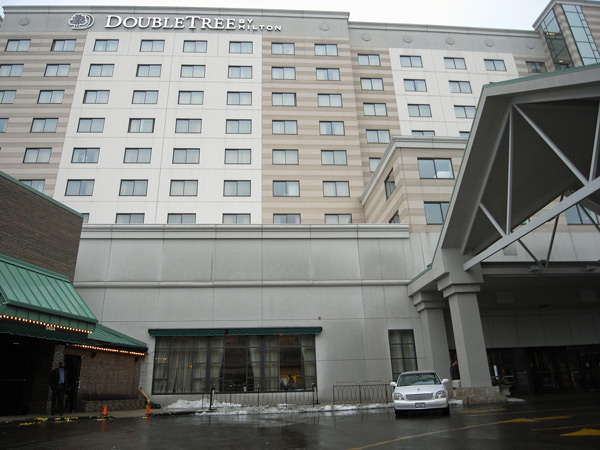
When Steve Davis told me that people were hungry for an audio show in Chicago, he wasn’t kidding. What Davis believes to be over 4000 attendees2000 tickets had been sold before the Show openedvisited over the course of three days, March 810. They mobbed many of the rooms on Saturday and actually managing to keep things lively in most of the rooms I visited on the 8th floor on Sunday. And that was with people having to choose among 90 exhibit rooms, a bunch of table displays, an art show, multiple seminars, and lively marketplace that together extended over five floors of the Doubletree in Rosemont (Ground, mezzanine, and all of floors 7, 8, and 9) near O’Hare Airport. (My thanks to John Atkinson for standing outside in the pouring rain to get the photograph of the hotel.)
I don’t know what the sound was like at Chicago’s last consumer audio show, sponsored by Stereophile, which took place in the Palmer House Hilton in the Loop in 1999, but at the Doubletree, a large number of dealers and manufacturers managed to produce good to excellent sound within the confines of hotel rooms that they had never before exhibited in.
To-Morrow is Not Just Another Cable
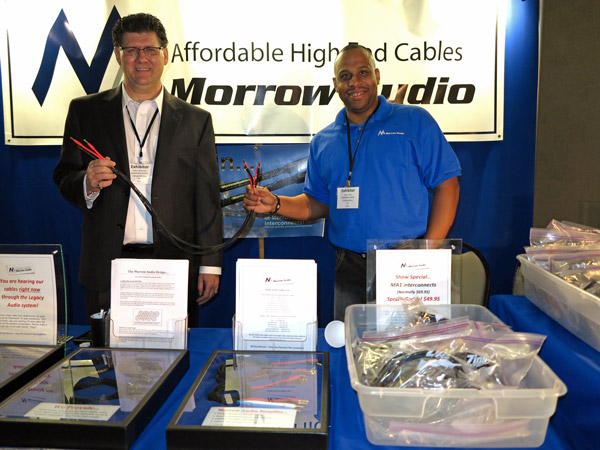
With deepest apologies to Scarlet O'Hara, and perhaps even deeper apologies to the Deep South and Bad Pun Police, it's time to toot the horn of Morrow Audio of Northern Kentucky. Mike Morrow (on the left), who began the company in 2006, came to AXPONA with Larry Love (on the right) to proudly announce Morrow Audio's partnership with Legacy. Morrow, who initially started out as a Legacy dealer, has seen his business grow 25%/year. Currently selling direct on the net, he and Love have plans to start a dealer network. When? Well, tomorrow is another day.