

New SVS Subs
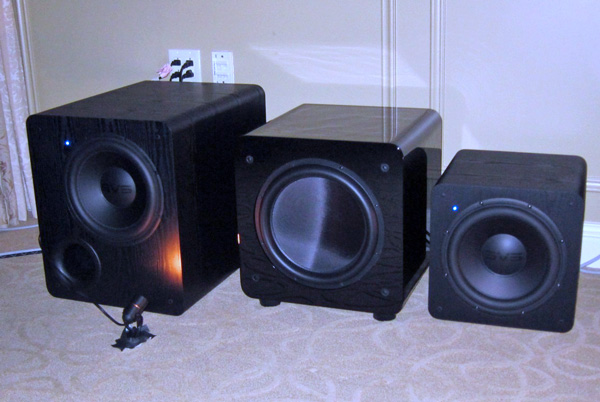
SVS showed two new subwoofers, both based on a newly-developed 12" driver that features dual ferrite magnets, a reinforced Nomex spider, a long-throw rubber surround and tinsel leads integrated into the cone to eliminate tinsel slap and improve reliability. Each is also powered by a amplifier, the Sledge STA-500, rated at 500W continuous and it incorporates a DSP engine with an array of filters, controls for volume, gain and phase as well as a frequency-dependent limiter/compressor to control driver behavior. Both driver and amp come in a compact sealed design, the SB-2000 ($699, right above) with a FR of 19-240Hz and in a larger, more powerful ported design, the PB-2000 ($799, left above). During a brief audition, even the smaller SB-2000 seemed more than capable of filling the demo room with powerful, tight bass.
New Tannoys
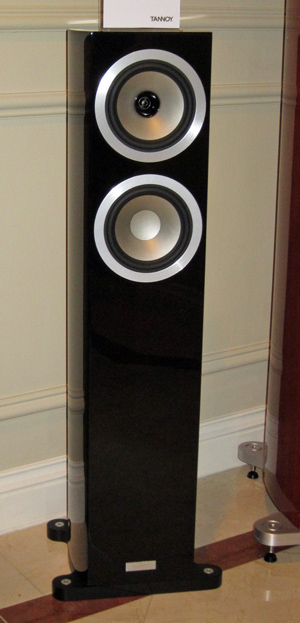
The name Tannoy is, of course, synonymous with "Dual Concentric" and their classic designs were in full display and demonstration. Off to the side, however, they were showing their new Precision range of more affordable designs, which are based on a new implementation of the Dual Concentric concept in a 6" driver that incorporates a wide-band tweeter.
Nola Concert Grand Reference Gold
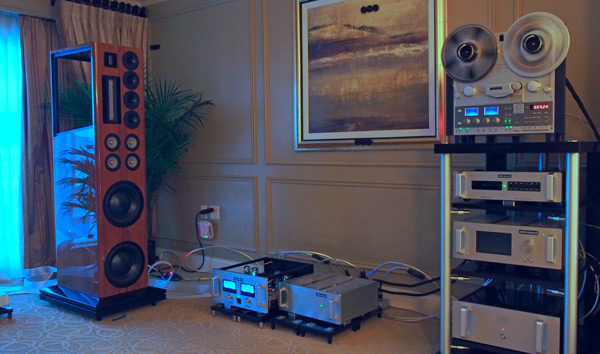
On first glimpse, Nola’s Carl Marchisotto appeared to be demming the same Concert Grand Reference Gold loudspeakers he had shown at the 2013 CES. However, those were the preproduction protypes and the 2014 show featured the production version. Costing the same $197,000/pair, the speaker features a new ribbon supertweeter taking the response up to 100kHz and two new Gold Technology woofers operating below 40Hz. Driven by an Audio Research Reference 75 stereo amplifier and an Audio Research Reference 10 preamp, with source two United Home Audio Tape decks running 15ips, 2-track analog tape and hooked up with Nordost Odin cabling, the sound in this room had an impressive, full-range sweep that usefully loosened up as the show progressed and the speakers/system broke in.
Olasonic Nano Campo Line

Axiss Distribution was on hand to display new products from Olasonic including a CD transport and DAC (shown in photo). Axiss' Arturo Manzano explained that Olasonic is a Japanese company comprised of ex-Sony engineers who had worked on SACD development. The products are made in China and come in white or black finishes while retailing for $800 each.
On The Left: PCM

As I walked into "The Hi-Res Audio Experience" ballroom, I scanned the room and noted several high resolution audio vendors along the walls. Then I noticed an odd symmetry to the arrangement: the PCM distributors and labels were lined up on the left, while all of the DSD folks were lined up on the right.
I was wishing this wasn't symptomatic of greater divisions between the two HD audio worlds, but when someone in a DSD booth asked if I'd be back for the big PCM vs DSD battle the next day, with a gleeful glint in his eye, I realized this might be shaping up as a format war after all. I sure hope not.
On The Right: DSD

The DSD exhibitors included Native DSD Music, Blue Coast Music and representatives for Acoustic Sounds new download web site: Super Hi-Rez. In all fairness it should be pointed out that Super Hi-Rez offers both DSD and PCM HD downloads, though the numbers of titles seem heavily weighted towards DSD at this point.
One touch—the BeoSound Essence

"One touch," that’s all it takes for you to enjoy your music, said B&O CEO Teo Mantoni, introducing the Danish company’s BeoSound Essence music-streaming system to the press at CES, and compared that one-touch solution to the current compendium of 10 swipes and presses that you need to playback a Spotify playlist from your smartphone. Mr. Mantoni is holding the elegant Essence Remote in his hand; a ring around the small aluminum puck controls volume and play/pause, forward and backward buttons are embedded on the top. The circular puck is available as wall-mount and desktop versions, and a remote box both connects to the playback system and is the center for AirPlay streaming, DLNA streaming, Spotify Connect, QPlay and Internet radio stations.
Pass Labs Pays Tribute to Sony

“A kiss back to Sony,” was how Nelson Pass described the debut of a unique pair of Pass Labs monoblocks driving Sony’s SS-AR1 speakers in the Sony room at Venetian. And it was an affectionate kiss indeedthe sound in this room, with a Pass Labs XP-20 preamplifier and Sony’s HA-P1ZES media player, I thought one of the best of the 2014 CES. Yes, it had superb clarity and dynamics, with an impossibly low noisefloor on the 24/176.4k Reference Recordings file of Stravinsky’s Firebird, but these qualities were even apparent on a Red Book file of a Rossini opera excerpt. There was something just right about the sound.
Pass Rises High to .8
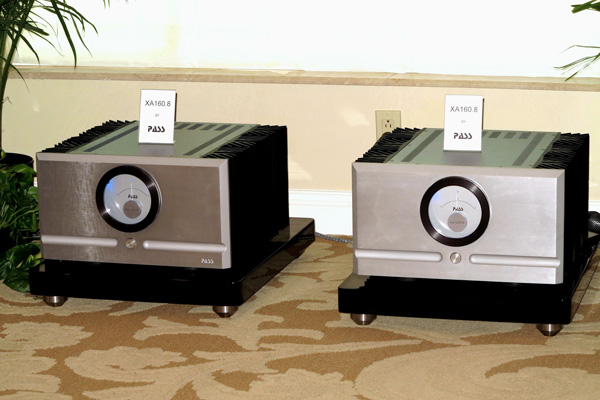
Before I learned a thing about Pass Labs' new .8 Series of amplifiers, which is designed as the new bridge between the company's current .5 and XS Series, Pass's Kent English welcomed me to listen to the Impex Records LP transfer of an RCA Red Seal 1958 mono recording of Beethoven's Violin Sonata No.8 with Jascha Heifetz and Emanuel Bey. (Only 2000 LPs were pressed, and this was number 1244.) Wow! The clarity and believability of the presentation were phenomenal. Bey's piano was recorded far too distant, but the layered complexity of the sound of Heifetz's violin was mesmerizing. All that audiophile talk about hearing the sound of the rosin on the bow had never before seemed as real as when I auditioned this recording. And the presentation was musical to boot!
Pathos Musiteca Music Server
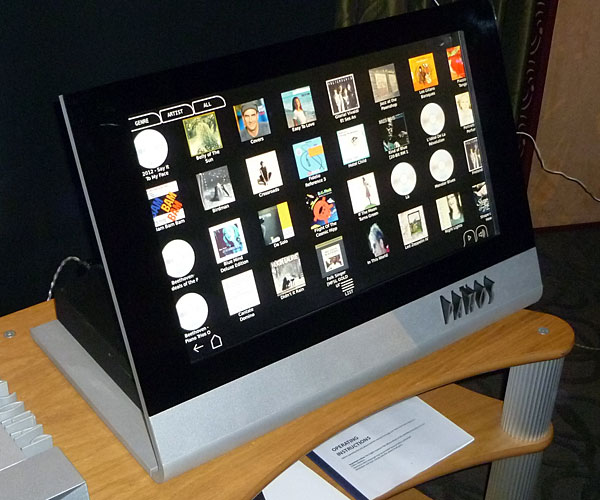
Having had a Meridian Sooloos in my system for the last few years, I'm a sucker for a nice big touch screen for controlling a music collection. Done right, there's nothing like it. So I made a beeline to the $9,995 Pathos Musiteca, which I first observed in prototype form at a previous CES.
Very similar in features to Meridian's Control 15, with built in 1TB drive, CD slot for ripping discs and network connection for gathering metadata, the Musiteca also has a built in tube DAC based on the design for the company's Endorphin CD player.
The Musiteca has beautiful styling, however when I started tapping the screen and calling up music, I found it a bit pokey in the speed department. Also, there is currently no method for adding more hard drive space in case you exceed the roughly 2,000 CD storage capacity.
Still, it looks gorgeous sitting there and should be available in April.