

Clearaudio's Absolute Phono
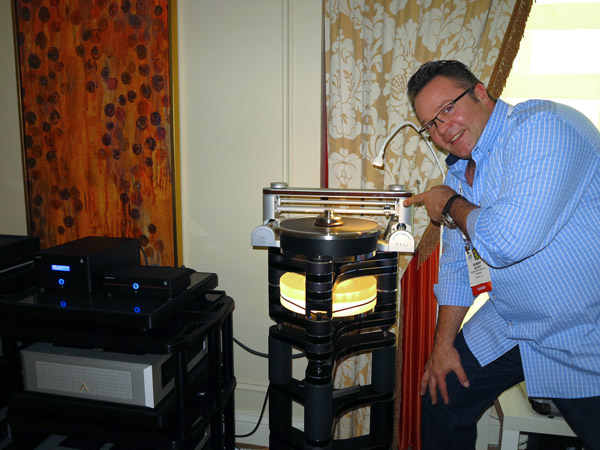
Clearaudio's Robert Suchy points to Clearaudio's Absolute Phono ($15,000), a unique moving-coil phono stage system, here installed in the headshell of the TT1i Tangential tonearm ($30,000), which includes its own amplification stage. I am told there are no loading issues, and that the arm can accommodate any cartridge and produce sound without the use of coupling capacitors in the signal path. A second version of Absolute Phono is on the way. Also distributed by Musical Surroundings, its active headshell stage will be outboard, allowing it to be used with other tonearms.
Constellation Comes Nearer to You

Trickle-down theory may not work on the economic front, but it sure seems to apply to Constellation Audio's prestigious products. After a very high priced launch, the company has slowly introduced lower-priced products. Most exciting is the arrival of the Argo 125Wpc integrated amplifier ($20,000, above), whose price is one-third that of the Virgo preamp and Centaur amp. With four inputs (two balanced), a preamp output that can run headphones, and two slots in back for optional, not-yet-available phono and DAC cards, the Argo will ship by February.
Control from Soulution
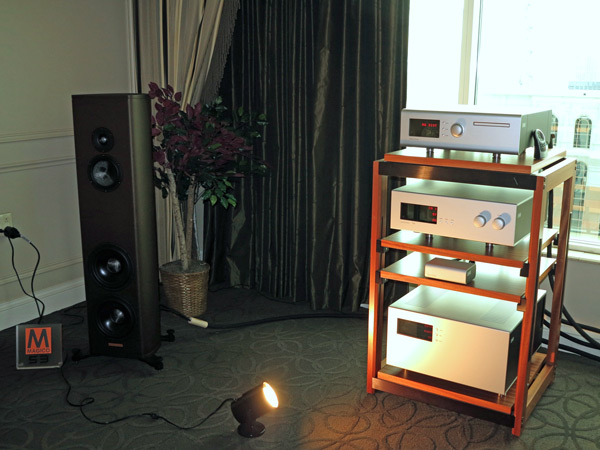
"Bass really impressive . . . very neutral," I wrote in my notes as I listened to the Budapest Symphony Orchestra blast away in the last movement of Mahler's Symphony 1. "Really excellent in clarifying complex instrumental layers that other systems blend together. A little toned down on top and lacking in ultimate color, but rich in ultimate clarity and control."
Cozying up with Rogue's Egyptian Royalty

In one of the last rooms I visited on the 30th floor of the Venetian hotel, Mark O'Brien, Rogue Audio founder, president and electrical engineer/designer, debuted the big brother of the Rogue Audio Sphinx, the Pharoah hybrid integrated amplifier ($3495). A tube/solid-state hybridtheir literature variously claims the power at 185Wpc and 175Wpc into 8 ohms, 350Wpc into 4 ohmsthe Pharoah includes an adjustable MM/MC phono preamp section, tube headphone amplifier, processor loop, and home-theater bypass. Paired with a Dr. Feickert Analogue Woodpecker turntable with Jelco tonearm and Arché headshell, Ortofon Cadenza Black cartridge, Synergistic Research "Core" cabling and Quantum power strip, and Dynaudio Confidence C1 II loudspeakers, the system exhibited quite lovely, fairly neutral, and extremely listenable sound. "A good cozy-up system," I wrote in my notes.
Creek EVO 50CD Player/DAC

Creek's new EVO 50CD made its debut at CES and will also include a DAC built around 2 Wolfson 24/192 chips. On the back will be coaxial, toslink and USB inputs as well as coax and toslink as well as analog outputs. The player/DAC with USB will be available in spring this year for $1,495.
Dali's Kubik Free speaker
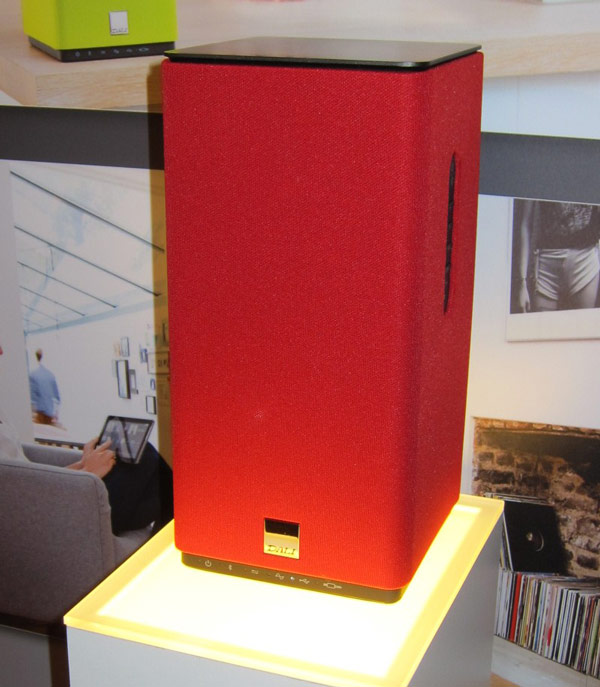
When I asked for something new and under $2000 at the Dali room, I was shown their new Kubik Free speaker ($1295/pair). This active compact single-stereo speaker with Bluetooth, USB, optical (up to 24/96) and analog was not exactly what I was looking for even though it did sound pleasant by itself. However, I was won over when it was demonstrated with its optional Kubik Xtra ($695) passive mate to produce some really spacious and open stereo sounds. Sure, adding the matching Sub 1 ($695) puts it over $2000 but the contribution to the sound was substantial. The Kubik system looks like and has the features of a life-style system but it is definitely a Dali.
Dan D'Agostino Master Audio Systems' Eye Candy

Given Dan D'Agostino's products recent awardsStereophile Joint Amplification Component of the 2013 for the original Momentum monoblock amplifier, and CES 2014 Innovations Design and Engineering awards for the Momentum preampit's no wonder everyone was buzzing around the new Momentum integrated amplifier ($45,000). Manufactured inyou're going to love thisCarefree, AZ, the Momentum integrated is a no-compromise design that includes the same preamp and stereo boards used in the Dan D'Agostino Master Audio Systems' separates
Daniel Hertz and Mark Levinson's Major Statement
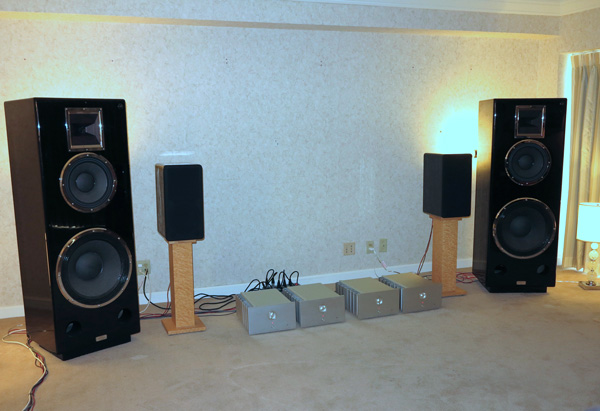
When I entered the Daniel Hertz room, close to a full house was sitting at attention as someone was giving a spiel about room correction. As I wrote in my notes, "I don't know what's going on, but the choir is overloading and the sound is too warm." Said person, whom I only later learned, after I left the room, was Mark Levinson, then announced that he wanted to show off the system's dynamic range. "Any sound known to man this system can reproduce," or something very close to that, he declared as he proceeded to play sounds created by Norah Jones.
Darin Fong's "Out Of Your Head"
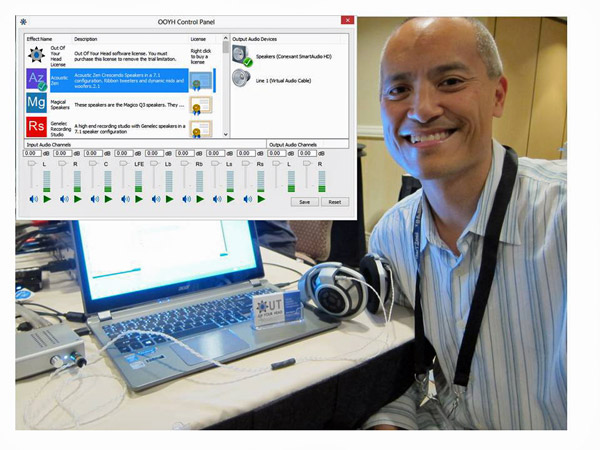
Over at T.H.E Show at the Flamingo, and surrounded by booths offering all sorts of discs and their supporting paraphernalia, I came upon Darin Fong's table of laptops and headphones but he was not selling any of those. His company, Darin Fong Audio, is offering a software program called "Out Of Your Head" which reprocesses stereo and multichannel sources so that you can hear them as you would over a loudspeaker-based system. This is similar, in intent, to the marvelous Smyth Realiser that I reviewed in November 2010, but, at just $149, is much more affordable. Like the Smyth, it supports multiple presets (acoustic environment files) although it is not personalized to the user's own HRTF. It was also quite effective. There is free trial version on the website.
DartZeel's Integrated Streaming Amplifier

DartZeel's prototype LHC-208 integrated line amplifier with double DSD DAC and full digital streaming capabilities ($TBD, due early summer) was hardly broken in, but its potential was beginning to emerge at T.H.E. Show. Thanks as well to Evolution Acoustics' MMMicroOne loudspeakers and the company's top-of-the-line cabling, I could hear into the heart of the Nash Ensemble's Red Book recording of Brahms Piano Quartet No.3 in c. No hi-res content was available, alas, given that a previous visit by an esteemed member of the press had inadvertently obliterated it. But the appetite was whet, especially by the potential of LHC-208's two clocks to eliminate jitter.