Stand Loudspeaker Reviews

Sort By: Post DateTitle Publish Date

Snell Acoustics LCR7 XL loudspeaker
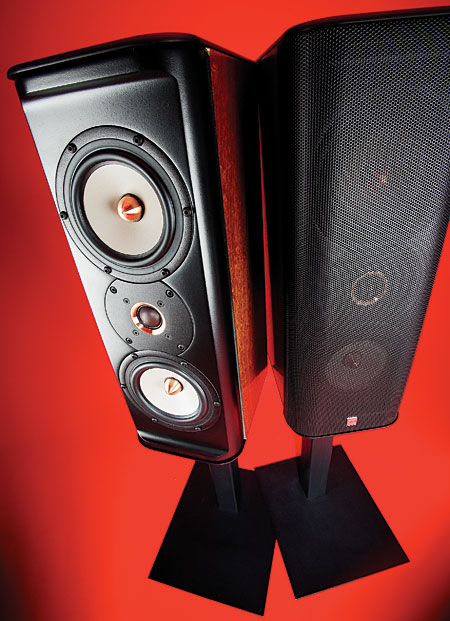
When someone is described as having "written the book" on a subject, it is generally taken as a figure of speech. But veteran speaker designer Joseph D'Appolito, PhD, quite literally "wrote the book." His Testing Loudspeakers (Audio Amateur Press, 1998) is an invaluable resource for those of us who, lacking any talent for designing speakers ourselves, nevertheless find the subject of speaker performance endlessly fascinating. So when Snell's PR consultant, Bryan Stanton, contacted me a while back about reviewing the LCR7, the first design D'Appolito had seen through from start to finish for the Massachusetts-based company since he had replaced David Smith as Snell's chief engineer, I suffered from more than a little anxiety.


Focal Electra 1007 Be loudspeaker

Back at the end of September 2005, I dropped by Jonathan and Kathleen Scull's Chelsea loft after work. I can't remember why; I think I was returning some gear. But we had also just finished shipping the 2006 Stereophile Buyer's Guide to the printer that day, and it was possible that I needed some high-quality musical R'n'R. Sitting in Jonathan's listening seat—the legendary Ribbon">http://forum.stereophile.com/photopost/showphoto.php/photo/450/password… Chair"—and enjoying the sound of his system, I flashed on the days when he worked for Stereophile full-time and I occasionally used to pop round to his place, just two blocks away from what was then our office, on Manhattan's Fifth Avenue. Whatever components Jonathan was writing about, a consistent factor in the always superb sound of his system was the presence of the pair of JMlab">http://www.stereophile.com/floorloudspeakers/273">JMlab Utopia loudspeakers that he had reviewed in the April 1998 issue of Stereophile. The Utopias delivered a seamless, full-range presentation that served Jonathan's eclectic taste in music while also allowing him to easily hear the effects, good or bad, of the various tweaks he was always trying.


Audio Note AN-E Lexus Signature loudspeaker

Given Audio Note's early dominance of the low-power scene, you'd expect any loudspeaker from them to be a high-efficiency design, and you'd be right. What you wouldn't expect is how they go about doing it, since none of the 20-odd models in their speaker line appears to be much more than a plain-Jane two-way box, with nary a horn or whizzer in sight.


Dynaudio Focus 140 loudspeaker

Perhaps there is no subject more vigorously debated among audiophiles than the primacy of the loudspeaker. Many 'philes believe there is no more important element in a hi-fi system—after all, they reason, it doesn't matter how good the components ahead of the speakers are; if the transducers can't reproduce the signal, you can't hear it. On the other hand, the source adherents maintain, speakers can't reproduce information that hasn't been retrieved from the recording. Loudspeakers can limit the amount of information you hear, but they can't increase it. This is one of those irresolvable paradoxes similar to the question of which came first, the roast chicken or the omelet.


Usher Audio Technology S-520 loudspeaker

The last few years at our annual Home Entertainment Show, many readers have come up to me and asked: "How do you select which speakers to review?" In my case, most candidates are either new products that have impressed me when demonstrated at our HE Shows, or new products from manufacturers whose designs have impressed me in the past. Occasionally, editor John Atkinson gets wind of a speaker and asks if I'd like to review it. But once in a while, a manufacturer reads a rave review of a competing product that makes his or her blood boil.


NHT Xd active loudspeaker system

NHT's Xd system is what audiophiles have been saying they want: a matched loudspeaker system that optimizes the performance of its components for a real-world domestic listening environment. But with their dollars they've voted against just such systems for years. If we put our money where our mouths are, active speaker systems such as Meridian's DSP or those used in recording studios would dominate the High End.


Paradigm Reference Signature S2 loudspeaker

Canadian company Paradigm has made a name for itself over the past 20 years with affordably priced, high-performance loudspeakers. Its Reference Series designs have garnered much praise from this magazine—I was well impressed by the floorstanding Series 3 Reference Studio/100 ($2300/pair) last">http://www.stereophile.com/loudspeakerreviews/105paradigm">last January, my review following hard on the heels of Kalman Rubinson's enthusiastic recommendation of the smaller Studio/60 v.3 ($1600/pair) in December">http://www.stereophile.com/loudspeakerreviews/1204paradigm">December 2004, while the bookshelf Reference Studio/20 ($800/pair) has been a resident of Stereophile's "Recommended Components" listing ever since Bob Reina's original review in February">http://www.stereophile.com/loudspeakerreviews/628">February 1998.


In Praise of a Classic: the BBC LS3/5A

If there's one article in Stereophile that generated more reader response than any other, it was Peter Breuninger's review of the classic Fisher 500-C tubed receiver in June 2005. Peter reviewed another classic component from the 1960s, the Bozak B-410 Concert Grand loudspeaker; my involvement in the review, in the October 2005 issue, brought home to me with a vengeance how much the science of speaker design has evolved in the 40 years since this armoire-sized model was introduced.
Advertisement
Advertisement
Advertisement