Stand Loudspeaker Reviews

Sort By: Post DateTitle Publish Date

Infinity Intermezzo 2.6 loudspeaker

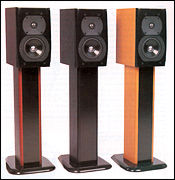
You can bet Infinity plans on selling a respectable number of $8000/pair Prelude">http://www.stereophile.com//loudspeakerreviews/295/">Prelude MTS speakers (reviewed in the May 2000 Stereophile) over this ambitious, full-range design's anticipated lifespan. But will the company make enough money to recoup the megabucks spent on researching, designing, and developing the all-new CMMD (Ceramic Metal Matrix Diaphragm) drivers, BASH (Bridge Amplifier Switching Hybrid) powered subwoofer, and RABOS (Room Adaptive Bass Optimization System) bass-equalization system? NOWAY (Never Over-Estimate What Acronyms Yield).

Dynaudio Contour 1.3 Mk.II loudspeaker

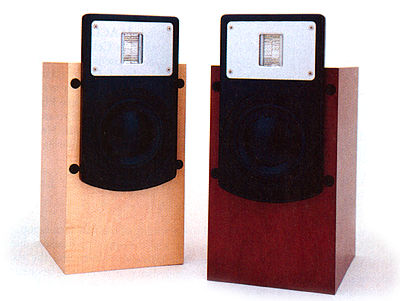
Dynaudio's $2399/pair Contour 1.3 Mk.II follows on from the Mk.I, which grabbed Russ Novak's enthusiastic attention in November 1996 (Vol.19 No.11). Because a full description was included in the original review, I will only touch briefly on the differences between the original version and the sample reviewed this month. A Special Edition of the Contour 1.3 is also available for $3499/pair. Sam Tellig's comments on the sound of this loudspeaker appeared in the December 1999 Stereophile and are included at the end of this review.


Thiel PCS loudspeaker

Although Kentucky loudspeaker manufacturer Thiel has produced some standmounted models for home-theater use, all of their serious music speakers have been floorstanders. Enter the PCS: even though styled to match every Thiel speaker since the groundbreaking CS5 of 1989, the 19"-high PCS sits on a stand, not the floor.


Mirage MRM-1 loudspeaker

The Mirage OM-6 loudspeaker, from Canadian manufacturer Audio Products International, mightily impressed Stereophile's Tom Norton when he reviewed it back in November 1997. But with its "omnipolar" design and powered woofer, the OM-6 wasn't a speaker for those of us with more conventional tastes in speaker design. So when I heard that Mirage's Ian Paisley was working on a high-performance two-way minimonitor based on the OM-6's drive-unit technology, I asked API's affable PR man, Jeff Percy, for review samples.


Acoustic Energy Aegis One loudspeaker

In this issue's "Letters" column, you will find comments from readers who are bothered by what they perceive to be this magazine's emphasis on reviewing very expensive technology. Yes, we do cover a lot of cutting-edge technology, and it is, of necessity, expensive. But our experience has been that that technology invariably trickles down to products that real people can actually afford.


PSB Alpha A/V loudspeaker

The original PSB Alpha was reviewed for Stereophile by Jack English in July 1992 (Vol.15 No.7). A modest-looking two-way priced at just $199/pair, it combined a reflex-loaded 6.5" woofer using a plastic-doped paper cone with a 0.5" plastic-dome tweeter. JE summed up the Alpha by saying it "is simply one of the best buys in audio, providing a musically satisfying sound...a sensational audio bargain." It went on to become one of the best-selling audiophile speakers ever, with over 50,000 pairs sold.


Evett & Shaw Elan loudspeaker

Like many audiophiles, I am finding myself listening to more and more music sitting in front of my computer. My experience with the little plastic-box horrors sold as "computer speakers" has not been positive, however, with even models from Altec Lansing and Cambridge SoundWorks scoring an "F." For a long time, therefore, I used a pair of RadioShack Optimus LX5s, stuck at the far ends of my desk because their unshielded drivers messed with the colors on my monitor. I tried and liked a pair of the A/V version of PSB's best-selling $249/pair Alphahttp://www.stereophile.com/loudspeakerreviews/241">Alpha;. Then Jonathan Scull recommended I try a pair of the diminutive Elans from Utah-based Evett & Shaw, with which he had been impressed at the 1999 Consumer Electronics Show.


B&W Nautilus 805 loudspeaker

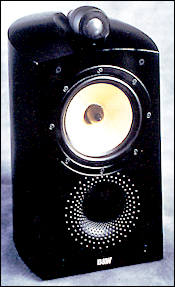
Unless you've recently returned from a five-year tour of Tibetan monasteries, the odds are pretty good you've heard about the Nautilus revision of B&W's classic three-way floorstanding monitor, the 801. Having sold 30,000 of the earlier 801, the Matrix, B&W recently revised this classic to incorporate some design features of its $40,000, four-way concept speaker, the Nautilus. Wes Phillips reviewed the new Nautilus 801 in the January 1999 Stereophile (p.107) and found it "incredibly dynamic, images and soundstages like crazy, and has that special magic that marks it as one of the great loudspeakers."


Genelec Studio Monitor 1031A loudspeaker & Studio Monitor 1092A powered subwoofer

Which loudspeakers do audio professionals listen to? And why should we care? After all, it's not as if recording engineers are the kind of refined, sensitive, music-loving types who read Stereophile. As much as they may love music, many audio pros appear only to view the original sounds of musical instruments as raw materials to be creatively reshaped and manipulated. (Okay, there are exceptions. But recordists who care about the sounds of real instruments usually record them in real acoustic spaces rather than in studios, and use as little signal processing as they can get away with.)
Advertisement
Advertisement
Advertisement