Solid State Power Amp Reviews

Sort By: Post DateTitle Publish Date

Mark Levinson No.53 Reference monoblock power amplifier

Mark Levinson founded Mark Levinson Audio Systems in 1972, but sold it, and the right to market audio gear under his own name, to Madrigal Audio Laboratories, then owned by the late Sandy Berlin, in 1984. Harman International bought Madrigal in 1995. As well as Mark Levinson, Harman's Luxury Audio Group now also includes digital processing pioneer Lexicon, speaker manufacturer Revel, and JBL Synthesis. The Mark Levinson brand is now headquartered in Elkhart, Indiana, at the Crown Audio facility, another Harman-owned brand. The No.53 ($25,000 each; $50,000/pair) is Mark Levinson's first new Reference series monoblock since the No.33, way back in 1993, when Madrigal owned the company. Like other Mark Levinson products, it is manufactured at an independent facility in Massachusetts.

Anthem Statement M1 monoblock power amplifier

When I first saw Anthem Statement's M1 at the 2011 CEDIA Expo, it was a bolt from the blue. Happening on this flat, black slab of an amplifier lying on a display table or bolted to a wall, reminded me of the appearance of the iconic monolith in Stanley Kubrick and Arthur C. Clarke's 2001: A Space Odyssey. The M1's dimensional ratios are not 12:22:32, and there are many other one-rack-unit amps—yet, like the monolith on the moon, the M1 was in such striking contrast to everything else in its environment that it demanded attention and reflection.

darTZeel NHB-458 monoblock amplifier

A recent (unpublished) letter to the editor argued that the reference for audio perfection is the sound of real instruments in a real space. The writer claimed that, since the art and/or science of audio is advancing, and because it is a "scientific truth" that the closer you get to perfection, the less divergence there is components, that therefore there should be less difference in sound among the components listed in Class A of Stereophile's "Recommended Components" than among those in Class B, much less Class C. This should be true of loudspeakers, he said, but even more true of top-rated amplifiers, since "they inherently have less divergence."

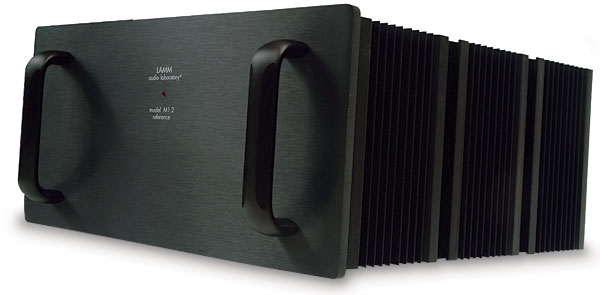
Lamm M1.2 Reference monoblock power amplifier

There is always a conflict between the needs of reviewers and the realities of the marketplace. Once a reviewer has invested his time and energy in a review, he would like that product to remain in production for all time, which would allow it to be used as a reliable recommendation forever. But whatever the product and whatever the category, sales of a product almost always follow the same triangular curve: a sharp rise at the product's introduction, a maximum reached sometime thereafter, and then a steady decline to a sustained but low plateau. Marketing-minded manufacturers therefore introduce a new model every three or four years, in hopes of turning that single triangle into a continuous sawtooth wave.

Musical Fidelity AMS100 power amplifier

"That's just silly on so many counts, Antony."


I was talking last winter to Musical Fidelity's Antony Michaelson, who had been enthusing about his forthcoming stereo amplifier, the AMS100. It would be physically enormous—almost a yard deep—and commensurately heavy at 220 lbs. Despite its bulk, its maximum rated output would be just 100Wpc into 8 ohms. It would also be expensive, at $19,999. And to cock a snoot at environmentalists and their concerns, the AMS100's output stage would be biased into class-A up to its rated 8 ohm power, meaning that, even when not playing music, it will draw around 10 amps from a typical US wall supply of 120V. This also means that it will run very hot, making the amplifier impracticable for summer use in homes without central air-conditioning. Like mine.

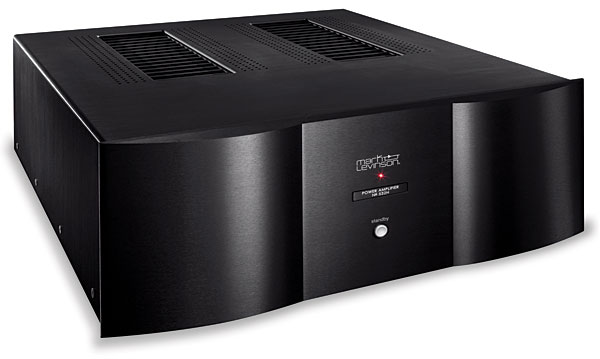
Mark Levinson No.532H power amplifier


"Larry, you have too many amplifiers!" exclaimed John Atkinson during a recent visit. This surprised me—I didn't think it was possible to have too many amps. While I'm not going to open an amp museum, I do have a starter collection of Mark Levinson amplifiers from different eras. This either makes me exactly the right or the wrong person to size up Mark Levinson's new No.532H.

Soulution 710 power amplifier

That is not a typo. The company is named Soulution—as in soul commitment to designing and manufacturing the finest audio gear it knows how, as in souldiering on in the face of skeptics who can't imagine why a power amplifier that puts out 130Wpc into 8 ohms or 260 into 4 ohms should cost $45,000, or weigh as much as a small pickup truck.

Plinius Audio SA-103 power amplifier

Audio reviewers are kinda slutty. Not sexually, of course, but in the way we promiscuously go through equipment. Like the most popular girl in school, or Tiger Woods, we have our choice of any hot thing we want, whenever we want it. Heck, reviewers don't even have to pick up equipment at bars or clubs: the stuff is delivered right to our homes. We use the gear for a few months, then send it packing once the next hottie comes over to play in our room.

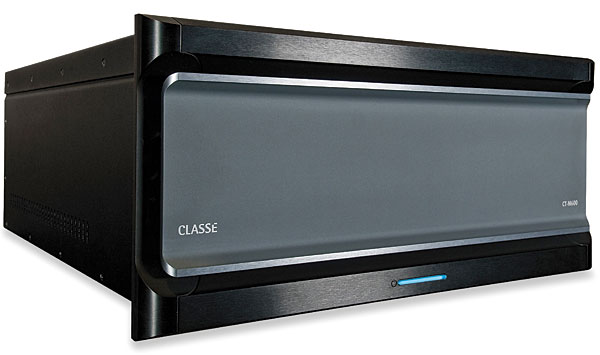
Classé CT-M600 & CA-M600 monoblock power amplifiers

On the face of it, the power amplifier has the simplest conceptual task of any audio component. Fed an audio signal at its input, all it has to do to satisfy the demands for current made by the loudspeaker is to modulate a high-voltage voltage supply with that signal. Yet power amplifiers vary enormously in their ability to perform that task without editorializing. As a result, when I find an amplifier that appears to step out of the way of the music in the manner I desire, I make the commitment, I buy it, and I stick with it.
Advertisement
Advertisement
Advertisement