Interviews

Sort By: Post DateTitle Publish Date

What's His Naim? Julian Vereker

Editor's Introduction: One of the big industry stories of 1985 was the split, both personal and commercial, between the British Linn and Naim companies. Led by Ivor Tiefenbrun and Julian Vereker (footnote 1) respectively, both companies had started up in the early 1970s. Both men held similar views, both about the fat-cat complacency of British designers (which had led to a grievous sound-quality slump in the mid '70s), and about the system rethinking necessary for what some writers, unaware of the rigors of thought required by followers of that spiritual descendant of Fowler, William Safire, would term a "quantum leap" forward in sound reproduction.

John Bau: Interstellar Overdrive

Elsewhere in this issue, I review the new Spica Angelus loudspeaker, only the fourth product to appear from this Santa Fe-based manufacturer since it started operations at the end of the 1970s. You will have to read the review to learn what I thought of the speaker, a distinctively styled floor-standing two-way, but I also thought it would be beneficial to talk with Spica's founder and chief engineer John Bau. I therefore made arrangements to meet with him in their facility just a couple of blocks from Stereophile's old Early Street HQ. I had been told that John was tall, but until he unfolded himself from his stool in his laboratory, surrounded by computers and computerized test equipment, I had not realized how tall! Undaunted, I settled into a conventional chair, pointed the microphone in a vaguely upward direction, and asked John how he had gotten into loudspeaker design.—John Atkinson

Pierre Lurne: Audiomeca's Turntable Designer

Someone, I forget who it was, once wrote a perceptive essay on how in any field of human endeavor, apparent perfection is attained only when that field is in the process of being superseded. The Palace at Versailles was built when the power of the French monarchy was well into decline; Wagner's "music of the future" was in fact the end of a particular line of development; the nuvistor was developed almost simultaneously with the silicon transistor which would render tubes almost obsolete; and six years after the commercial introduction of Compact Disc, with record shops increasingly filling up with silver discs, to the detriment of black, turntables exist which render LP playback pretty much on a level with CD technically (many audiophiles, of course, feel that the LP has always been musically ahead).


Henry Azima: A Mission to Succeed

1087azima.jpgIn its first three years, UK hi-fi manufacturer Mission Electronics employed a number of engineers to reinforce the creative talents of founder and hi-fi enthusiast Farad Azima. The lineup included John Bicht, now with Versa Dynamics, and Stan Curtis, now heading up Cambridge Audio. But when Farad's brother Henry—"Henry" is actually a nickname and I am sure you can see the derivation—joined the company in 1979, he brought both a much-needed stability, and initiated a considerable degree of commercial success for the company's products. Now resident in Canada, he spends his time commuting between his laboratory in Toronto and the company's headquarters near Cambridge, England (footnote 1). Prior to joining Mission, however, Henry had served in the Iranian Navy for 15 years, an unusual training for an audio engineer. I asked him if this had been an appropriate preparation for the world of hi-fi.


Henry Azima: I had actually been a student in the UK, studying electronic engineering at the University of Surrey in Guildford. When I left the Navy in 1979 after the revolution in Iran, I moved to the UK and got a job with my previous University as an Assistant Lecturer and Researcher. However, Farad then asked me out of the blue to join Mission. I said, "Well, I have no idea about hi-fi, and stuff like that." He said, "You will learn, there's no problem!"

Bill Firebaugh: The Well-Tempered Innovator

Bill Firebaugh's first product, the outrageous-looking Well-Tempered">http://www.stereophile.com/tonearms/485well">Well-Tempered (tone) Arm, established him as one of audio's most innovative designers. At the 1985 Winter CES, he showed a prototype companion product—the Well-Tempered Turntable—and was producing production units by January 1987. He discusses here the WTT's unusual design features. (Readers should note that, since we have not yet tested the new turntable, this interview is not to be interpreted as an endorsement of the product.)


A.J. van den Hul: Going Dutch

It was eight years ago that I first met Aalt Jouk van den Hul. I was visiting Ortofon in Denmark, and, with a group of hi-fi journalists from all over Europe, was traveling by bus to visit the cartridge-production facility in the far south of that country. Bus journeys are not my ideal way of passing time; naturally I gravitated to the rear of the bus, where bottles of Tuborg were making their presence felt. One journalist, however—a pixieish fellow hailing from The Low Countries—resisted the blandishments of the opened bottles. Producing a sheath of black-and-white glossies from his briefcase, he announced that he had just developed the ultimate stylus profile!


James Boyk: All-Tube Analog

It is a widely held belief that musicians do not assess hi-fi equipment in the same way as "audiophiles." I remember the British conductor Norman Del Mar—an underrated conductor if ever there was one—still being perfectly satisfied in 1981 with his 78 player, never having felt the need to go to LP, let alone to stereo. And some musicians do seem oblivious to the worst that modern technology can do. I was present at the infamous Salzburg CD conference in 1982, for example, where Herbert von Karajan, following one of the most unpleasant sound demonstrations in recorded history, announced that "All else is gaslight!" compared with what we had just heard. J. Gordon Holt proposed a couple of years back ("As">http://www.stereophile.com/asweseeit/348">As We See It," Vol.8 No.1) that sound is not one of the things in reproduced music to which musicians listen. I have also heard it said that even the highest fidelity is so far removed from live music that a musician, immersed in the real thing, regards the difference between the best and the worst reproduced sound as irrelevant to the musical message: both are off the scale of his or her personal quality meter.


The Music Goes Round & Round

"Turntable Wars" was the phrase used by Anthony H. Cordesman to head his review of the Oracle, SOTA, and VPI turntables in Vol.9 No.4. To judge from the reaction of the manufacturers at CES to this innocent phraseology, you would have thought that Stereophile had been warmongering, rather than publishing what were actually pretty positive opinions of the products concerned. So enraged was Jacques Riendeau of Oracle, and concerned that the record be put straight, that he insisted on a "right to reply" to AHC's review; as it happened, Ivor Tiefenbrun and Charlie Brennan of Linn (right in photograph, footnote 1), and SOTA's Rodney Herman (center in photo, footnote 2), also wanted to contribute to the debate, so a small crowd of illuminati gathered in Room 417 of the Americana Congress to commit opinions to tape. I held the microphone and clicked the shutter; Larry Archibald (left in photo) was there to lend the proceedings a businesslike air.

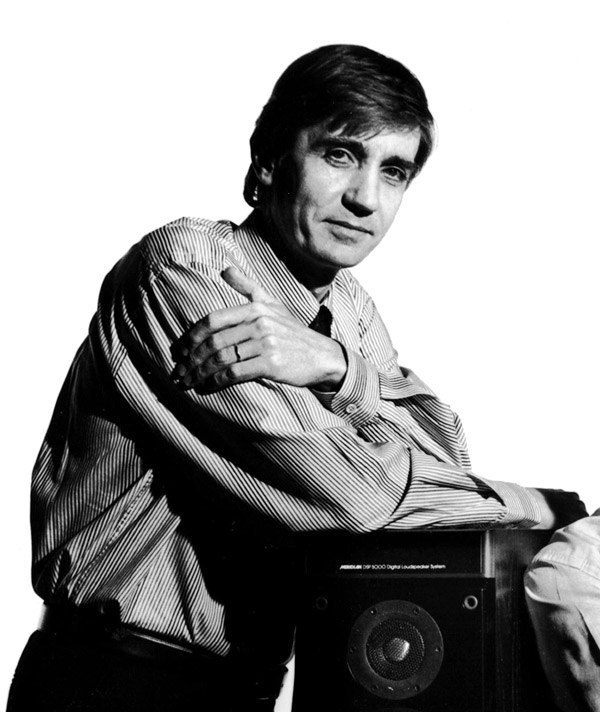
Meridian's Bob Stuart

Meridian's MCD CD player was perhaps the first audiophile-quality player to be introduced in the high-end market. I met with Bob Stuart of Meridian at the Winter Consumer Electronics Show in Las Vegas, in January, 1986 (footnote 1). My first question was about the name of the company he runs with industrial designer Alan Boothroyd:


J. Gordon Holt: Meridian in England is called Boothroyd Stuart, right?


Bob Stuart: Yes, the company is called Boothroyd Stuart, Limited, and the trademark is Meridian.

Doug Sax: From Direct-Cut to Compact Disc

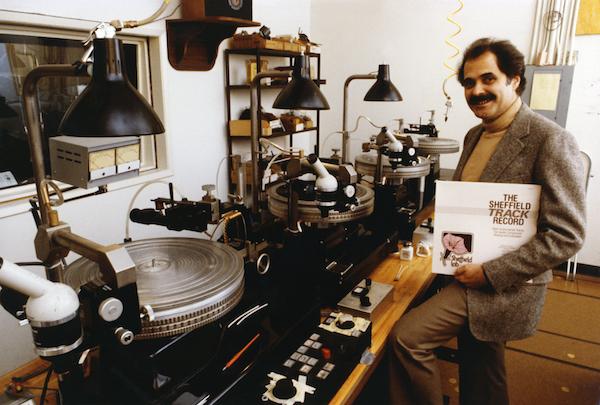
As reported by Michael Fremer on AnalogPlanet.com, legendary mastering engineer and co-founder of Sheffield Lab, Doug Sax, passed away on April 2. Doug had been suffering from cancer and would have been 79 on April 26.


Coincidentally, we had just posted J. Gordon Holt's October 1982 review of the Sheffield Track Record, which Doug had cut direct-to-disc. This reminded me that Robert Harley had interviewed Doug in the October 1989 issue of Stereophile; rereading that interview reminded me that in September 1984, I had published an interview with Doug in the magazine Hi-Fi News, which I edited at that time.


So, in tribute to Doug, here is my 1984 interview, reprinted with the kind permission of Hi-Fi News editor Paul Miller.—John Atkinson

Advertisement
Advertisement
Advertisement