Tube Preamp Reviews

Sort By: Post DateTitle Publish Date

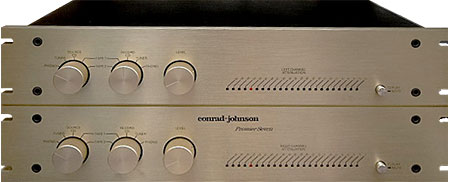
Conrad-Johnson PV10 preamplifier

Last September, in Vol.15 No.9, I started my quest for the Ultimate Kilobuck Tube Amp with reviews of the $995 Panor/Dynaco ST70-II and the $1695 Nobis Cantabile. While neither really fit the bill—the Dynaco fell a bit short in terms of sonics, while the Nobis was priced a bit higher than a thou—they got me thinking of the Ultimate Kilobuck Tube Preamp. Because the greatest amp in the world can only sound as good as whatever drives it, and there's no sense looking for a kick-ass affordable tube amp if you're going to play Scrooge McDuck when it comes to the preamplifier.
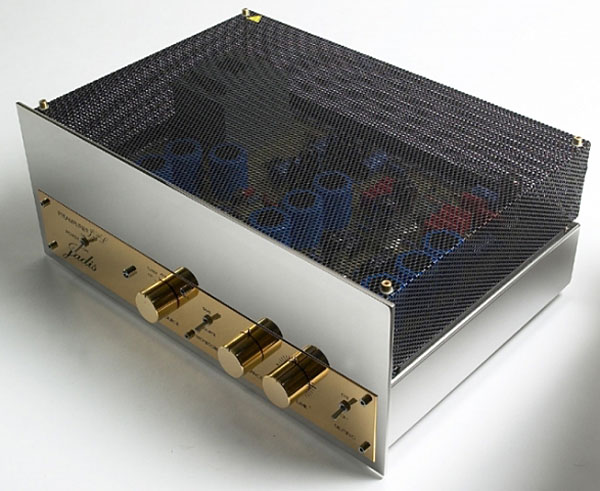
Jadis JPL line preamplifier

In its comparatively few years in the marketplace, the line-level preamplifier appears to have established commercial parity with its full-function big brother. That this was inevitable was clear as far back as the mid-'80s. The advent of the CD and the proliferation of digital sources argued for a modular approach to preamp design. In such an environment, line-level sources (eg, DAT, CD, even analog tape) deserve special attention.

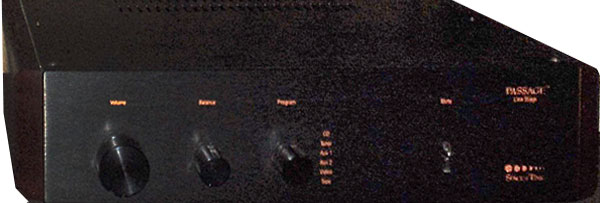
TARA Labs Space & Time Passage preamplifier

Better known for their speaker cables and interconnects, The Absolute Reference Audio Labs (TARA Labs) has quietly branched out into electronics and loudspeakers. Their Passage is a line-level–only preamp. I actually favor such a modular approach to preamp design. Standing as we are at the dawn of the digital audio age, the breakup of the traditional preamp into separate phono and line-level stages represents a more flexible, cost-effective design approach.

Conrad-Johnson Premier 7A preamplifier

Conrad-Johnson launched the all-tube Premier 7 in 1988 as an all-out sonic assault on the state of the preamplifier art. A great deal has happened since then. For starters, C-J has gotten a great deal of feedback from customers, dealers, and reviewers. None other than J">http://www.stereophile.com/interviews/66">J. Gordon Holt (Stereophile, November 1988, Vol.11 No.11) concluded that: "It appears that nothing which could possibly have improved its sound had been omitted....It is, in fact, about as close as any tubed preamp has come to being perfectly neutral in sound—in nearly all respects." In the now-defunct Sounds Like... (issue 3), Sam Burstein concluded that "It is, with certain reservations, absolutely delightful to one's musical senses." And, speaking of absolutes, even Harry Pearson gave the Premier 7 a rave in the first round of his preamplifier survey (TAS, issue 58). As icing on the cake, John Atkinson (Stereophile, Vol.12 No.8) concluded that the 7 had "the requisite degree of sonic magic to make it a Class A recommended preamplifier."


Conrad-Johnson PV11 preamplifier

I must admit that, for a long time, I found it difficult to accept the idea that a major portion of one's audio budget should be spent on the preamplifier. Speakers, yes—they produce the sound; amps drive the speakers, so they're important. And source components? Well, everyone knows it's garbage in/garbage out. But a preamp? Even the name suggests something that's not quite the real thing, like pre-school, pre-med, or premature. Unlike amplifiers, they don't have to contend with loads that sometimes approach a short circuit, and heat dissipation is not normally a problem. What's the big deal?
Cary Audio Design CAD-5500 "CD Processor" preamplifier

A "CD processor," is how I distinctly heard Cary Audio's Dennis Had describe it. The venue was Stereophile's High End Hi-Fi Show in New York last April. Nothing really unusual in today's digital marketplace, I thought to myself, though a bit out of character for a company dedicated to vacuum-tube technology. But wait a minute. Dennis had described it as an analog CD processor. Analog!? Well, yes, the unit processes the analog signal from a CD player.


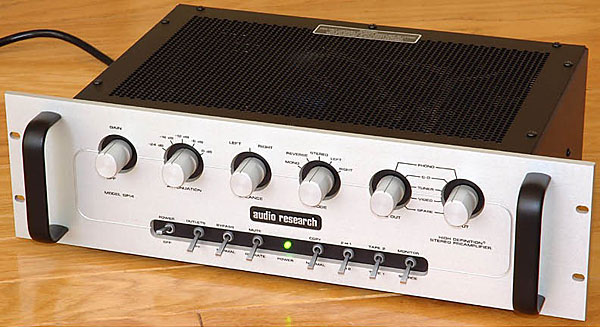
Audio Research SP14 preamplifier

The name "Audio Research" will be familiar to many readers of this magazine. It belongs on the list of that select group of manufacturers who continue to offer the audiophile and music lover equipment which enables him or her to truly enjoy the muse. With equipment of this caliber, one is no longer caught up in the anxiety-inducing process of listening to (evaluating) the equipment used in the presentation of the music. Instead, the listener can focus attention on the much more important message uncovered in the music via the performance and conveyed through the network of transducers, cables, tubes or FETs, more cables, more tubes or FETs, and more transducers, to the brain. If this process has been successful and our sensitivities heightened, our souls will be touched.

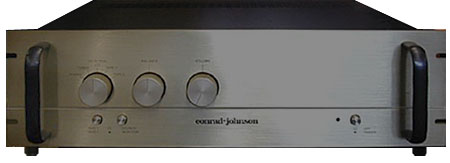
Conrad-Johnson PV9 preamplifier

As I write, it is garage-sale season here again in Santa Fe, and a recent sign near my home advertised "Over 3000 LPs, good condition, low prices." To my surprise, the seller wasn't a yuppie enamored of his new CD player but a true collector discarding the duplicates and dogs from his collection. 30 minutes later, many LPs heavier—including a mint Flanders & Swan At the Drop of a Hat (footnote 1)—and not too many dollars lighter, I returned to a great night's listening courtesy of the black vinyl disc.


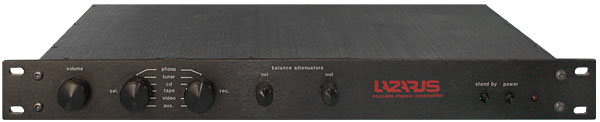
Lazarus Cascade Deluxe preamplifier

The Lazarus, a slim, quite elegant unit finished in black with red and gray legends, lived up to its advance billing: it literally rose from the dead! Out of its coffin (ie, shipping box) and plugged into the wall, it showed no signs of life. Troubleshooting revealed a blown AC mains fuse. That in itself was not a major problem, but what worried me was the root cause of the trouble. Preamplifiers as a rule are not power-hungry, so a current surge at turn-on sufficient to destroy the 250mA slow-blow mains fuse appeared symptomatic of a major circuitry failure.

Conrad-Johnson Premier Seven preamplifier

Whenever an audio high-ender thinks about tubes, he usually thinks about Audio Research. This is only natural, because Audio Research Corporation was almost single-handedly responsible for saving tubes from oblivion in the early '70s when everyone else switched to solid-state. But ARC was soon joined in its heroic endeavor by an upstart company called Conrad-Johnson, which entered the fray in 1977 with its PV-1 preamp, priced at an affordable (even then) $500.


Advertisement
Advertisement
Advertisement