Integrated Amp Reviews

Sort By: Post DateTitle Publish Date

Cayin SP-10A Integrated amplifier
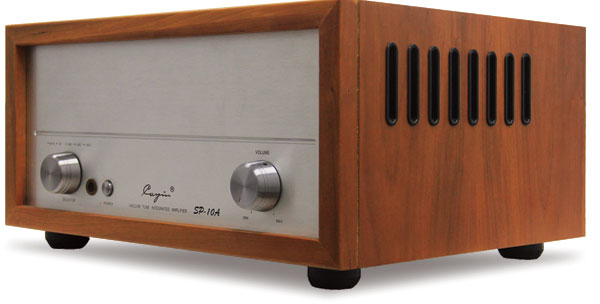


Stereophile has reviewed two integrated amplifiers from Chinese manufacturer Cayin in the past: the A-50T, which I wrote about very positively in March 2008, and the A-300B, which Art Dudley reviewed in February 2007. So when I read about Cayin's $2195 SP-10A integrated amplifier, which has a wood-covered sleeve, just like the old Marantz and McIntosh gear and offers 38 watts of push-pull power, in our coverage of the 2008 CES, I put in on my must-write-about list.

Harman Kardon HK 990 integrated amplifier

The very first amplifier I bought was a Harman Kardon PC-200, aka The Prelude. It was a 10Wpc integrated, but I chose it over the competition for some of the same reasons that the HK 990 has appealed to me. Almost all amps back in the1960s had a plain cake-pan chassis with tubes, capacitors, and transformers studding the top. Integrated amps had the standard four knobs on the front for input selection, volume, bass, and treble. The HK PC-200 had an enclosed black chassis cage that formed a graceful cowl over the brushed-copper front panel and the six matte-black knobs: for Input selection (with three phono turnover settings), Volume, Bass, Treble, Loudness contour, and Treble rolloff. In addition, it had a Rumble Filter switch. The PC-200 was not only more beautiful than the rest of the push-pull competition powered by EL84 tubes, it also had more useful features. (Take that, you fans of the Grommes Little Jewel!). Over the decades, H/K products have always been stylish and innovative, but in today's fractured marketing world, most such creative energies are applied to audio/video receivers and lifestyle products.

Luxman SQ-38u integrated amplifier

Let's not beat around the bush: this is what an amplifier is supposed to look like. The silver front panel contains over a dozen knobs and switches, yet somehow avoids seeming cluttered. The solid wood cabinet wouldn't look out of place next to Hugh Hefner's cognac decanter. And the controls! The SQ-38u is as full-function as they come ("as they used to come" would be closer to the truth), with a Balance knob, separate Bass and Treble Tone Controls, a low-frequency cutoff (aka "rumble") switch labeled Low Cut, a Mono/Stereo switch, and a mute button; plus switching and connectors for two pairs of loudspeakers. Everything but curb feelers.

Quad II Classic Integrated amplifier

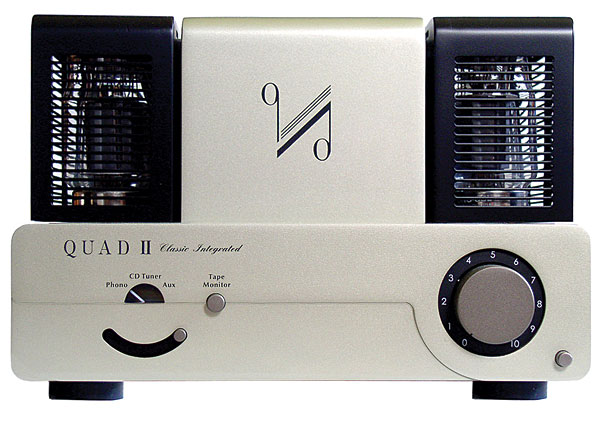
Given that Quad's founder, the late Peter J. Walker, wasn't around to design the Quad II Classic Integrated, the English firm relied instead on Tim de Paravicini, whose credits include the comparatively recent Quad II-eighty mono amplifiers and QC-twentyfour preamplifier (not to mention his own line of E.A.R./Yoshino electronics and countless other well-regarded products). It's with respect for both men that I say: In turning to Tim de Paravicini, Quad has probably chosen the closest approach to the original.

Micromega AS-400 D/A integrated amplifier

Blind though I am to the allure of blind testing, I can appreciate some degree of review-sample anonymity: Distinctive products elicit distinctive responses, but a plain black box encourages us to leave our prejudices at the door. It asks of us a certain . . . objectivity.


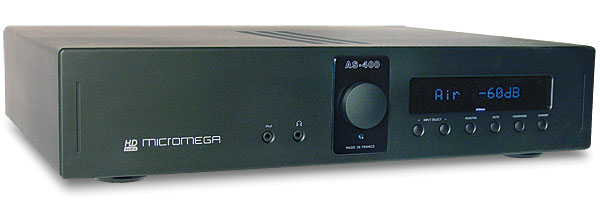
So it was with the Micromega AS-400 digital source/integrated amplifier ($4495), the anonymity of which was compounded, in my case, by a generous helping of forgetfulness: I suppose I was told, ahead of time, that this was a class-D amplifier, but at some point in time before my first at-home audition I apparently killed the brain cells responsible for remembering that fact. So I was innocent of conscious prejudice when I listened to this elegant cipher of a box and wrote, in my notes: "Dynamic, dramatic, and almost relentlessly exciting with some recordings. Imbued pianos with almost too much dynamism for the room—too much being very good!—but lacked some 'purr' in the die-away. Basically fine and fun. Wish it had a little more color and spatial depth."

Audio Note Jinro integrated amplifier

It's asked all the time, wherever audiophiles gather to grumble: "Everybody knows about Ferrari, Rolex, and Leica. But why hasn't anyone heard of . . ."


The last word is up for grabs: Wilson? Levinson? Linn? Maybe. But for me, whenever I'm in pissing-and-moaning mode, the choice is easy: Why hasn't the average consumer heard of the Audio Note Ongaku?

Linn Majik DS-I D/A integrated amplifier

My quandary on receiving for review the Linn Majik DS-I: What, precisely, is it supposed to do? Does the Majik DS-I contain a hard disk and music-ripping software, so I can use it to store all the music in my CD collection? Does it have a graphical user interface (GUI) that at least matches the one provided by the endearingly free Apple iTunes? Does it include a DAC that allows it to play the music files I've already put on my computer?

Mystère ia21 integrated amplifier

My first trip to a Consumer Electronics Show, in January 2010, was an eye-opener. Not only had I never before seen the phony glories of Las Vegas, it was the first time I'd been to a high-end audio show. Between the offerings on the top floors of the Venetian and T.H.E. Show at the Flamingo, I met some great people and heard some wonderful new products. One of those people was distributor Kevin Deal, and one of those new products was from Mystère. Though I was familiar with the PrimaLuna line that Deal also distributes, Mystère was, well, a mystery. However, after a listen to the Mystère pa21 power amplifier making a pair of MartinLogan speakers sing, and after noting the reasonable prices for some of Mystère's beautifully designed and built amps, I put Mystère in my review queue.

Simaudio Moon Evolution 700i integrated amplifier

In my review of Krell's FBI integrated amplifier in the July 2007 issue, I noted that $16,500 (it now costs $18,000) seemed an astonishing chunk of change to spend on a product category generally associated with "budget" gear. Now, the 2011 edition of the Stereophile Buyer's Guide lists no fewer than 19 companies selling integrated amps for five figures—one goes for $100,000!—which perhaps suggests that economic slumps prod even the well-heeled to alter their habits. There are, after all, advantages to cramming a preamplifier and a power amplifier into a single box: you need one less pair of interconnects, one less power socket, one less cabinet shelf. And if the integrated contains state-of-the-art parts, elegant circuitry, and a hefty power supply, what's the problem?


And so we have Simaudio Ltd., the veteran Canadian high-end electronics firm, leaping into this realm after 30 years of business with the Moon 700i, priced at $12,000—only two-thirds the price of the Krell, but aimed at the same downsizing but still toney demographic.

Advertisement
Advertisement
Advertisement