CES 2008

Sort By: Post DateTitle Publish Date

Esoteric Tube Amplifier

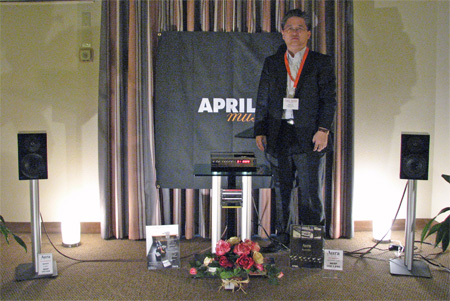
At a press conference on the first day of CES, TEAC Esoteric launched a new range of source">http://blog.stereophile.com/ces2008/010808eso/">source components. That was expected. But what was not expected was Esoteric's manager of overseas sales, Kazutaka Tsuda (above), introducing a new monoblock tube amplifier, the AT-100. Using KT88s in its output stage, the 50Wpc Esoteric amp features a new variable bias system and an output transformer using specially treated copper foil as the secondary winding to give the best coupling from the primary. The heaters of the input and driver tubes are DC-powered, to give the lowest noise; in fact, Esoteric claims the AT-100 is extremely quiet, despite its all-tube design. While it was designed as a power amplifier, a rear-panel switch, in conjunction with a volume control knob on its front panel, turns the AT-100 into an integrated, with three RCA inputs ands one XLR. Price will be $18,500.
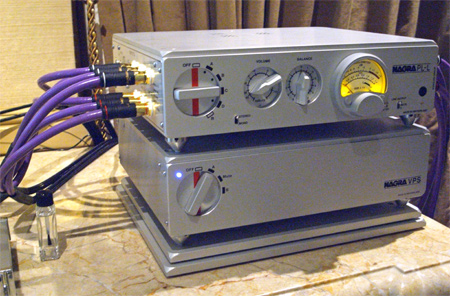
Nagra Valve Phono Stage

In their suite at the Mirage, Nagra introduced the VPS (Valve Phono Stage), shown here under the Swiss company’s well-regarded PL-L line preamplifier. The front-panel switch selects between A and B inputs and mute, while the rear panel features two sets of inputs and outputs and an output level switch. The A inputs accommodate MC cartridges, while the optional B input can be set for either MM or MC operation. Capacitive and resistive loading can be changed with modules that plug into the pcb close to the input connectors. The MC circuit is based on high-quality transformers wound in-house by Nagra, followed by gain and RIAA stages using ECC81 and ECC83 tubes. The RIAA equalization can be set with internal jumpers either to the 1953 standard or to the 1976 standard. The circuit boards are mounted on compliant supports, to minimize microphony and the power supply is housed in a separate chassis. Unusually, the output can be taken either directly from the tube stage or via a solids-state buffer.


Dare We Say “Digital?”

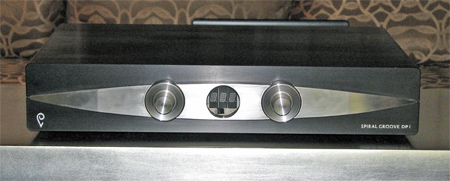
Although Allen Perkins' Spiral Groove has until now focused exclusively on analog products, the company has taken a big step into the digital domain by announcing the forthcoming Spiral Groove DP1 line stage preamp and 24/96 DAC. Projected to become available in four months, the DPI is so new that it has yet to be priced.


Spiral Groove

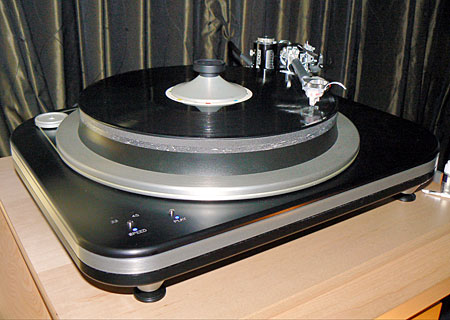
Immedia's Allen Perkins was running not one, but two Spiral Groove turntables. He was running the original SG1 ($20,000) with Continuum's new Copperhead tonearm ($12,000), but he was also debuting his new SG2 ($15,000) with a Triplanar Ultimate tonearm ($4200).


Perfect 8's The Force

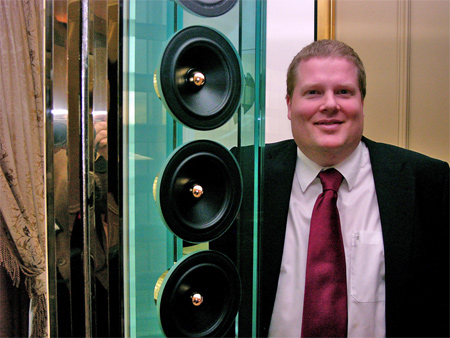
What does $275,000 buy you these days besides a used Porsche Carrera GT with 20,000 miles on it? Yes, there is now a loudspeaker system with that asking price, which gets you 900 lbs of hardware, including two midrange—tweeter towers, two subwoofers, and two subwoofer amplifiers. Frequency response is rated from 8Hz to 50kHz, and the minimal load impedance is 3 ohms. Furthermore, the Force is made of glass.


Hovland's Stylin' New Preamp & DAC

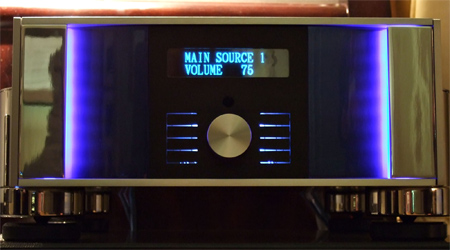
Hovland introduced a new preamp; in fact it was so new that it hasn't been named yet, and the price hasn't been determined ($16k–$18k range). The only thing known for sure is that it's a solid-state design, with balanced inputs and outputs, and has the blue back-lighting that Hovland is known for. It's another contender for the “Most Beautiful $18k Preamp” title.


Amazing Aura

After hearing the Stello stack, I thought I had heard it all. But in the next room, April Music President Simon K. Lee blew my mind even more with the one-piece Aura note Music Center ($1850). This little baby, available through a dealer network, even includes a USB port on back, a second USB memory stick port on the side, a built-in tuner, and two RCA inputs. Paired with the Aura speaker ($650/pr), the parallel single-ended MOSFET design (thank you, Nelson Pass) sounded a bit more mellow and soulful than the Stello stack. (It would have probably extended as low as that stack if it had been paired with the B&Ws).


Vienna Acoustics Introduces Die Musik Loudspeaker

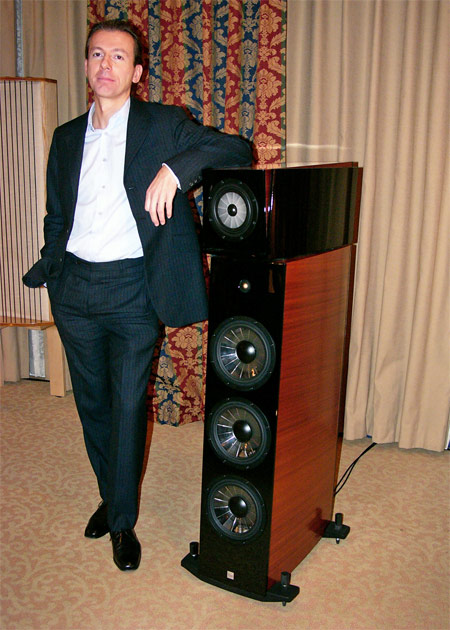
The Sumiko suite at CES provided a huge listening space to introduce the new Vienna Acoustics' full-range, four-way Die Musik loudspeaker ($25,000/pair). Designed by Peter Gansterer (see photo), a pair of Die Musiks produced some of the best sound I heard at the show. The speakers were positioned quite far apart against a side wall, and the listener sat on a couch closer to the plane between the speakers than the distance between the speakers. This created a very wide, coherent soundstage quite unlike any other than I heard at the show. Bass response, which was superb, actually could be credited, in part, to a huge REL Studio 3 subwoofer, which was parked and running in the nearest room corner.


Advertisement
Advertisement
Advertisement