SSI 2010

Sort By: Post DateTitle Publish Date

"Nothing Over $2500"
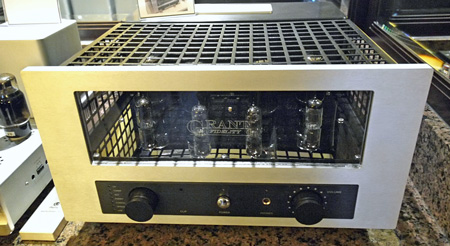
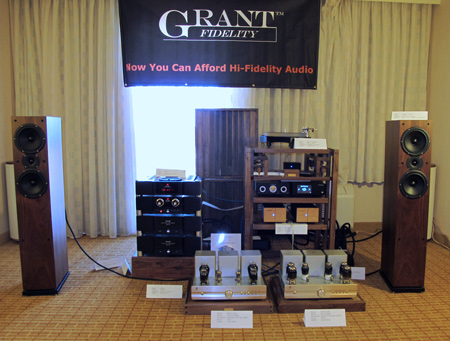
In addition to ingenuity in dealing with setup problems, Grant Audio had another claim to show exhibitor fame: their sign said "Nothing Over $2500," In fact, most of their products—some designed by Ian Grant in Canada but made in China, and others of Chinese design as well as manufacture—were well under $2500. One of the more expensive items was the W30GT: tube-based integrated amplifier designed by Ian Grant that includes a phono stage and a DAC. It's $1950.
Problem Solving

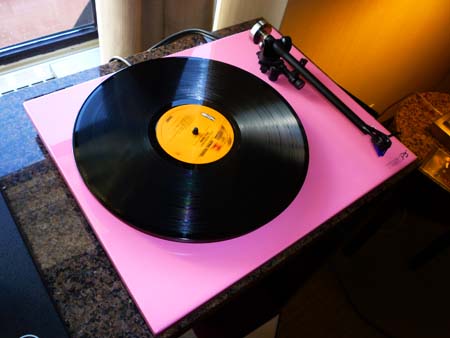
Audio show exhibitors have a lot of obstacles to contend with: equipment not showing up or showing up damaged, problem with room acoustics, problems with the electrical supply, equipment malfunctioning just as the show starts, and countless others. Ian Grant of Grant Fidelity told me that when he first set up his turntable front end it was picking up the signal from a local radio station! Being an ingenious engineering-type, he located the source of the interference (he could see the station's antenna from the hotel window), and got some building insulation material that had aluminum foil as part of its construction, and taped it to the hotel window. Voilà! Problem solved!


The Quantum "Power Purifier"

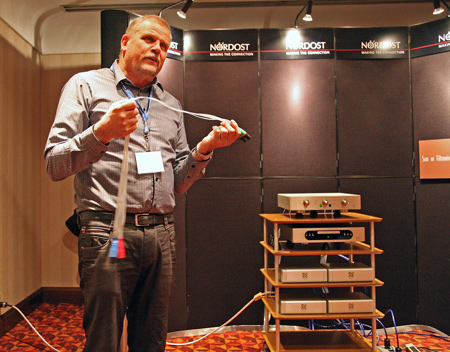
Nordost's Lars Kristensen can always be relied on to give an enthusiastic and instructive demonstration, and so it was at SSI 2010. I missed the first part of the demo, but I was there for what I was most interested in: the effects of the Quantum Qx2 ($1700) and Qx4 ($2700) Resonant Technology "power purifier" devices that Art Dudley has written">http://www.stereophile.com/artdudleylistening/listening_85/">written about. I can't say that I really understand the technical explanation of how these devices work, but the demonstration showed that they certainly do work, the sound—which without the Quantum devices was actually better-than-average—acquired greater dynamic freedom, sharper imaging, and the soundstage became more spacious.


Focal's Daniel Jacques

The Focal Electra 1037 Be that was reviewed">http://www.stereophile.com/floorloudspeakers/707focal/">reviewed by Michael Fremer a while back has been superseded by the Electra 1038 Be II ($13,500/pair). The major change is the upgrading of the beryllium tweeter to the level of the units used in the Utopia series. There is also the inevitable crossover change, and the manufacturing of the midrange and woofer drivers has been made more precise. Here's Daniel Jacques of Audio Plus/Plurison, the North American Focal importer, with the Electra 1038 Be II.


Extending the Gradients' curve

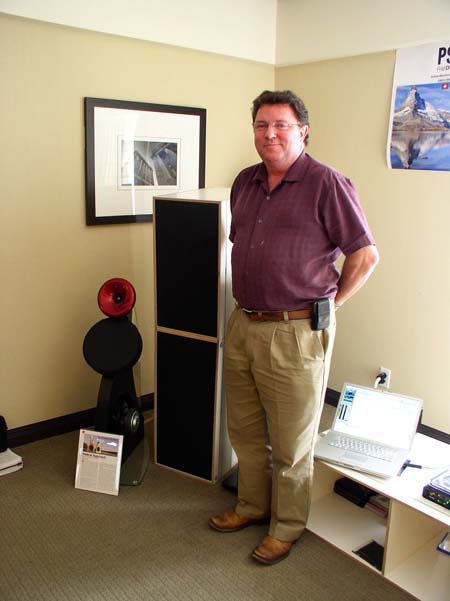
As a Quad ESL enthusiast, I know how difficult it is to blend subwoofers with very good, very fast loudspeakers. Consequently, I was impressed with the new A225-M powered subwoofer from the Swiss company PSI, on demonstration at the Simplifi Audio room. Used with the Gradient Helsinki loudspeaker, of which I also have some experience, a pair of PSI subs ($4500 each) provided lots of deep, impactful bass with no apparent change in the Gradients' timbral character: very impressive. The subwoofer was housed within one of the the same IKEA units as Simplifi's Tim Ryan was using for component stands, to show that high-quality sound can still be domestically acceptable.


Simaudio and Dynaudio

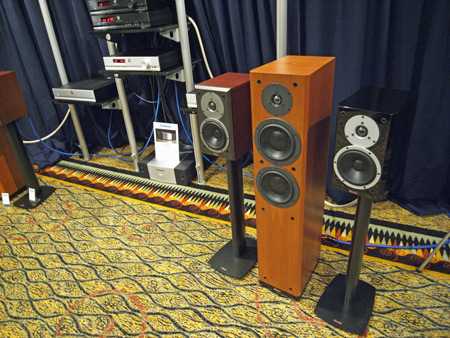
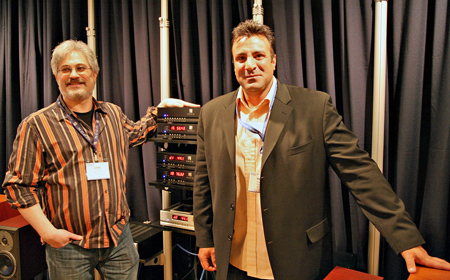
Simaudio had two product introductions at the show that conform to this approach: the Moon 400M is a 400Wpc fully balanced mono power amp selling for $2995 each, and the Moon 350P preamplifier (also fully-balanced), $1995 without phono stage and CN$2795 with. Dynaudio had the new Focus 220 Mk.II floorstander ($3600/pair) and the DM 2/6 ($800/pair). The DM 2/6 is the least expensive Dynaudio speaker, and although the drivers are not quite at the level of their more expensive brethren, Dynaudio's Mike Manousselis told me that they're still made in the same factory in Denmark, and follow the core Dynaudio technical quality. Lionel Goodfield (Simaudio) and Mike Manousselis look pleased with their new products.


Traveling in Pairs

Simaudio, represented in my photo by Lionel Goodfield (left) and Dynaudio, represented by Mike Manousselis (right) often exhibit together, an arrangement that seems to represent the friendly relationships between people in these companies as well as the synergistic relationships between the products. They certainly sound good together, and both companies seem to be guided by a desire to offer not necessarily the cheapest possible products, but ones that offer high quality combined with good value.


Going Rogue

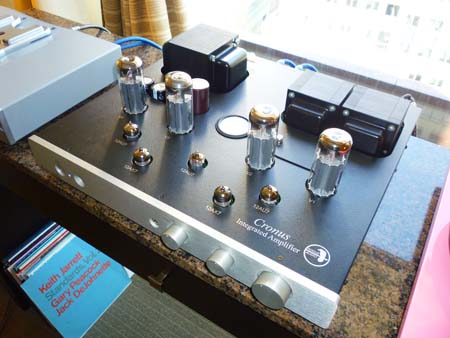
In the Son Ideal room, Harbeth’s Compact 7ES-3 loudspeakers were being driven by Rogue Audio’s Cronus Magnum ($2200), which swaps the standard Cronus’s EL34s for beefier KT90s, delivering 90Wpc for a more extended top end and more robust bottom, Robert DeKoninck told me. I’ve been interested in Rogue Audio for awhile, and hope to listen to a Cronus soon.


The dCS Debussy

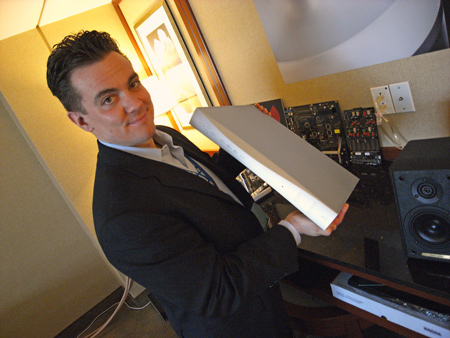
I was immensely impressed by the dCS Puccini SACD player and U-Clock when I reviewed the British combination last">http://www.stereophile.com/hirezplayers/dcs_puccini_sacd_playback_syste… December. But as the physical discs becomes a legacy source of music, there was obviously a need for a related D/A product. SSI saw the public debut of the dCS Debussy ($10,999 with remote), shown off here by Tempo Marketing's John Quick. The Debussy basically combines the D/A, DSP, and analog board from the Puccini with the true asynchronous USB input topology from the U-Clock in a slim, attractive package. There are two AES/EBU and two S/PDIF inputs, as well as USB, and there is also a word-clock input to allow the Debussy to be controlled by an external master clock unit. Two digital filters are included, one a conventional symmetrical type, the other a variant of the increasingly popular minimum-phase "apodizing" type.


Advertisement
Advertisement
Advertisement