CES 2011

Sort By: Post DateTitle Publish Date

MIT’s New Matrix Line
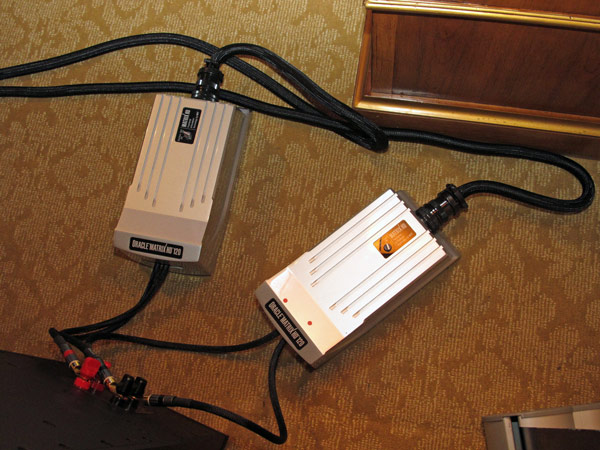
Steve Holt, global sales manager for MIT, proudly introduced me to the company’s brand new Matrix line of cables. Designed by Bruce Brisson, the cables retail between $9999 and $21,999, and are part of the company’s reference line.


The new speaker cable comes in three flavors: Oracle Matrix HD 90 ($9999/8ft pair), Oracle Matrix HD 100 ($14,999/8ft pair), and Oracle Matrix HD 120 ($21,999/8 ft pair). There is one interconnect, Matrix 50 ($4999/1m pair, $5999/1m balanced pair). For digital cabling, one needs to go up one step in the reference line to Oracle MA-X digital ($3495/1m RCA or BNC, $3995/1m AES/EBU)


These new cables use MIT’s multi-pole technology. “We talk about poles of articulation,” said Holt. “There are electronics inside our boxes on the cables to provide wider bandwith coverage to power, so that sounds at either end of the spectrum won’t be rolled off as quickly.” The Matrix cables also employ a new technology called F.A.T. (Fractional Articulation Technology) that helps maintain the harmonic structure of audio signals.


In the Magico room where they were displayed, the new Magico Q3, Soulution amplifiers, and files from Paul Stubblebine’s Tape Project made wonderful music through Oracle Matrix HD 120 speaker cable and the Oracle MA-X interconnects (start at $8495/1m pair). You can see the Oracle Matrix HD 120 boxes in the above photo, which was taken behind one of the Magico speakers. If other rooms hadn’t called, I would have dropped everything then and there and stayed for hours.
CAT-MSB-Vandersteen-Stealth

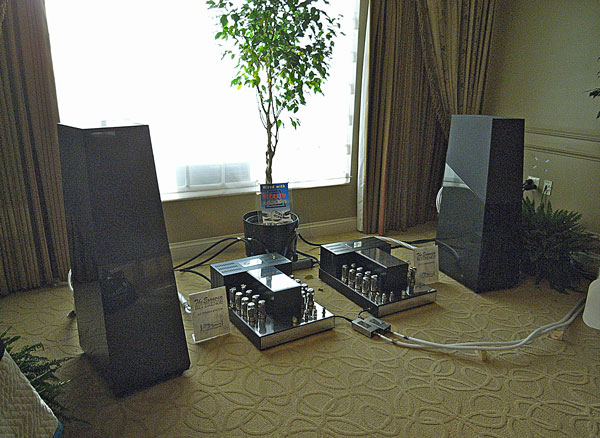
I heard a lot of good sound at the 2011 CES and T.H.E. Show. But my joint best sound must go to the room at the Venetian where Convergent Audio Technology was demming the new Ken Stevens Statement tube monoblocks with a CAT SL1 Legend preamp, Vandersteen 5A loudspeakers and MSB digital front-end, with cabling from Stealth and AC supplied by The Essence Reference system.


As I walked into the room on the final afternoon of the Show, a Chopin piano work was playing. yes, the recorded perspective was close, but my goodness, the instrument was there in the room! (It was the Gold Collector's Edition on First Impression Music of Jun Fukamachi at Steinway.) Effortless dynamics, palpable instrumental presence, tonality, musical power—you name it, this system did it.

Mark Levinson & Revel

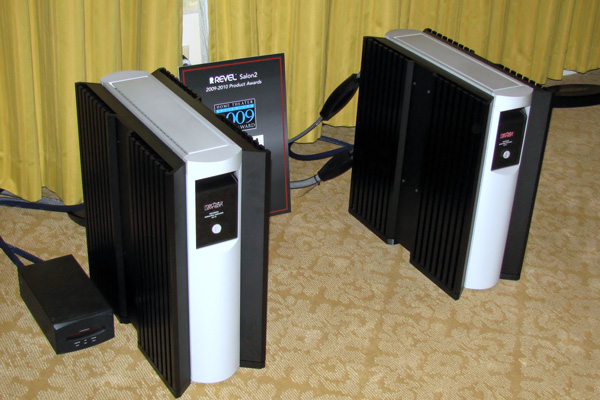
My most emotional moment at the 2011 CES came in the Harman suite on the Venetian’s 35th floor. I finally got to meet Kevin Voecks, Revel Loudspeakers’ head honcho, and he is every bit the gentleman people told me he would be. Playing in one room of the Harman suite was a system comprised of Mark Levinson digital and amplification gear including the new No. 53 monoblock amplifiers ($25,000 each) and the Revel Ultima Salon2 loudspeakers. The No.53 is Levinson’s first digital switching amplifier. One of the inherent problems of a switching amp is that it creates dead bands in the audio signal when the output devices cross over from a positive voltage to a negative one. Levinson says they have eliminated this problem through a patented technology that allows both sets of output devices to be on simultaneously for short periods of time. This is designed to be done without damaging the output devices or reducing their life expectancy.


After listening to a bit of the sample CD they had playing in the room, I thought I would play the opening cut, Eric Whitacre’s “Lux Aurumque,” from the CD While You Are Alive, which I had produced with John Atkinson engineering. It was the best I had ever heard it. I sat there listening to this recording, into which I poured my soul, next to Kevin, who headed the speaker’s design team, that delivered my vision back to me in a way I’d not realized was possible. I felt so lucky and thankful that I live in a world where designers like Kevin, and so many others who show their heart’s labors at CES, can help artists connect to listeners and listeners connect to artists. All I could do was thank Kevin and give him a copy of the CD, as he clearly enjoyed listening to it almost as much as I did. I only wish I could have played him the high-resolution master files.


I told Kevin that JA and I mixed While You Are Alive on a pair of Revel Salon2s while John had the speakers in-house for review. Kevin looked at me with a smile and told me that I was listening to the very speakers John had in his house. Life is magic sometimes.


The No. 53’s were clearly doing a great job, outperforming JA’s Mark Levinson No.33Hes we had used during the mixing. I gotta stop dissing the digital amps.

Dan D’Agostino's Momentum

Dan D’Agostino is no newbie to high-end audio, but his namesake company is. In the new company’s first showing at a CES, Dan brought in his new Momentum monoblock amplifiers ($42,000/pair). The amps, visually inspired by Swiss watch design, are among the most distinctive and beautiful pieces of equipment I’ve seen. The sides of the amplifier are made of copper, which not only gives the amps a lustrous, glowing color, but also serve as very efficient heatsinks for the 28 output transistors.


The amplifier is completely made in-house, including such things that are usually handed off to subcontractors, like stuffing the printed-circuit boards. There are no surface-mount parts used, Dan feeling that traditional through-hole parts offer better long-term performance consistency.


A 1.2kVA power transformer is packed into the compact chassis and in the tradition of Krell, the company that he cofounded 30 years ago, the new amplifier puts out 300W into 8 ohms, 600W into 4 ohms, and 1200W into 2 ohms, all with class-A/B biasing. Yet, there was nothing about this system that sounded like class-A/B amplifiers. Driving Wilson Sashas, the sound was warm, fast, open and generous—tonally and spatially. Voices all sounded balanced, life-like and three-dimensional. Dan told me a matching preamplifier is on the way.

Devialet & the D-Premier

Michael Fremer and I got up early Friday morning and headed to the Mirage hotel where Devialet, a new French audio company, and its new North American distributor, Audio Plus Services, hosted a breakfast gathering to unveil their new D-Premier ($15,995). Encased in a mirror-finished solid aluminum chassis, the D-Premier is an all-in-one DAC, streamer, preamp, power amp, and phono stage. Not only does the D-Premier combine all these features in one product, but it also has a new and novel amplifier section; a patented Analog Digital Hybrid.


The input signal goes directly to a class-A amplifier. Though the output of this connected to the speaker terminals, it can’t deliver enough current to do so without help. The necessary high current is sourced from a class-D amp. The analogy of this amplifier is like power steering on a car where the driver is assisted by a powerful engine to turn the wheels; the driver turns the wheel but the power steering does the heavy lifting. In the same way, the class-A section of the amplifier controls the class-D section. The idea is that the amp retains the sonics of class-A yet maintains 85% efficiency in a 240Wpc amp.


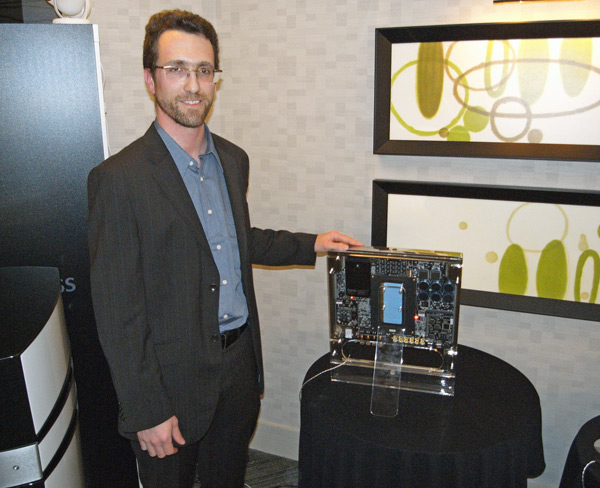
The Devialet design team— Pierre-Emmanuel Calmel and Matthias Moronvalle (the latter shown in JA’s photo holding a demonstration version of the amp housed in acrylic)—was insistent during the presentation the D-Premier is not a class-D amp.


The sound with Focal speakers was clear, balanced, open, and grain-free, with no hint of the hash sometimes associated with class-D amplification. (The eggs at the breakfast were also excellent.)


Stage III Concepts Cables

Stage III Concepts, a Pasadena-based company whose products are distributed by Brian Ackerman of AAudio Imports, has released four newly re-engineered, top-of-the-line cables. All are part of the A.S.P. Reference series (Absolute Signal Purity), and are entirely handmade (including connectors) by Luis de la Fuente. Connectors are made of ceramic with a mixture of special resins to minimize crosstalk between pins, and the entire housing composed of carbon-fiber and epoxy resin. The wire itself is silver-palladium alloy. The A.S.P. Reference interconnect and speaker cable also sport a vacuum dielectric.


On display were the Zyklop power cord ($6000/1.5m), Gryphon interconnect ($5800/1m pair RCA, $6300/1m pair XLR), and Mantikor speaker cable ($13,200/2m pair). Besides digital and phono cables and speaker jumpers, the company sells hook-up wire for components in a variety of gauges. The least expensive, 22 AWG ($66/1.5m) is followed by 17 and 15 AWG ($280/1.5m).


Asked about the cable’s sonic properties, Ackerman replied, “It has no sound at all. It’s probably the closest thing I’ve heard to having no wire. It’s virtually invisible, like a direct connection.”

The Magico Q3

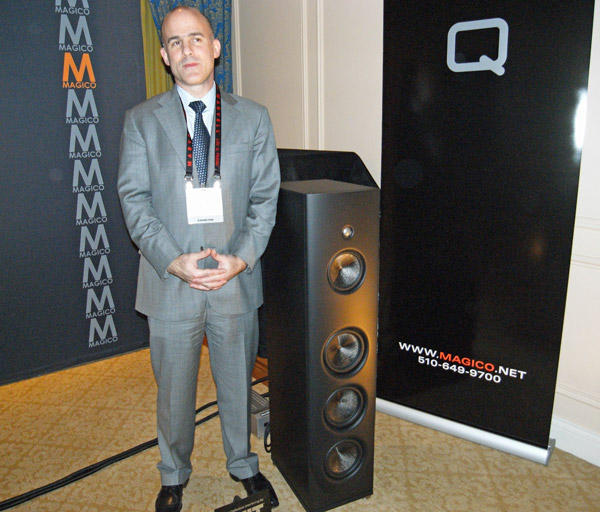
Without a doubt, the four-way, five-driver Magico Q5 that Michael Fremer reviewed last November was one of my loudspeaker high points of 2010. But at $59,950/pair, the Q5 is definitely a speaker aimed at the deep-in-pocket. Magico's Alon Wolf proudly showed his new Q3 at CES, which, at $34,000/pair, is going to appeal to a somewhat wider market.


A three-way sealed-box with three 7" Nano-tec–cone woofers, the 47"-tall floor-standing Q3 uses the same proprietary beryllium-dome tweeter as the Q5 in the same type of space-frame enclosure, with a 6" Nano-tec midrange unit. The lower woofers roll off earlier than the upper one, to optimize the crossover to the midrange unit. Frequency response is specified as 20Hz–50kHz, sensitivity as 90dB (which is significantly higher than the Q5's 86dB), and impedance as 5 ohms.


I auditioned the Q3s in a system comprising Soulution pre- and power amps hooked up with MIT's new cables, and listening first to a Red Book file of Patricia Barber, then to a Jordi Savall/Hespèrion XXI recording of a baroque double-violin concerto, this was one of the best sounds I heard at CES, with excellent LF extension and definition, if a touch on the mellow side.


Magico were showing a prototype of the Q1 stand-mount in a back room, which they will be introducing at the 2011 Munich Show. This combines the beryllium-dome tweeter with a single Nano-tec midrange-woofer, but the price has yet to be decided upon.

Ultimate Wisdom

I have been following with interest the goings-on at Nevada-based Wisdom Audio, since the company was revitalized with members of the team that had led Madrigal to success in the 1990s. But their concentration on in-wall speakers, using planar technology developed by David Graebener, means that they fall within the bailiwick of our sister publication Home Theater. Going in their room at CES, however, I was confronted by the LS4 floor-to-ceiling on-wall ($80,000/pair), which sounded magnificent driven by Classé's superb new CT-M600 monoblocks and reinforced below 80Hz by a pair of Wisdom enormous STS 2x15" subwoofers ($10,000 each; STS stands for "Steamer Trunk-sized Subwoofer"). The system controller, which includes an active crossover and room correction, costs $6500.


The LS4 uses four identical push-pull modules, each comprising a central HF section operating above 750Hz flanked by midrange sections covering the 80&#150Hz range. The backwave is absorbed within the enclosure, but the enormous radiating area still gives a sensitvity of 100dB/2.83V/m. (Impedance is 4 ohms.) Though the LS4 is fastened to the wall behind it, the weight is supported by a single spiked foot.


The LS4 is where architectural audio becomes aspirational audio.

Devialet's power transformer

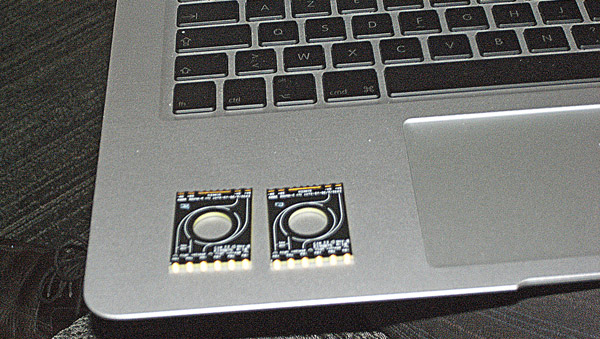
The Devialet D-Premier directly converts the wall current to DC, then uses a high-efficiency switch-mode power supply running at a very high frequency to power the audio circuitry. I asked Matthias Moronvalle if this meant that the power transformer could be much smaller than usual? His response was to show me the two small wafers sitting on his laptop. "That's the transformer," he told me, "with a continuous rating of 600VA." Ulp!


Organic Cables

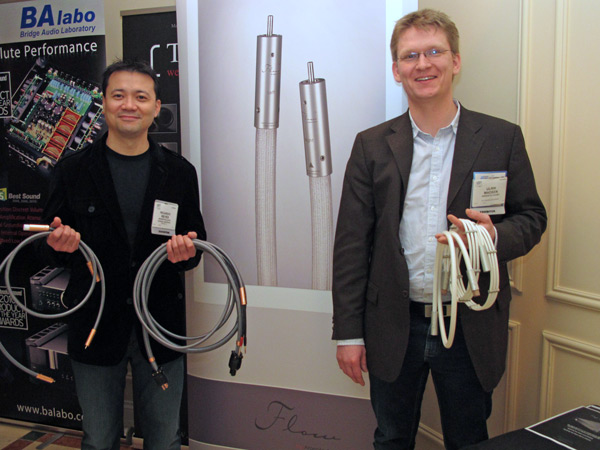
A sister company of Argento Audio of Denmark, Organic Audio now launched a complete line of copper cables. These include Organic Audio interconnects ($995/1m pair RCA, $1075/1m pair XLR), speaker cable ($1950/2m pair), and power cords ($995/2m). By contrast, interconnects in the all-silver Argento range from $2000–$9500/1m pair. All products are distributed by Ricardo Reyes (left) of Musical Artisans in Skokie, IL.


Ulrik Madsen (right), who designs the cables and owns the company, was on hand to discuss his products. All Organic Audio cables are derived from Argento Audio’s entry-level Argento Serenity. “I wanted to take advantage of the connectors I developed for Argento,” Madsen explain. “We make all our Organic Audio connectors ourselves from the same metal as the conductors in the cables, which is OFC 99.997% copper. (The more expensive Argento cabling uses silver). There are no solder points; all attachments are made by applying set-screws to accomplish compression.

Advertisement
Advertisement
Advertisement