Capital AudioFest 2011

Sort By: Post DateTitle Publish Date

Carnegie—Onkyo

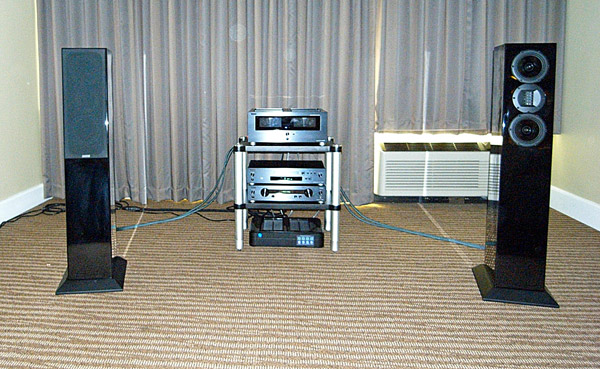
This room was pitch-black when I went in, so, sitting in the listening chair, I held my camera over my head, crossed my fingers and my heart, and pressed the shutter. What the flash revealed was a nicely finished pair of 2-way towers, the Carnegie CST-1s ($1999/pair) driven by an Onkyo Reference M-5000R 150Wpc amplifier. The CST-1 combines a 1"x3" Mylar-film planar tweeter with two 5.25" composite-cone woofers in a transmission-line enclosure. Carnegie's Ron May asked if I would like to hear some Nils Lofgren but to my surprise, he didn't select the track "Keith Don't Go" from the Acoustic Live CD, which has been a fixture at recent audio Shows. Instead he played me "A New Shoulder to Cry On," which sounded excellent. Carnegie is designing its products for the "Affordable Audiophile," an admirable goal.

Audience 2+2

The Audience room was featuring the Clairaudient 2+2s ($5000/pair) when I popped in for a listen. This speaker features four metal-cone units, two on the front two on the back, operated full-range, and reinforced by a passive bass radiator on one of the speaker's sides. Brian Damkroger enthused about the clarity conferred by the absence of a crossover when he reviewed the speaker in the July 2011 issue, but I was less keen on its balance, finding it very forward. Both aspects was readily apparent at Capital AudioFest, though I admit the room's acoustics were problematic. This is definitely a speaker that you must audition for yourself.

Command—Carnegie—Da Vinci—Manley

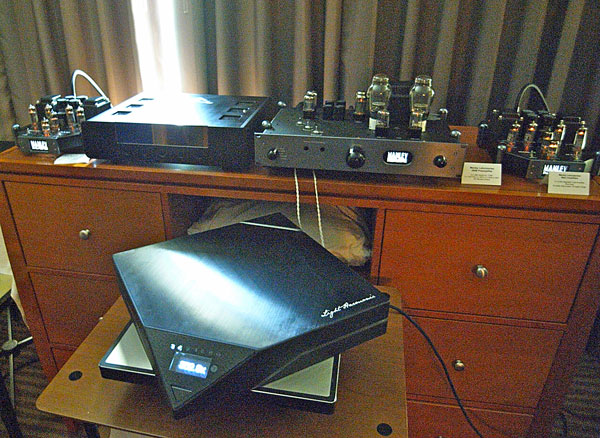
One of the Command Performance AV rooms at Capital AudioFest featured Carnegie speakers, the CST-2 ($5999/pair), which combines a Mylar-film planar tweeter with eight 5.25" composite-cone woofers in a slim tower supported on a marble base. The speakers were driven by Manley Mahi EL84 monoblocks and a Manley 300B preamp, with the source a silent CommandPC server feeding 352.8kHz USB data to the Light Harmonic Da Vinci DAC that had impressed at the Atlanta Axpona. The DAC has been upgraded since Axpona: when handling 16-bit data, it would pad out bits 17–24 with 0s to give 24-bit data, which is standard practice. But in 2s-complement digital arithmetic, which is how audio data are encoded on a CD, there are actually two zero levels: 16 0s but also 16 1s, which represents a magnitude one LSB lower. Light Harmonic's engineers found that if they padded 16-bit data with 8 1s rather than 8 0s, the sound improved.

Surreal Sound

The Surreal Sound Speaker ($10,000/pair) is the small, three-way floorstander finished in cherry, not the massive bass bin behind it, which belongs to the GOTO Horns speaker (see next story). Surreal Sound's Ralph Helmer is passionate about midrange, feeling it is in the midrange where the music truly lives. To that end, his speaker features a beryllium-disc midrange unit, mounted in an open baffle. A Heil Air Motion Transfomer supertweeter and three spider-less, aluminum-alloy, 10" cone drivers for the bass, all also mounted in open baffles, complete the drive-unit line-up. Mr; Helmer believes that one of the advantages of his dipole speakers is their high Wife-Acceptance Favor, in that they are smaller than expected for same amount of bass.

Mapleshade—Sonist

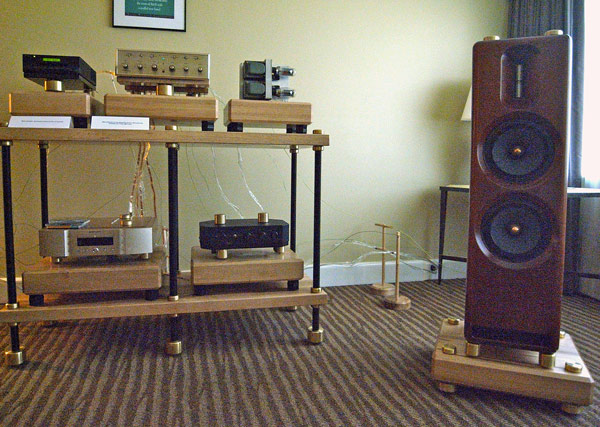
"Concrete is toxic to the sound of speakers!" explained Mapleshade's Pierre Sprey, when I asked about the maple platforms and brass footers on which everything was standing in his room at Capital AudioFest. Pierre makes superbly natural-sounding recordings, but also lives in a world where everything matters when it comes to optimizing sound quality. The system comprised Sonist Concerto 4 speakers ($5895/pair), these a 97dB-sensitive design with a solid poplar front baffle, driven by a heavily modified vintage tubed Scott integrated amplifier. (Pierre has been buying up used examples of this amp since 1989 and offers the modded amps for sale—see his website.) Source was a modded Cyrus CD-8SE CD player (the bottom panel was now maple) and preamp was a Kora Triode.


Whether it was Pierre's fanatic attention to detail that no-one else considers important, or maybe he is just an expert at setting up systems. But the Sonist speakers sounded very much better than the Concerto 4s and smaller versions that I heard at the Atlanta and Jacksonville Axpona Shows: clean, transparent, and uncolored.

JS Audio—Wilson—Dan D'Agostino—HRS—Nordost

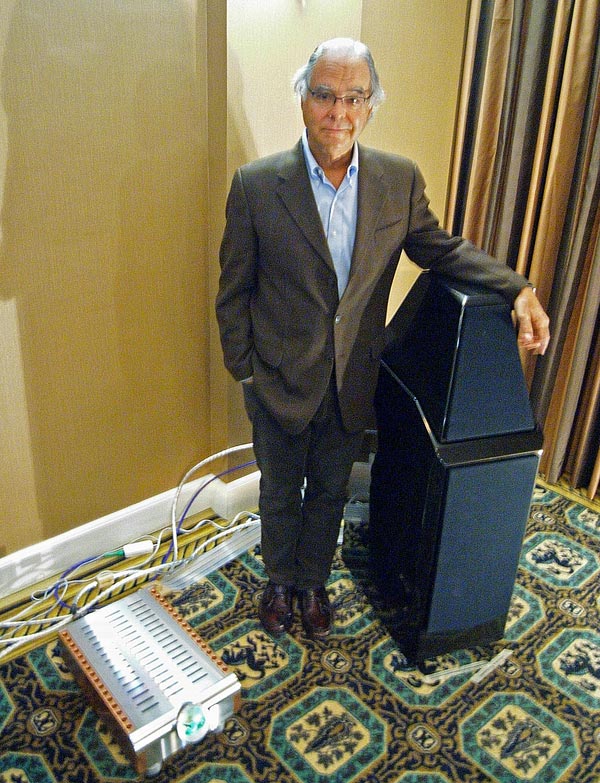
The larger of the two JS Audio rooms featured Wilson Sasha W/P speakers driven by Dan D'Agostino's new Momentum monoblock amplifiers. Source was either a Sooloos system or the Sound Devices digital recorder belonging to Wilson's Peter McGrath (pictured standing on that hotel carpet), both feeding data to Meridian's 808 Mk.3 CD player/digital processor, which also controlled playback volume. My hurriedly scrawled notes say that the Sooloos feed was via Ethernet, but don't hold me to that; the Sound Devices was definitely S/PDIF. The cabling was all Nordost Odin, which may well have cost more than everything else in the system, and the source components sat on a Harmonic Recovery Systems rack, which all involved said was a major contributor to the quality of the sound in this room.


And OMG, the sound! Whether it was Peter McGrath's hi-rez recordings or commercial material like Yello's "Stay," you were mainlining the music. Peter asked if he could play some of my hi-rez recordings, and played first the Cantus performance of Eric Whitacre's Lux Aurumque in 24/88.2k fidelity. I was transported to the Sauder Auditorium at Goshen College in Indiana, with the acoustic wrapped around me. The system did subtlety. Peter then played the 24/88.2k master of Attention Screen's "Blizzard Limbs," from Live at Merkin Hall. Again, the acoustic wrapped round me but the drum transients were more startling than I have ever heard before. And I mastered the recording!


I have heard Wilson Sashas in a number of systems, and yes, they are "fast," in that the bass doesn't boom or blur. Yes, the Nordost Odin is extraordinarily transparent cable (at a price) and that Meridian player's D/A is top-rank. And that HRS rack is a black hole for vibrations. But driven by the Dan D'Agostino amps—wow, did the Sashas kick some awesome booty! Without ever sounding crass or lacking in subtlety.

Advertisement
Advertisement
Advertisement