CES 2012

Sort By: Post DateTitle Publish Date

Astin Trew Concord DAC 1

UK manufacturer Astin Trew had their new DAC 1 on display. Managing Director Michael Osborn was on hand to answer questions and look for US distribution for his products. The DAC 1 features asynch 24/192 USB as well as FireWire and I2S inputs. It has a 6922 buffered tube output stage for single-ended connections and solid state for balanced output. Price should be around $4,500-$5,000 and would arrive in about 2 months once distribution is set up.

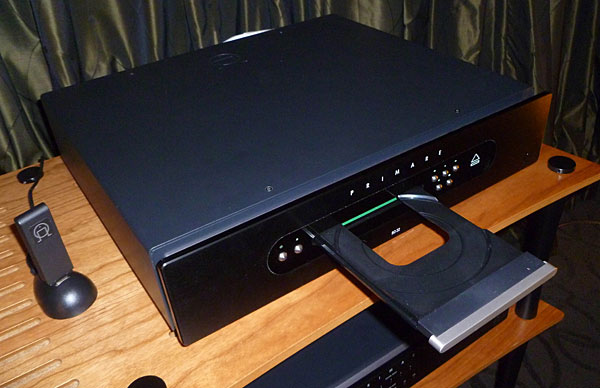
Primare BD32 Universal Disc Player

Based on the popular Oppo 93, Primare was displaying their universal player that will retail for $5495. It plays all the typical Oppo disc formats including 3D Blu-ray and has custom audio, video and power supply circuitry. The BD32 is a gorgeous-looking product and the photo does not do it justice.

Audio Research Reference DAC Digital Media Bridge

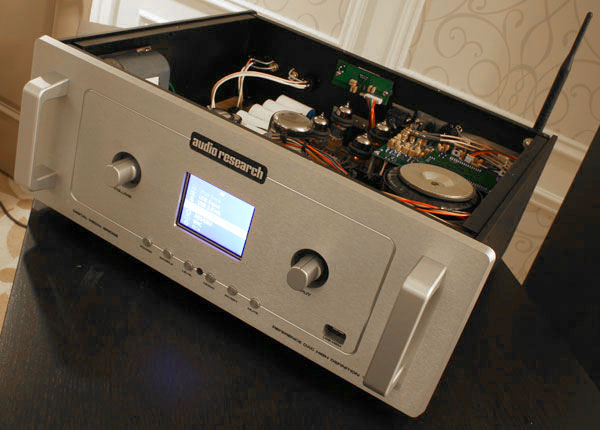
I'd file this one under DAC/preamp/streamer, with plenty of features and more to be announced. What we know: based on the company's DAC 8, there will be six digital inputs including all the usual suspects as well as wired and wireless networking, vTuner and UPnP. The DAC can upsample to 24/192 and includes a front panel display for control info and selected meta-data via DLNA/UPnP networked devices. Price will be around $15k.

YG Acoustics–Vitus

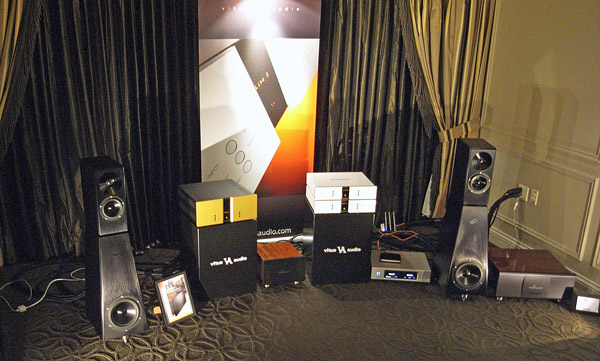
The second room in which I auditioned YG speakers was the Vitus Audio room, where the Kipod II Signatures ($49,000/pair) were doing their very musical thing. The Kipod uses the same materials and technologies as YG's top-model Anat III and now uses the BilletCore midrange unit and woofer, where the diaphragm is machined from a solid slab of aircraft-grade aluminum. First-generation Kipods can be upgraded to II status.

The Mighty YG Anat III Signature

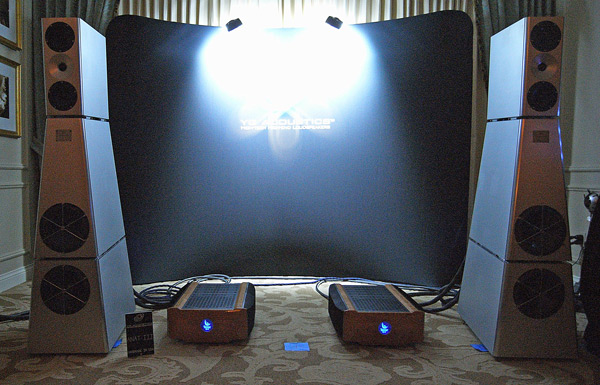
For the past few years, Colorado company YG Acoustics has been exhibiting in a large "air-wall" space in the Sands Convention Center. Their reason for doing so was that it was a great place for a new company to get foot traffic, but the downside was that it took heroic efforts to get sound quality that would indicate what YG speakers were capable of. For the 2012 Show, they had moved to a large suite in the Venetian Tower, and finally they were showing what their $119,000/pair flagship, the Anat III Signature, was capable of.

Crystal's Arabesque Mini

Crystal Cable's first loudspeaker, the Arabesque, used a complex-shaped enclosure fabricated from glass panels. Three years later, the Dutch company showed the new Arabesque Mini ($25,000/pair plus $1000/pair for matching stands), which uses a small aluminum cabinet with the same "comma" cross-section as the glass speaker, a shape that confers advantages when it comes to controlling the inevitable air-space resonances. A beryllium-dome tweeter is coupled to a long-throw, 1" maximum excursion (presumably peak–peak) 6" woofer. Crystal specifies distortion as being <0.5% from 120Hz to 20kHz, though no spl is given for this specification.

Loudspeakers by Volent

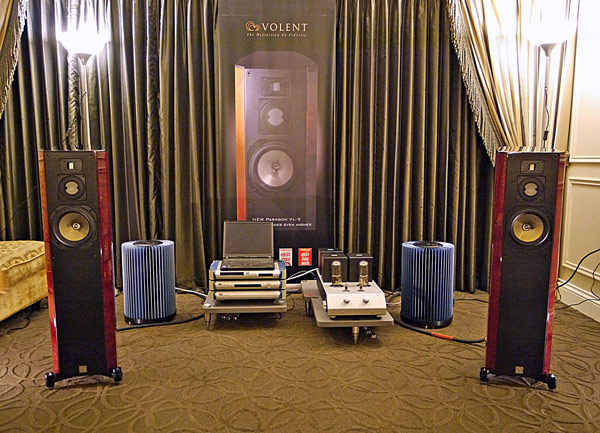
In my posting on Opera Loudspeakers, I wrote about company names, and how they might suggest something about the product and the priorities of a speaker's designer. In the case of Volent Corporation, I must admit to being puzzled. What does this mean? The Dictionary of Difficult Words defines "volent" as "exercising will power." How does a speaker do that? Finally, going through the company's website, I found the following explanation: "the name Volent [is] derived from the phrase, 'Voice of Excellence': signifying not only the quality of reproduced sound but also the vocal appreciation of music lovers."

PSB Introduces the Imagine T2 Speaker

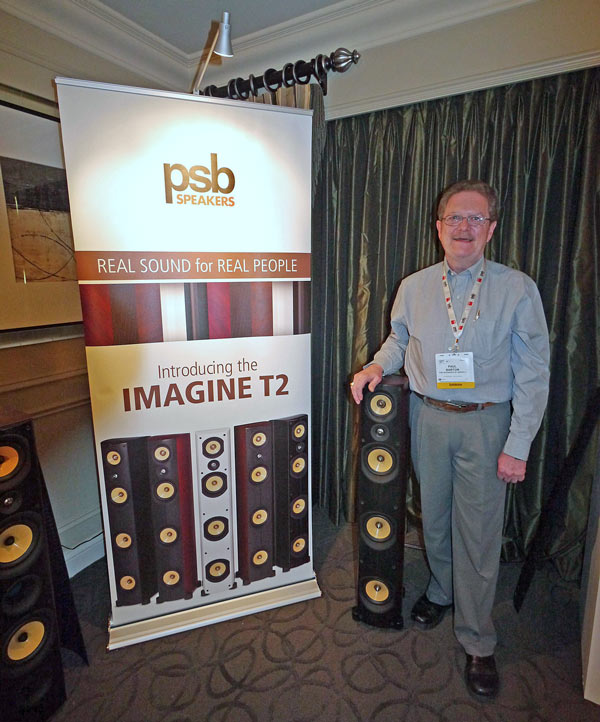
PSB's Synchrony One ($5000/pair) is listed in Class A (Restricted Extreme LF) of Recommended Components, and their Imagine T ($2199/pair) is in Class B. At the 2012 CES, PSB introduced the Imagine T2 ($3500/pair), which, according to Paul Barton (seen in my photo), applies the technology of the Synchrony series to the Imagine T. Like the Synchrony One, the Imagine T2 has three woofers, each in a separate compartment, which are driven together at the low end, and as we go higher in the frequency range the second and third woofer are rolled off gradually at the bottom. As with Paul Barton's other designs, the tweeter is mounted below the midrange. Driven by an NAD C390 all-digital integrated amplifier, the sound had superb clarity and detail, with excellent imaging.
Advertisement
Advertisement
Advertisement