RMAF 2012

Sort By: Post DateTitle Publish Date

Tocaro Loudspeakers

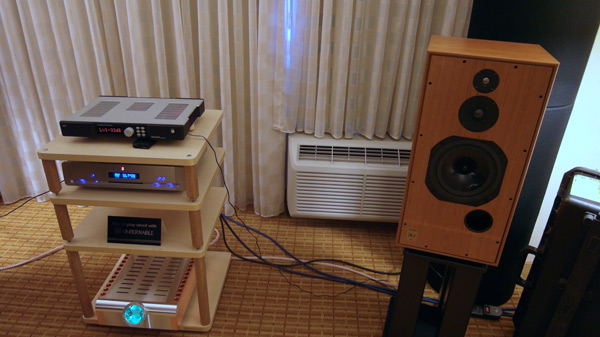
“We have no crossover,” I was told soon after I entered the Tocaro loudspeaker room. “Our tweeter receives the full signal. And even though our speakers are 100dB or more efficient, they can handle the 175W of power that we’re feeding them.”


Developed by Miguel Herrero and hand-built in Gütersloh, Germany, the Tocaro 42D ($14,000/pair including stands) was connected by Crimson interconnects ($360/m) and Crimson bi-wire speaker cable ($1070/8’ pair) to the Resolution Audio Cantata ($6500), Crimson 710 solid-state preamplifier ($7000), and Crimson 640E monoblock amplifier ($6000/pair). I tried to do what the sign said, and forget whatever I thought I knew, but I couldn’t overlook the sound of boxy percussion on my well-played Chesky CD of Marta Gomez, nor the bright edge around her voice.
Neat/Scheu/Zanden and More

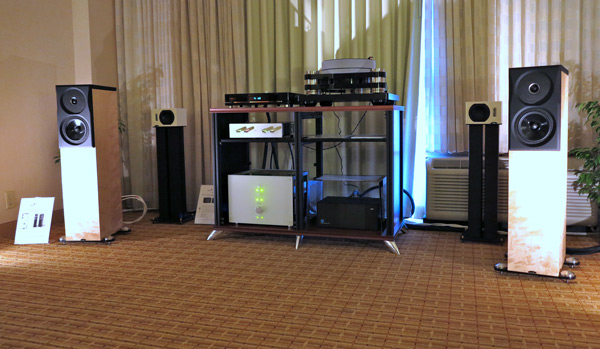
High Fidelity Services of Braintree, MA was producing good, solid sound on well-recorded rock on a system that mixed two products it imports and distributes, Neat Acoustics’ Ultimatum XL6 loudspeakers ($14,280/pair) and Scheu Analog’s Das Laufwerk 1 turntable with 12" Tacco arm and Scheu/Benz cartridge ($15.995), with Zanden’s Model 2500 CD player ($22,000), Model 6000 integrated amplifier ($22,000), and 1300 phono stage ($13,750); Running Springs’ Maxim power conditioner ($6400); and Chord Cable Company’s SArum cabling ($8400).

Sanders Sound Delivers

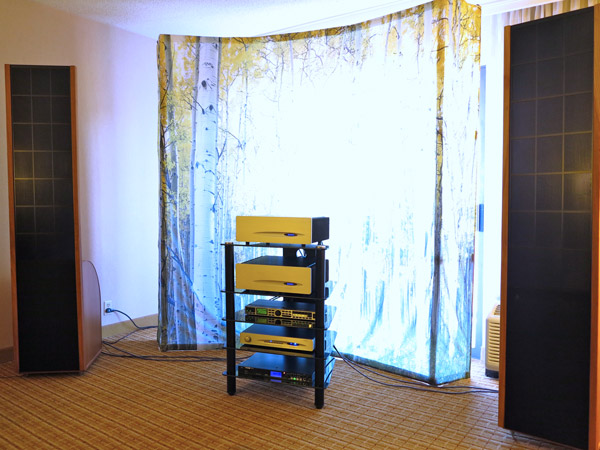
People sat up and took notice when Sanders Sound Systems released their Model 10 full-size electrostatic loudspeakers with analog electronic crossover amplifiers a few years back. The latest version, Model 10c ($13,000/pair) was delivering solid, full-range sound from a system that also includes Sanders Magtech Stereo amplifier ($5000), new preamplifier that combines both line and phono stages ($4000), and their own interconnects and speaker cables.

Sonic Studio’s Amarra Preview

Since Sonic Studio dropped the price of its Amarra music software system to $189, lots more people have been enjoying its sound. Less than two months after Amarra’s last release, James Anderson announced the imminent arrival of 2.4.3 (free to current owners). He also played Reference Recordings’ superb recording of Copland’s Symphony 3, one of whose movements has become known as the “Ode to the Common Man.” Turns out that the performance was recorded using Sonic Studio’s professional Soundblade products. Played back with Amarra 2.4.3, it sounded fabulous, with absolutely tight, room-shaking bass. No doubt Amarra’s optional equalization component, which can help control bass booming created by either room nodes or less than flat loudspeaker response, had more than a little to do with the success of the presentation.

Cactus Rules!

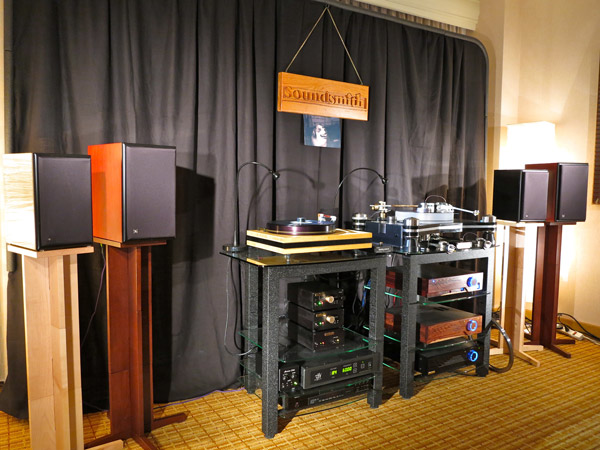
The big news in Soundsmith land, besides the fact that Peter Ledermann’s fastest top-of-the-line Hyperion cartridge with its cactus spine and diamond tip was making wonderful sound in multiple rooms at RMAF, was the introduction of the Hyperion Mk.II ($7500). Boasting great channel separation, its 10-year warranty includes retipping for the original owner.

Like a Firewire out of the blue

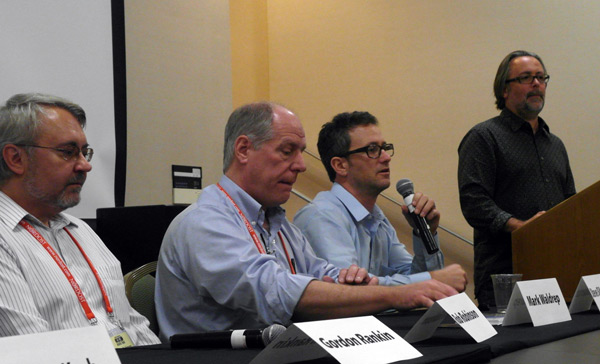
Perhaps I don't spend enough time at my local Apple store—which is, after all, only 70 minutes away—but I confess that I'd never heard the word thunderbolt in a high-tech context before RMAF 20212. Now, having attended the computer-audio seminar moderated by my friend Michael Lavorgna—of sister site AudioStream.com—I know that Thunderbolt is now the preferred interface for connecting a music-storage drive (or NAS) to a current iMac or MacBook. Seen here are panelists Rob Robinson (Channel D), Mark Waldrep (AIX and iTrax), Steve Silberman (AudioQuest), and Michael Lavorgna (left to right).

TAD, Zesto, and WyWires

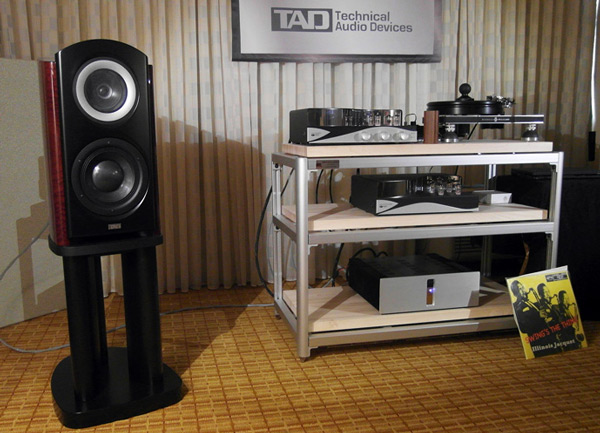
I've heard TAD's high-tech CR1 loudspeakers ($42,000/pair) on other occasions, at other shows. But they've never sounded as good as they did at RMAF, where they were demonstrated with electronics from a new company called Zesto (a great, un-self-conscious name that sounds like an affiliate of Slusho, the imaginary Japanese soft-drink company created for the 2008 film Cloverfield). The source was a Merrill-Williams REAL 101 turntable ($7200) with Triplanar arm ($5800), Dynavector XX2 MkII cartridge ($1985), and Zesto Andros phono stage ($4300) and Leto preamp ($7500), plus GamuT D200 amp ($6000) and WyWires cabling— which, like the Zesto gear, comes from Thousand Oaks, CA. On selections by Illinois Jacquet and others, this system sounded richly textured and very involving.

New addition to ADAM's family

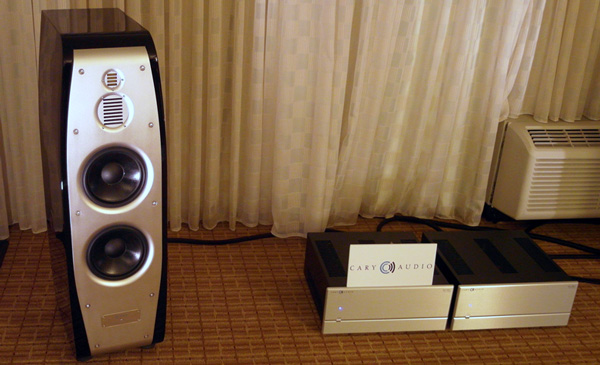
The German manufacturer ADAM Audio, whose high-frequency drive-unit technology is descended from that of Oskar Heil's Air-Motion Transformer, introduced their new Gamma loudspeaker ($22,000/pair), which is built around a 25mm-thick aluminum baffle: a departure from the honeycomb material used in elder ADAMs. Demonstrated with a pair of Cary SA 500.1 solid-state monoblocks ($4995 each), Cary SLP 05 preamp ($8495), and Cary CD 303T CD player ($6995), the Gammas were clear and distinctly articulate, with a pleasant balance overall—although I wouldn't have wanted them to be an iota lighter.

Bricasti: Greater than Average Insight

As a card-carrying member of The Insecure, I tend to clam up when I'm around people who are considerably more intelligent or well-informed than I. Consequently, I had embarrassingly little to say in the presence of Bricasti Audio's Brian Zolner, whose understanding of the various digital-filtering choices offered by his company's M1 D/A converter ($8495) was as deep as it was generously and at times even humorously offered. In any event, the Bricasti sounded fine at the front of a system in which a pair of Harbeth HL5 loudspeakers ($5690/pair) was driven by the undeniably beautiful Dan D'Agostino Momentum Stereo amplifier ($25,000).
Advertisement
Advertisement
Advertisement