RMAF 2012

Sort By: Post DateTitle Publish Date

Like a Firewire out of the blue
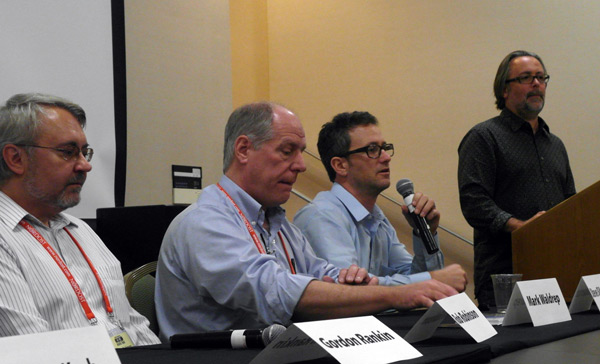
Perhaps I don't spend enough time at my local Apple store—which is, after all, only 70 minutes away—but I confess that I'd never heard the word thunderbolt in a high-tech context before RMAF 20212. Now, having attended the computer-audio seminar moderated by my friend Michael Lavorgna—of sister site AudioStream.com—I know that Thunderbolt is now the preferred interface for connecting a music-storage drive (or NAS) to a current iMac or MacBook. Seen here are panelists Rob Robinson (Channel D), Mark Waldrep (AIX and iTrax), Steve Silberman (AudioQuest), and Michael Lavorgna (left to right).
Ballad of the Red Glasses

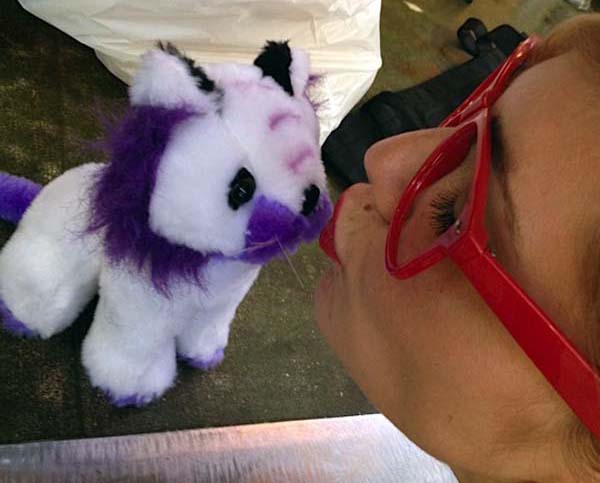
My audiophile doppelganger, Music Hall’s Leland Leard, brought props to RMAF&#151a pair of bright, red glasses and a stuffed kitty cat doll&#151and asked attendees to smile for the camera.


I can’t help wonder whether one’s truest self is revealed when donning the bright, red glasses. Or, I suppose, while petting the kitty.

Fun with Cayin and VAS

Steve (Sze) Leung, a neighbor of Stereophile’s Wes Phillips and a joy to boot, made my day when he played a 45 rpm audiophile pressing of Elvis’ “Are you Lonesome Tonight.” As the great one began to intone the chapters of this teenage melodrama with tongue-in-cheek sincerity, the sound was so vivid and lifelike that images of the night I tried to ask Ellen Schmidt to go steady flooded through my mind.

Vapor Audio: Anything but Vaporware

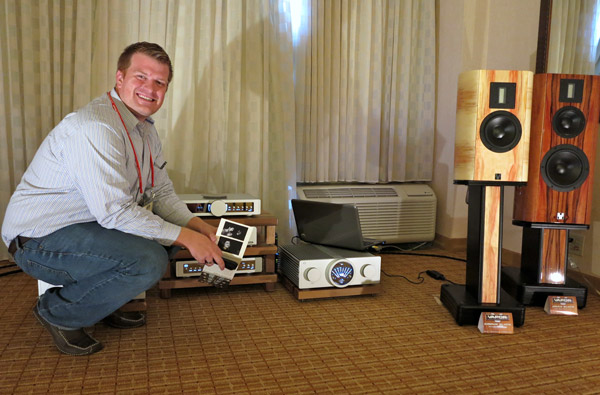
Vapor Audio’s Rick LaFaver had reason aplenty to smile. Playing M•A Recordings’ fabled CD of Sera Una Noche: La Segunda, his system nailed the timbre of instruments spot on. I was amazed at the depth he achieved from his small speakers, and took special note of the realistic decay of the sound of brushes on cymbals and bells being struck. “The hollow resonance of the percussion seems real,” I wrote in my notes.

Emerald Physics

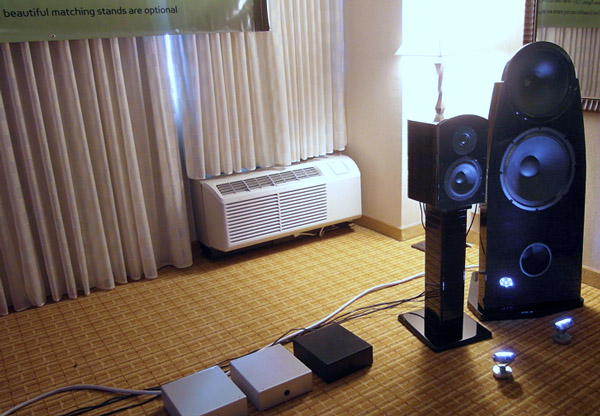
Hawaii-based Emerald Physics—a company I hadn't heard of until RMAF 2012—demonstrated their own US-built loudspeakers and electronics with a Peachtree Audio novaPre preamp–D/A converter playing music files from a laptop computer. Emerald's CS2P open-baffle loudspeaker ($2990/pair) works as a dipole below 1000 Hz, with a 15" woofer and a horn-loaded 1" tweeter. The retail price of the system I heard, including the Peachtree unit; the Emerald Physics CS2P loudspeakers; Emerald's DSP2.4 active outboard crossover/EQ unit ($850); and the company's EPI100.2 100Wpc digital amplifier ($1600) was under $7000, not including computer and playback software. While far from perfect—the bass wasn't especially taut, and there was little in the way of the sorts of texture and tone I crave—the performance was clean, spacious, and satisfying.

High Water Introduces Pure Sound

I’m afraid I hit High Water Sound’s room at the end of the fourth floor at a time when, overwhelmed by how many systems I had left to visit before show’s end, could only muster the words “very nice sound” in my notes. Clearly I owe you an apology, and Jeffrey Catalano’s high-end emporium a visit the next time I’m in New York City.

Haniwa from Kubotek Corporation

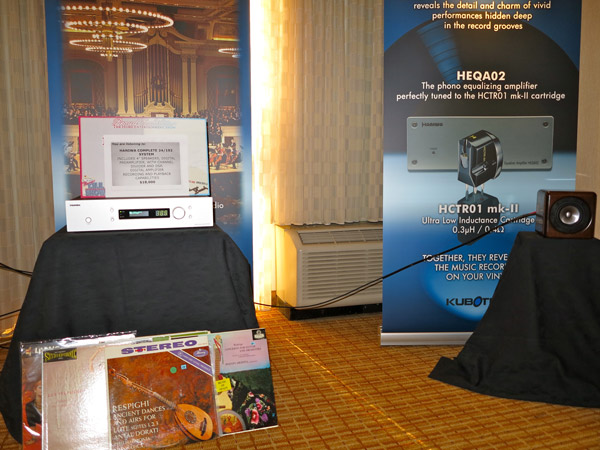
Having heard the complete Haniwa 24/192 system twice, at two shows, I confess that I don’t get it. The ad for this $18,000 system, which includes 4" speakers, digital preamplifier with channel divider and DSP, and digital amplifier with recording and playback capabilities, proclaims: “An authentic 3D image pops up from sharply focused, high resolution left and right images . . . .Then, an authentic 3D sound should pop up from sharply focused, high resolution right and left channel sounds...” What I hear from digital copies of fine classical analog recordings is bright, edgy sound.

Göbell: Playing with the Big Boys

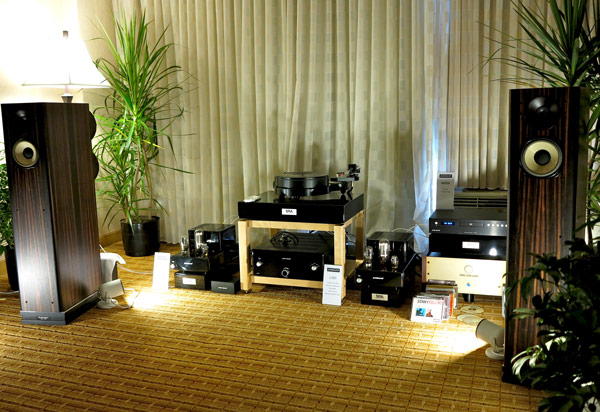
Squeezed into a small hotel room were the towering G’bell Epoque loudspeakers ($70,000/pair), driven by Artemis MK II monoblock amplifiers ($120,000), Stahl-Tek’s Opus DAC ($40,000) and Opus CDT ($37,000), with connections courtesy of Purist Audio Design 25th Anniversary cabling. How all this would have played out in a larger room, I do not know, but here, both period instrument and modern violins sounded edgy on different recordings, and bass was out of control on a third recording of a Mahler symphony.

Spot the working microphone in this picture

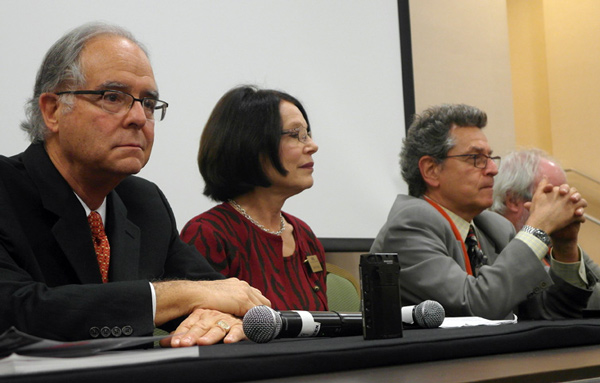
At the end of the first day of RMAF, veteran audio journalist Ken Kessler moderated a seminar titled "High-End Audio: Regaining the High Ground." Some such events—I would go so far as to say most such events—make me feel more like a reporter for Whine Spectator than Stereophile, but this one wasn't bad, and some of the observations expressed on the relationship between education (as in: music appreciation) and industry (as in: us) could actually prove useful. Ken Kessler stimulated the conversation with his own passionately held opinions, and many in the audience responded in kind (if with a little too much wind, in one case). Seen above are panelists Peter McGrath (Wilson Audio), Kathy Gornik (Thiel), Michael Fremer (Stereophile and AnalogPlanet.com), and Roy Hall (Music Hall).
Advertisement
Advertisement
Advertisement