RMAF 2013

Sort By: Post DateTitle Publish Date

McIntosh’s New Babies

Count on McIntosh to invariably dem something new, albeit in chassis that maintain the company’s distinctive aesthetics. This time around, Ron Cornelius showed the new MCD550 SACD/CD player ($6500) with volume control, headphone output, asynchronous USB 2.0 input, and 32-bit, “192kHz PCM/SD digital to analog conversion”; and MA8000 300Wpc integrated amplifier ($10,000) with MC/MM phono inputs, five digital inputs that decode music up to 32/192, home-theater bypass, and headphone amplifier. In an all-McIntosh set-up, the system delivered the classic warm midrange and solid bottom end I’ve come to expect. Highs, at least in this small hotel room, were a touch metallic, however.
Luscious Sound from Joseph Audio and friends

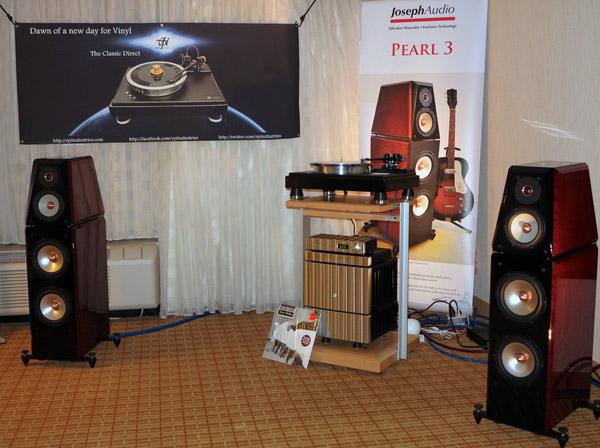
“Hands down great sound” I wrote of a room that combined Joseph Audio’s universally lauded Pearl loudspeakers ($31,500/pair with outrigger bases), Cardas Clear cabling, and a VPI Classic Direct with 3D arm ($30,000) outfitted with a Soundsmith Hyperion OCL cactus cantilever cartridge ($7500), with Jeff Rowland’s Capri preamp with phono option ($4300), Aeris DAC ($9800), and 825 power amp ($32,000). Sourced from computer, Boz Scaggs “Thanks to You” sounded gorgeous, and the beauty of Reference Recordings’ LP version of Vaughan Williams’ The Wasps confirmed the superiority of both the equipment chain and the Keith Johnson/Sean Martin recording team. Bass was profound, the midrange world-class, and highs just right. Transparency, too, was excellent. I wish I could have spent hours immersed in the beauty and grace of this system.

Cary and ADAM Audio

Roger Fortier, US distributor for ADAM Audio (Advanced Dynamic Audio Monitors), paired ADAM Column loudspeakers ($7500/pair) with Clarus Audio cabling from Tributaries and Cary’s CA0211 monoblocks ($20,000/pair), SLP-05 preamp ($6500) and Cary’s brand-new, prototype, full-function media streamer ($3995). Playing Christy Baron’s oft-heard “Ain’t No Sunshine When He’s Gone,” the system produced an exceptionally nice, warm midrange with an overall touch of sweetness. It also handled bass very well.

Your Final System

“YFS” stands for Your Final System. The company’s founder, Kevin O’Brien, worked in the A/V installation business, doing audio consulting and building systems of all prices, until around 2011, when he decided he wanted to solve that problem once and for all. To that end, the YFS HD Ref3 LE “computer transport” ($15,500) combines an 8-core processor, 32GB of double data rate type 3 (DDR3) RAM, a 1TB solid-state drive (SSD), and a SOtM USB 3.0 PCI digital output card&#151all with heavily modified external power supply and audio circuitry.

Audioarts: Zellaton, Robert Koda, CH Precision, Trinity, and more

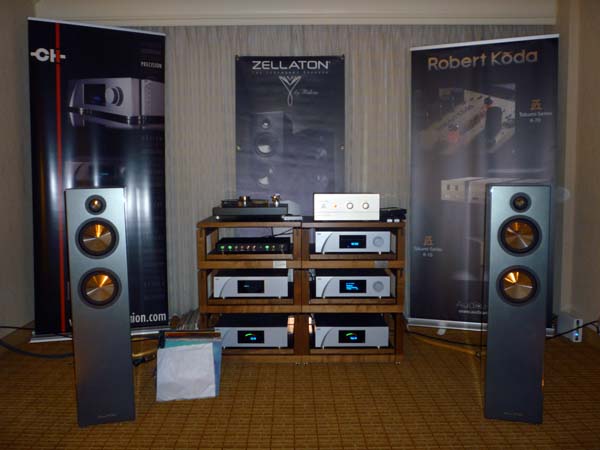
I’ve come to expect nothing but great and interesting music from Audioarts’ Gideon Schwartz. I walked in to Dead Can Dance’s Spirit Chaser, and, though the volume was much lower than that heard in most other rooms, the music was nevertheless engaging and in many ways more inviting: smooth and detailed, with exceptional image focus and superb stage balance.

Parasound, Monitor Audio, Kimber, and more

There was so much going on in Audiohouse’s Parasound–Monitor–Kimber etc . . . room that all I’m certain of is that the system had a really nice midrange. The Monitor Audio Platinum PL200 speakers ($9000/pair), alas, were insufficiently broken in, and there was no time to return on the last day when, I’m told, the system strutted its stuff so well that Audiohouse’s David M. McPhee sold two pairs of the Platinum PL200s to attendees.

Sonus faber Scales the Heights

Sonus faber mated its Olympica 3 loudspeakers ($13,500/pair) with Audio Research’s Reference CD9 CD/DAC player ($13,000), Reference 75 amplifier ($9000), and SP20 preamplifier ($9000). Heard through AudioQuest Redwood cables, the system uncompromisingly conveyed the take-no-prisoners nature of the demo CD that was playing during my time in the room.

Funk Firm Flamenca

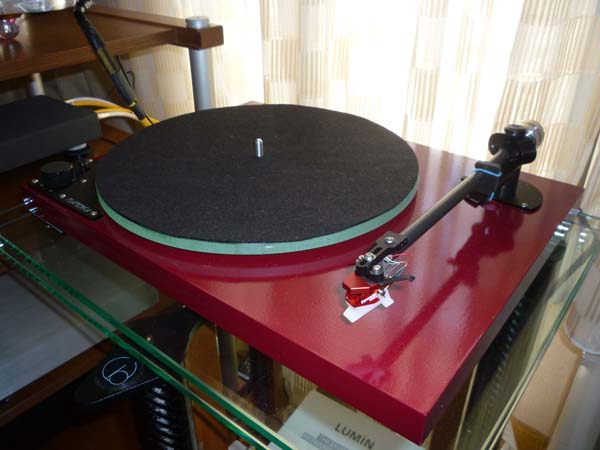
The Funk Firm’s new entry-level turntable, the Flamenca ($1495, without cartridge), will be available next month. The two-speed ‘table uses a DC motor and a very thin (0.15mm) thread-belt to drive its glass platter. Funk refers to their tonearm as a “pickup arm.” A tonearm, explained Pro Audio’s Brian Tucker, implies that the arm imparts its own sonic signature to the system. Funk aims to eliminate the arm from the system, thereby allowing the cartridge to perform optimally. In this case, the Flamenca’s new F6 tonearm is carrying a Dynavector DV 10X5&#151one of my fave cartridges. The F6’s detachable mounting block is meant to simplify cartridge installation. And, while the stock Flamenca is said to be specifically balanced for high-quality performance straight from the box, it can be easily upgraded with Funk’s Achromat platter mat and any of Funk’s higher-end tonearms.
Advertisement
Advertisement
Advertisement