AXPONA 2014

Sort By: Post DateTitle Publish Date

McIntosh

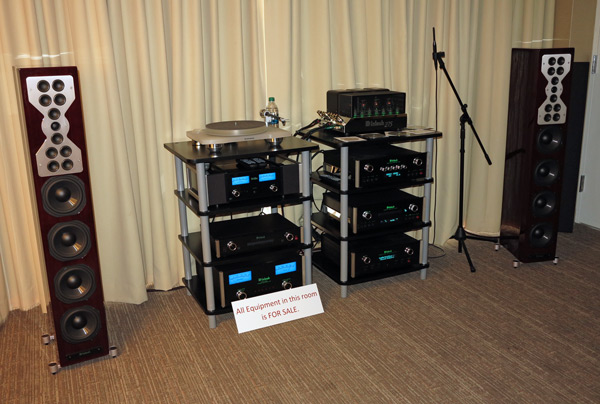
I have no idea exactly what was in use in the McIntosh room, because both times I paid a visit, the exhibitor was too involved in demonstrating the system's "Room Correction" component to stop to chat. Regardless, the sound was very, very good—just what you'd expect from a McIntosh system that can control challenging hotel acoustics—and the demo far more convincing than my mother's apple pie.

AXPONA 2014: Summing it Up

From whatever vantage point you choose, AXPONA (Audio Expo North America) 2014 in Chicago's Westin O'Hare was a major success. Attendance on opening day, Friday, April 25, was quite robust, and the feeling in the hallway and in rooms was extremely positive. Saturday was mobbed, with standees in many rooms during peak hours, and hallways buzzing.

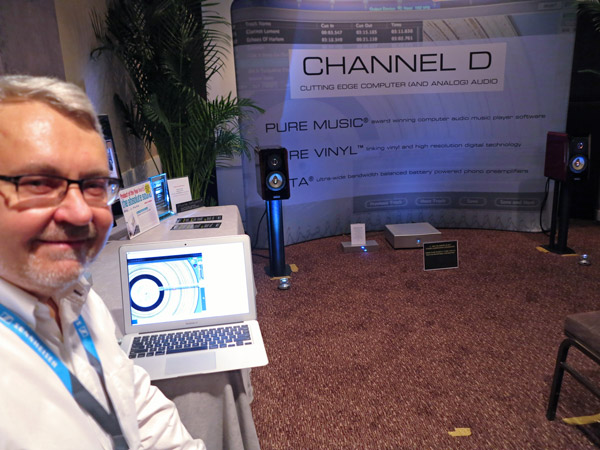
Channel D's User-Friendly Pure Vinyl 4

Released in early April, Channel D's Pure Vinyl 4.0 ($299, or $139 for previous users) enables you to easily split tracks via automation. Rob Robinson (above) describes it as "a major upgrade in usability. We've smoothed the rough edges and made it easier to use, while retaining the same sound." (The list of at least 25 improvements takes up a full sheet.) The software also has a built-in crossover time-alignment feature for time alignment of subwoofers, thereby enabling the sounds of main speakers and subs to arrive at your ear at exactly the same time with maximum impact and slam.

Proof without Proof from Music Hall

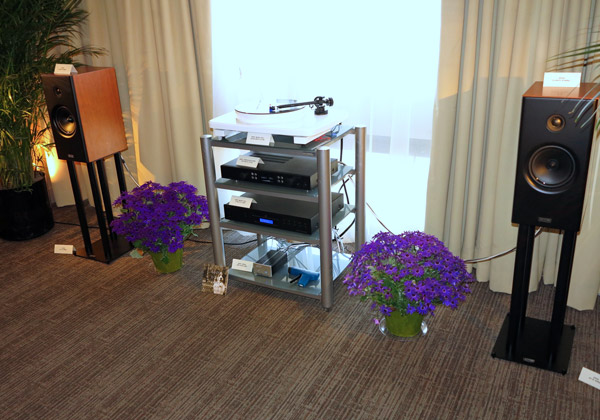
In an exhibit surprisingly free of whisky (unless I was too preoccupied to notice), Music Hall offered proof that you don't have to break the bank (assuming you have one to begin with) in order to get good sound. "Very smooth, nice, and pleasant," I wrote of the enjoyable music from the new Music Hall C-DAC 15.3 three-input DAC/CD player ($549), Creek Evo 50a 55Wpc integrated amp ($1195), and Epos Elan15 bookshelf loudspeakers ($1395/pair). The player contains two different DACs, a Burr-Brown for CDs and a Wolfson for external sources. Source was a computer playing Pure Music, and connected to the C-DAC via optical.

Revelations from Emerald Physics & PS Audio

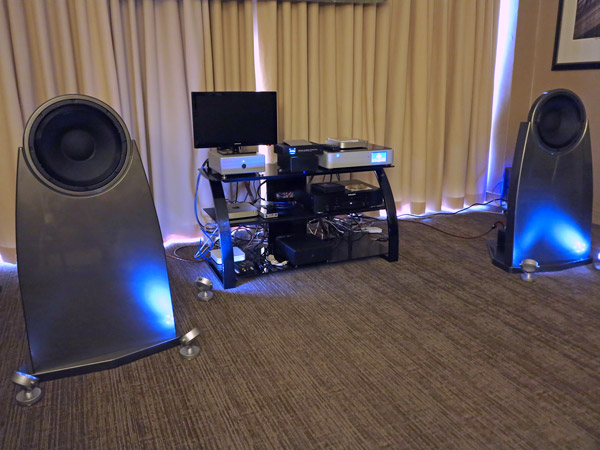
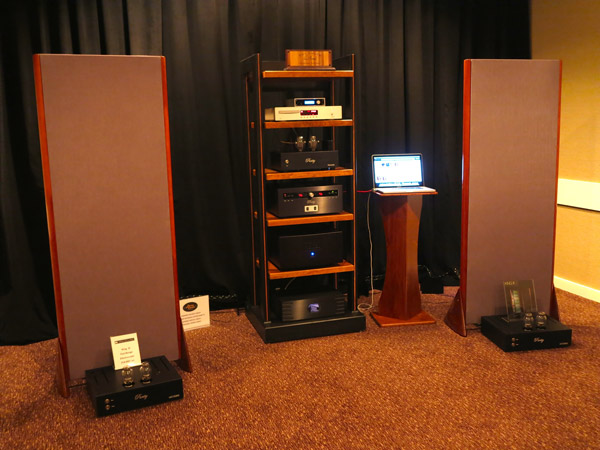
Admittedly, the title seems almost melodramatic, if not messianic. But after Emerald Physics' handicapped presentation at, I believe, the last Rocky Mountain Audio Fest, I was not expecting to hear such fine and pleasing sounds. While ample credit is due PS Audio's brand new DirectStream pure 1-bit DSD-decoding DAC ($6000), thanks also be to Mark Schifter's canny programming of the DSP2.4 DSP crossover/equalizer ($850) that comes with Emerald Physics' CSE MK2 Controlled Dispersion, DSP-controlled, open-baffle loudspeakers ($3500/pair). Thanks as well to the new Emerald Physics EP 100.2 power amplifier ($1600), DSPeaker preamp/DAC ($1200), and REL T9 active subwoofer that filled in from 25Hz to 48Hz.

Spatial Audio

Clayton Shaw, who designed Emerald Physics loudspeakers and founded the company, returned last year with Spatial Audio loudspeakers. The Spatial Hologram M2 standard ($1995/pair) contains a new Hologram Circuit, and is a completely passive, analog, high-efficiency, open-baffle speaker. Each baby contains two 12' mid/woofers and one coaxially mounted compression driver. Designed to eliminate floor bounce, it claims not to need DSP or bi-amping.

False Alarm Redux

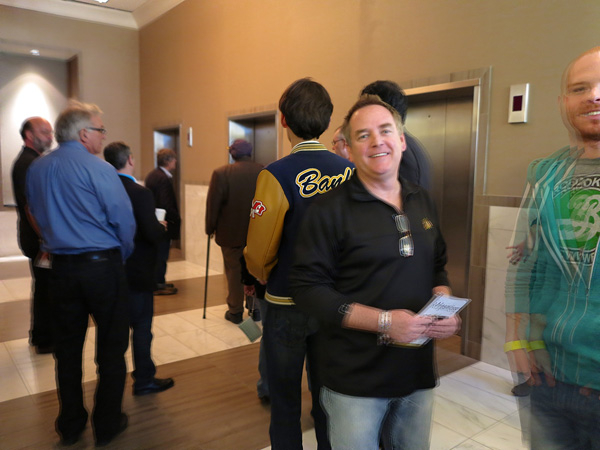
For the second year in a row, a fire alarm sounded in the middle of AXPONA's busiest afternoon. Although it seems that the warning didn't reach all floors, it sent some who did hear it scurrying. In my case, that meant grabbing my heavy jacket, computer, computer glasses, camera and monopod, and complete collection of show literature and notes and trudging down seven flights.

Kingsound and Purity

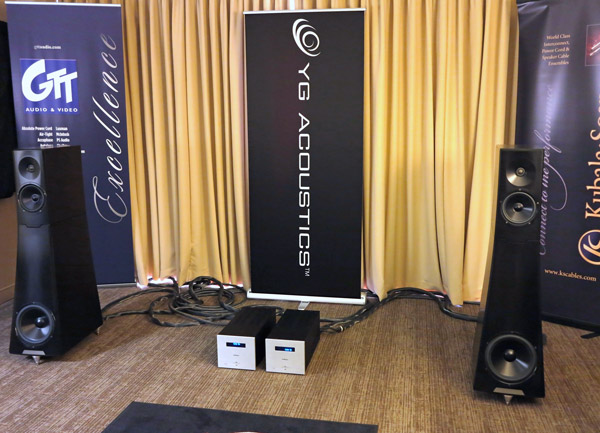
Through the excellent Kingsound KingIII electrostats ($14,995/pair), Hegel H30 350Wpc amplifier ($15,000), Purity Audio Design new Reference class-A balanced linestage preamplifier ($10,995), Purity Audio Design Harmonia 300B tube buffer ($5500), M2Tech's new Young DSD/DCD DAC ($1699), Trigon CD II ($4250), and Dana Cables, music sounded very smooth but somewhat damped on top. A tenor sax sounded especially warm and inviting.

The Live Acoustic Reference

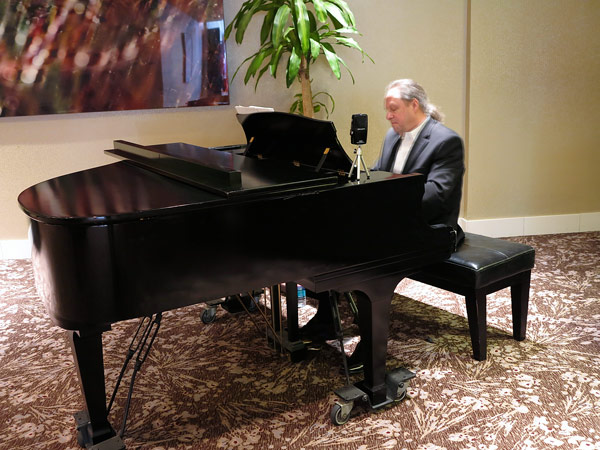
Thanks to musician and AXPONA founder Steve Davis, pianist John M. Yurick could be heard throughout the day in various locations on the lobby level of the Westin O'Hare. It's a shame that his piano's lid was closed in order to render his piano less obtrusive amidst the talking, because Yurick is an excellent musician who deserves more than "background music" attention. He also moves faster than my camera's flash-less "Night Setting" could accommodate.
Advertisement
Advertisement
Advertisement