Peter W. Mitchell
Cables & the Case for Solder
PASC & Philips' DCC
PDM, PWM, Delta-Sigma, 1-Bit DACs
1989 may well become the year of the D/A converter (DAC). CD-player manufacturers have, almost without exception, launched research projects focusing on this problem area of digital audio; many of these projects are already a year old. This is, however, by no means the only imperfection keeping us away from the high-quality sound we have come to suspect is possible with digital audio media, and maybe not even the most important.
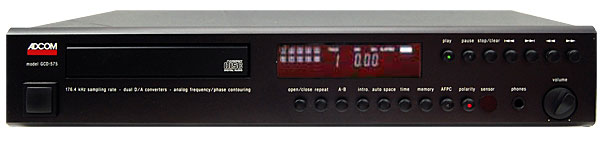
Adcom GCD-575 CD player
Lossy Compression: the Sonic Dangers
Cotton Balls & Delicate Precision Instruments
My topic today is not the hardware that we use to reproduce sound, but the delicate precision instruments we use to detect it: our ears. Our enjoyment of musical sound is important enough to justify spending thousands of dollars on recordings, electronics, loudspeakers, and concert tickets. What is it worth to preserve your hearing so that you can continue enjoying great sound 10 or 20 years from now? I've been conducting an experiment for the last 30 years, at a cost of less than a penny a day. It began when I was 17.
Can We Agree to Disagree? (LP vs CD)
I had a wonderful chuckle while reading the reviews of the Finial Laser Turntable in the May 1990 issue of <I>HFN/RR</I>. Perhaps I should preface this by saying that, in the entire quarter-century since I became intensely involved in audio, I have always found the LP an unsatisfactory playback medium for music. As a regular concert-goer in Boston and an addict of WGBH-FM's simply miked, virtually unprocessed live broadcasts of BSO concerts direct from Symphony Hall, I never learned to ignore the many anti-musical distortions endemic to LPs—the ticks and pops, the inner-groove congestion and tracing distortion, the harsh mistracking of high-level climaxes and overcut grooves, the persistent static in dry winter air, the constant slight wow due to off-center spindle holes, the muddy bass due to resonances and feedback, the universal cutting engineer's practice of blending low bass into mono (which wipes out low-frequency hall ambience).
I Have Heard the Future...(DSP Room Acoustics Correction)
<I>Dateline—Chicago, May 30, 9:00pm.</I> Exploding fireworks lit up the sky above the Chicago river as 200 leading high-end designers gathered in the Hotel Intercontinental for <I>Stereophile</I>'s 30th Anniversary banquet. After a repast of four gourmet courses and five wines, the time came for after-dinner speeches to celebrate <I>Stereophile</I>'s past and high-end audio's future. <A HREF="http://www.stereophile.com/asweseeit/593">Publisher Larry Archibald</A> described his adventurous transition from the high-end car business to risky publishing. Introducing <A HREF="http://www.stereophile.com/historical/712">J. Gordon Holt</A>, he praised JGH's uniquely lucid writing and his unflinching insistence that equipment designed to reproduce music should be judged on its ability to do just that—the unconventional view that launched high-end audio.
A Question of Bits
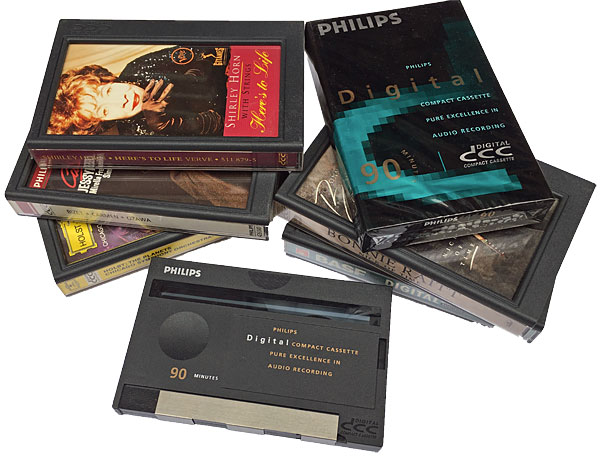
Someday we may speak wistfully to our grandchildren about the "golden age" of digital audio when consumer formats (CD and DAT) contained a bitstream that was an exact bit-for-bit duplicate of the original studio master recording—not a digitally compressed, filtered, copy-resistant version whose sound is "close enough" to the original. Digitally compressed formats such as DCC and MiniDisc represent, in effect, a return to the pre-CD era when consumer-release formats were always understood to be imperfect copies of the studio original. Even the most ardent audiophile accepted the fact that LPs and mass-produced tapes did not, and could not, sound as good as the master tapes they were derived from.