Robert Deutsch
Audio Excellence at the Toronto Home Show
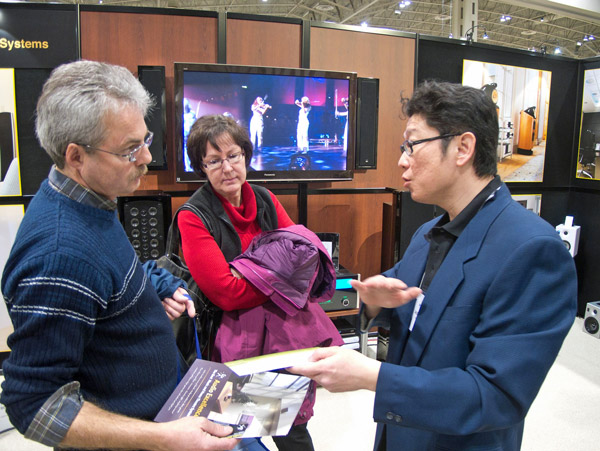
Toronto-area audio dealer Audio Excellence decided to tackle the problem last year by setting up a booth at the annual National Home Show in Toronto, reportedly with great success. I heard that they were planning to exhibit again this year, so I decided to check it out.
Long Lines at the Venetian
The last time I attended CES was three years ago. Although many things have stayed the same, there were also interesting changessome of them profound. At the Las Vegas Convention Center, it seemed that almost every exhibit had to do with 3D, iPods, or tablet computers. At the Venetian, in addition to the traditional areas of speakers and amplification, it was music servers and related productsably summarized by Jon Iverson in his wrap-up. Cables were big. (More on this anon.)
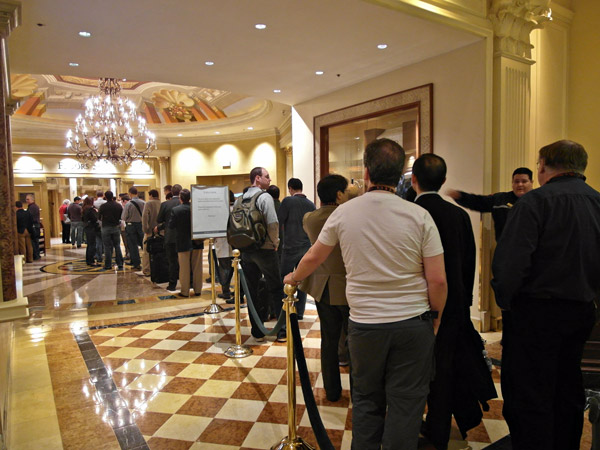
It was a very crowded show. At the convention center, the scene was at times like being on a subway platform during rush hour. At the Venetian, home of high performance audio, there were long lineups for the elevatorssee photo. Although officially CES is not open to the general public, there were a lot of attendees with “Industry Affiliate” badges, and being an industry affiliate was apparently very broadly defined. This had the effect of increasing attendance, which I guess is not a bad thing, but it also meant that some of these attendees were really consumers, not industry people. One veteran speaker designer told me that some of the questions he was asked at this year’s CES were quite naïve, like “What if you played all these speakers at the same time?” He attributed this to these attendees being consumers (and not very knowledgeable ones at that).
My show report assignment was low-to-moderately-priced speakers, and I was very pleased to get this assignment, leaving John Atkinson to report on expensive speakers. As I said in one of my reviews, I’m more of a Volkswagen/Honda/Toyota than a Ferrari/Lamborghini/Aston Martin kind of guy. But CES had lots for the Ferrari/Lamborghini/Aston Martin crowd, and sometimes I was taken aback by the prices. In one case, I saw a three-way not-too-huge floorstanding speaker that I thought might be under the $10k that for me defined the top of the moderately-price range. I asked how much it cost. The answer: ninety thousand. I wasn’t sure I heard correctly. Nine thousand? No, ninety thousand. OK, this one is for JA.
One thing I thought was interesting was. . .

GoldenEar Triton Two
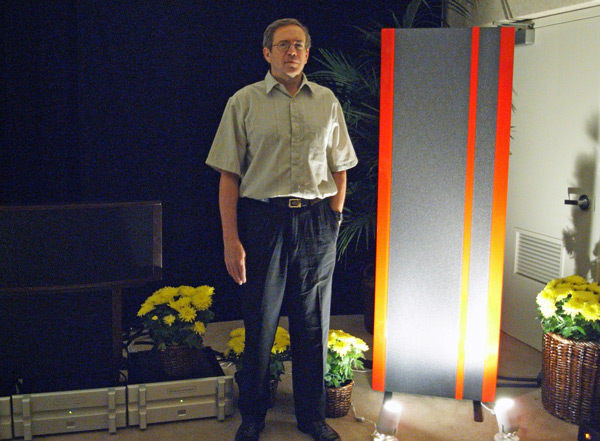
There were quite a few speakers that impressed me at this show, but, taking price and sound quality into account, I have say that the Triton Two, shown here with Sandy, was my favorite. It’s a floor-standing three-way, narrow in the front (5¼”), widening in the rear (7½”), and just 48” high, making it visually unassuming. It uses an unusual driver complement, starting with what they call a High-Velocity Folded Ribbon Tweeter (a variant of the Heil AMT tweeter), two 4½” mid/bass drivers, and two 5”x9” subwoofers, each coupled with a 7”x10” passive radiator facing the side. Each subwoofers is driven by a 1200W DSP-controlled class-D amp. With all this technologyand truly full-range soundthe Triton Two costs just $2500/pair.
Gallo Classico
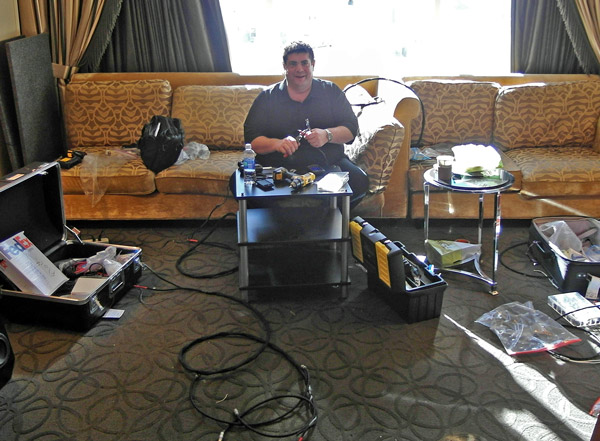
It was when I was going through the CES photo files on my computer that I ran across the photo that served as a reminder. Of courseAnthony Gallo! I visited his room in the Venetian briefly on the Press Day, when the exhibitors were still in the process of setting up. What drew me into the room was that, unlike other exhibitors that still had all their equipment in boxes, there was some music playing in Gallo’s roomand it sounded pretty nice. Anthony was hard at work, preparing loudspeaker cables for his speakers. I took his picture and promised to return later.
And I did, too, on the last day of the Show. The speakers that made their debut at the 2011 CES represent a significant change for Anthony Gallo’s approach to speaker design: instead of the spherical enclosures, the new Classico line uses traditional wooden boxes enclosures. The speakers (there are five in the line, plus a subwoofer) combine a cone midrange/bass driver with Gallo’s own Cylindrical Diaphragm Transducer (CDT). (That is, except the lowest-priced Series I, which has a dome tweeter.) The speakers also feature something called BLAST, which “reveals the true potential of the box.” (Yes, I found the product literature, which was hiding in one of the compartments in my luggage. It mentions BLAST, but doesn’t have any information on it.) The speaker that I heard initially, and that I had a chance to listen to again, was the Classico Series II ($1195/pair), the smallest speaker to use the CDT tweeter. And it still sounded pretty nice.
Magnepan MG3.7
New MartinLogans
Revamped Polks
Nola's Contender
PS Audio's Perfect Wave
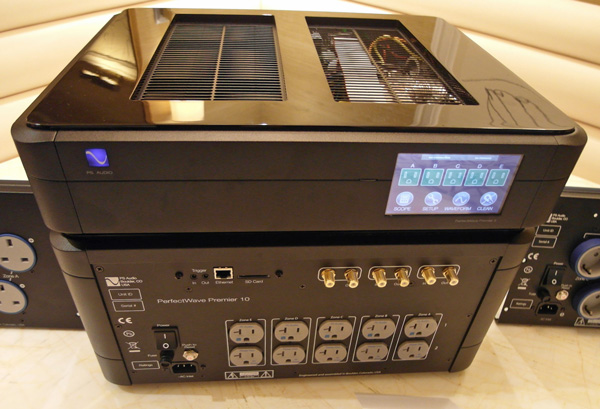
It turns out that they have two successors, both representing substantial reworking of the product while staying with the principle of “regenerating” rather than merely “conditioning” power. Alas, the “power plant” terminologywhich I’ve always thought was quite aptis gone: the two products are called PerfectWave P5 ($2999) and P10 ($4499). They differ mostly in terms of the amount of maximum current they can produce, the P5 putting out 1000VA and the P10 1200VA. The bigger unit also has more zones. Output impedance is lower than ever, and so is distortion.